

Neglecting soil engineering can lead to costly infrastructure failures and environmental harm, making it a cornerstone of modern development. As the industry faces rapid technological change and new regulations in 2026, understanding best practices in soil engineering is more important than ever.
This essential guide will equip engineers, developers, and project managers with the knowledge to address emerging trends, core principles, site investigation, soil testing, design integration, sustainability, and future challenges.
Stay ahead by mastering these critical practices and ensure your projects are resilient, sustainable, and compliant with the latest standards.
The Evolving Landscape of Soil Engineering in 2026
Modern infrastructure faces new challenges, and soil engineering stands at the forefront of adaptation. The industry is transforming rapidly as societies demand safer, more resilient, and sustainable solutions. Understanding these shifts is crucial for anyone involved in engineering, construction, or project management.
Key Industry Trends and Drivers
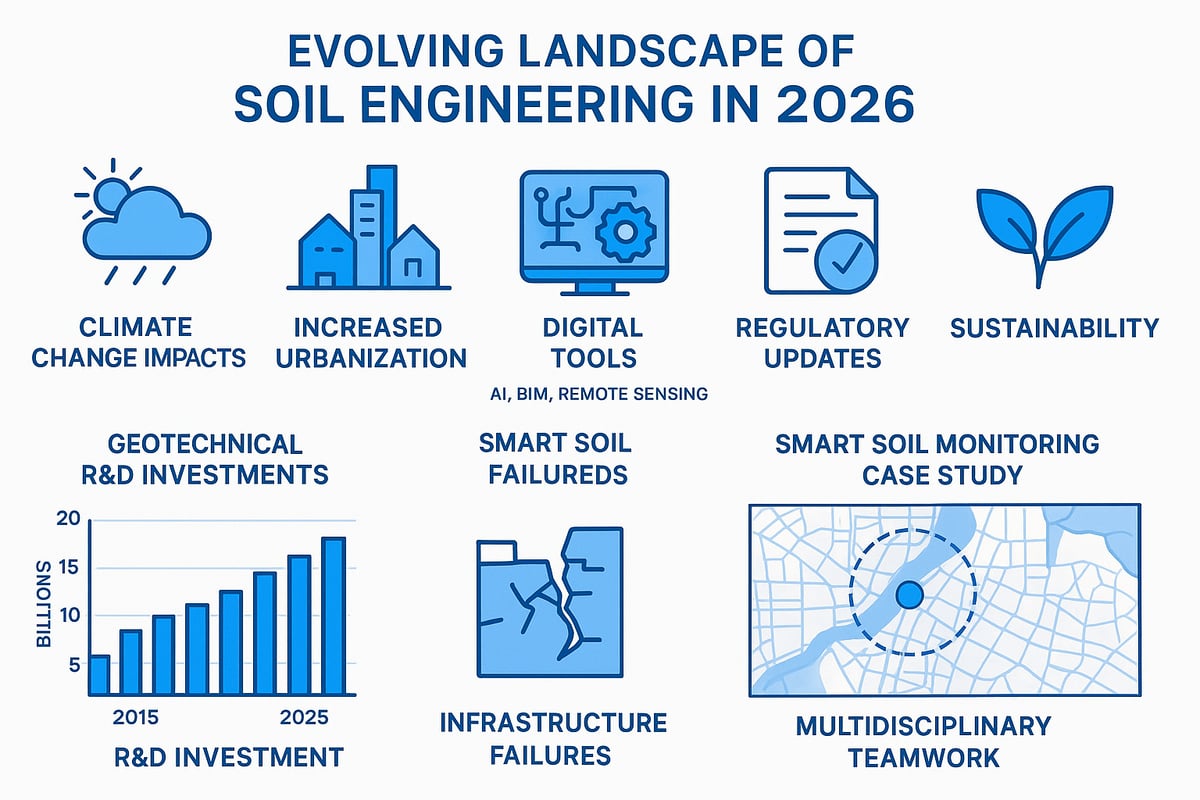
In 2026, soil engineering is deeply influenced by global trends. Climate change has intensified rainfall patterns, droughts, and temperature swings, changing soil behavior and requiring new engineering approaches. Urbanization continues to push infrastructure into challenging environments, increasing the demand for resilient foundations and earthworks.
Regulatory frameworks are evolving, introducing stricter standards for soil management and construction practices. Authorities are prioritizing safety, environmental stewardship, and lifecycle performance. The adoption of digital tools like AI, Building Information Modeling (BIM), and remote sensing is revolutionizing soil analysis, making site assessments faster and more accurate.
Sustainability and circular economy principles are now central. There is a growing expectation to reuse soils, minimize waste, and adopt greener materials. Data shows that global investment in geotechnical R&D has increased by over 25% since 2022, while infrastructure failures linked to inadequate soil engineering still account for billions in losses each year. High-profile project successes, such as flood-resilient developments in Asia, contrast with failures where poor soil data led to costly delays.
For those seeking a deeper understanding of these foundational shifts, the Geotechnical engineering services overview provides a comprehensive look at current and emerging industry practices.
Technological Advancements
The rapid evolution of technology is reshaping soil engineering workflows. Advanced modeling software allows teams to simulate soil-structure interactions with greater precision, reducing risks in both design and construction. Real-time monitoring sensors and IoT devices have become standard in field investigations, enabling continuous data collection on settlement, moisture, and stress.
Machine learning is transforming predictive analytics. By processing vast datasets from previous projects, engineers can anticipate soil behavior under various conditions, improving decision-making. For example, a major city in Europe recently implemented a network of smart soil sensors across its hillside neighborhoods. This system provided early warnings and prevented landslides during an extreme storm, demonstrating the tangible benefits of digital transformation in soil engineering.
These advancements not only enhance accuracy but also streamline project timelines and reduce costs. The integration of digital tools ensures that soil engineering adapts to rapidly changing site and climate conditions.
Shifting Professional Roles and Skills
As the field evolves, soil engineering professionals are expected to bring multidisciplinary expertise. Beyond traditional geotechnical knowledge, proficiency in environmental science, data analysis, and digital modeling is now essential. Employers increasingly seek candidates who can bridge these skill sets, reflecting the interconnected nature of modern projects.
Training and certification programs are adapting, with new courses focused on digital tools, sustainability, and regulatory compliance. In 2026, continuing education is a requirement for most soil engineering professionals, ensuring skills remain current as technologies and standards advance.
The role of teamwork has never been more important. Successful projects rely on collaboration between engineers, data scientists, and environmental specialists. This collective approach helps address complex challenges and delivers resilient, future-ready infrastructure.
Fundamental Principles of Soil Engineering
Understanding the fundamental principles of soil engineering is essential for every successful construction project in 2026. These principles guide how professionals assess, classify, and manage soils to ensure safety, performance, and sustainability. By mastering the basics, engineers minimize project risks and optimize design outcomes.
Soil Properties and Classification
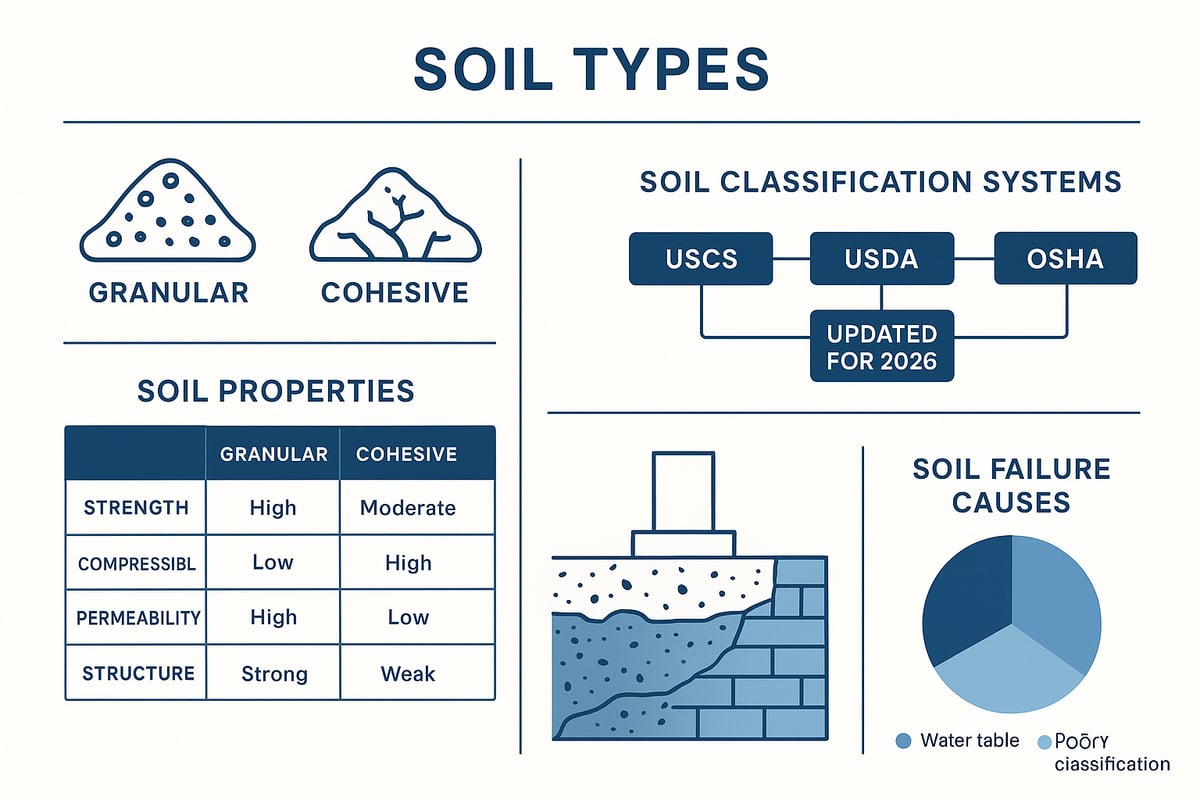
Soil engineering starts with a thorough understanding of soil properties and classification. Soils are typically grouped into granular (like sands and gravels), cohesive (such as clays), and organic types. Each type has unique characteristics affecting construction decisions.
Key soil properties include:
- Strength: Determines the load a soil can bear.
- Compressibility: Influences settlement under structures.
- Permeability: Affects water movement and drainage.
- Structure: Relates to the arrangement of soil particles.
Professionals rely on standardized classification systems, such as the Unified Soil Classification System (USCS), the USDA system, and OSHA guidelines. In 2026, updates to these systems reflect greater precision and digital integration for rapid site assessment. Accurate classification is vital, as it directly influences foundation design and risk mitigation in urban environments.
Modern projects benefit from digital field investigation and in-situ geotechnical testing methods, which deliver real-time data on soil conditions. This approach streamlines analysis, improves safety, and supports compliance with evolving standards in soil engineering.
Soil Behavior Under Load
The behavior of soil under load is a cornerstone of soil engineering. Engineers must consider both total and effective stress, as well as pore water pressure, to predict how soils will respond when supporting structures. Consolidation, or the gradual reduction of soil volume under sustained load, is a critical phenomenon for foundation performance.
Shear strength, defined by the angle of internal friction and cohesion, helps determine a soil’s ability to resist sliding or failure. These measurements are essential for designing safe slopes, foundations, and retaining structures. Water table fluctuations and climate variability further complicate predictions, making ongoing monitoring a necessity in soil engineering.
Recent statistics highlight that misjudged load-bearing capacity remains a leading cause of soil-related failures. By applying rigorous testing and predictive analysis, engineers can avoid costly errors and enhance structural reliability.
Soil-Structure Interaction
Soil-structure interaction refers to how soil properties influence the performance of foundations, retaining walls, pavements, and other built elements. The relationship between soil and structure is dynamic, requiring careful consideration during every project phase.
Advanced modeling and simulation tools enable engineers to predict interactions more accurately, accounting for variables like soil type, load distribution, and environmental factors. Learning from past engineering failures emphasizes the importance of comprehensive analysis in soil engineering, as inadequate understanding can lead to settlement, cracking, or even catastrophic collapse.
By integrating lessons from previous projects and leveraging modern technology, the field of soil engineering continues to evolve, supporting safer and more efficient infrastructure development.
Site Investigation and Soil Testing: Best Practices for 2026
Thorough site investigation and soil testing are the backbone of successful soil engineering. In 2026, as projects grow in complexity and regulations tighten, the need for precise, data-driven practices has never been greater. This section outlines how to achieve best-in-class results across every phase of site assessment.
Planning and Executing Site Investigations
The success of any soil engineering project starts with a robust site investigation. Setting clear objectives, understanding potential risks, and selecting the right methods are essential steps. In 2026, multidisciplinary teams collaborate to determine the investigation scope, considering project size, location, and environmental factors.
Common investigation techniques include:
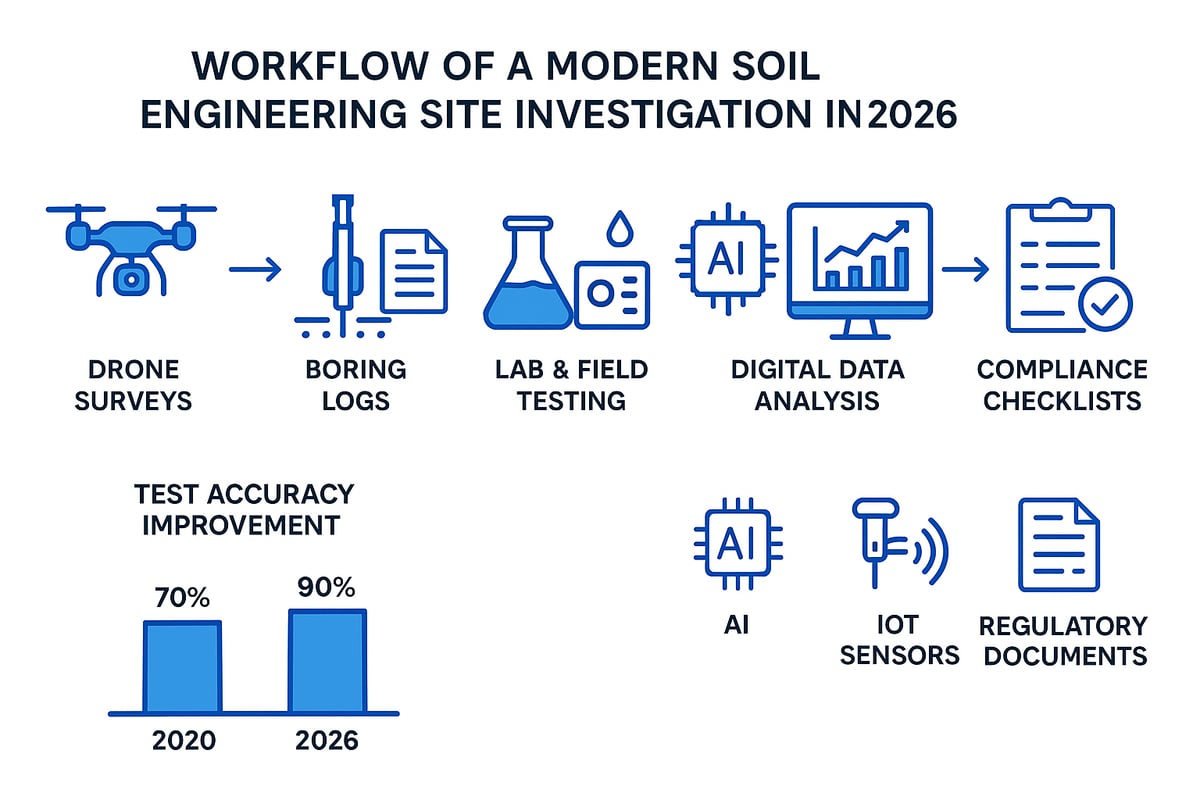
- Boring logs to identify subsurface layers
- Rock core logging for detailed geological information
- Geophysical surveys, such as seismic or ground-penetrating radar
Digital tools have revolutionized data collection. Drones equipped with remote sensing technology now capture high-resolution imagery and topography, streamlining large-scale investigations. For example, a recent infrastructure project used drone-based surveys to reduce field time by 40 percent while increasing data accuracy.
Attending events like the INSITU 2026 Conference Details helps professionals keep pace with innovations in soil engineering site investigation methods and technology. Integrating these advances ensures that critical subsurface conditions are identified early, minimizing costly surprises.
Laboratory and Field Testing Procedures
Laboratory and field testing remain central to soil engineering, providing the data needed for safe, reliable designs. In 2026, both standard and advanced tests are widely employed.
Laboratory tests include:
- Unconfined compression tests for soil strength
- California Bearing Ratio (CBR) for pavement design
- Permeability and Atterberg limits for classification
Field tests feature:
- Standard Penetration Test (SPT)
- Cone Penetration Test (CPT)
- Vane shear and in-situ density tests
Recent advances in equipment and automation have improved both speed and accuracy. Automated data logging and remote monitoring enable real-time quality checks, reducing human error. According to industry data, projects using advanced testing protocols report a 30 percent decrease in post-construction failures.
By combining laboratory precision with field realism, soil engineering teams achieve a comprehensive understanding of site conditions.
Data Interpretation and Reporting
Interpreting test results is critical for translating raw data into actionable insights. In soil engineering, accurate analysis determines the suitability of soils for foundations, embankments, or other structures.
Comprehensive soil reports are now generated using specialized software. These platforms automate data analysis, visualize trends, and flag anomalies for further review. Digital soil report systems have reduced project delays by improving communication among engineers, contractors, and stakeholders.
A clear, concise report supports design decisions and ensures compliance with regulatory requirements. As soil engineering becomes more data-driven, the ability to interpret and communicate findings effectively is a key differentiator for project success.
Incorporating Regulatory and Safety Standards
Compliance with evolving regulatory and safety standards is vital in soil engineering practice. Site work in 2026 requires strict adherence to updated safety protocols, especially during excavation and field testing.
OSHA guidelines remain the benchmark for safe operations, with new risk mitigation strategies focusing on real-time hazard detection and documentation. Thorough record-keeping is essential, not only for legal protection but also for insurance and quality assurance.
By prioritizing safety and documentation, soil engineering professionals protect both workers and investments. These best practices ensure that projects meet the highest industry standards and are prepared for future audits or inspections.
Integrating Soil Engineering into Project Design and Construction
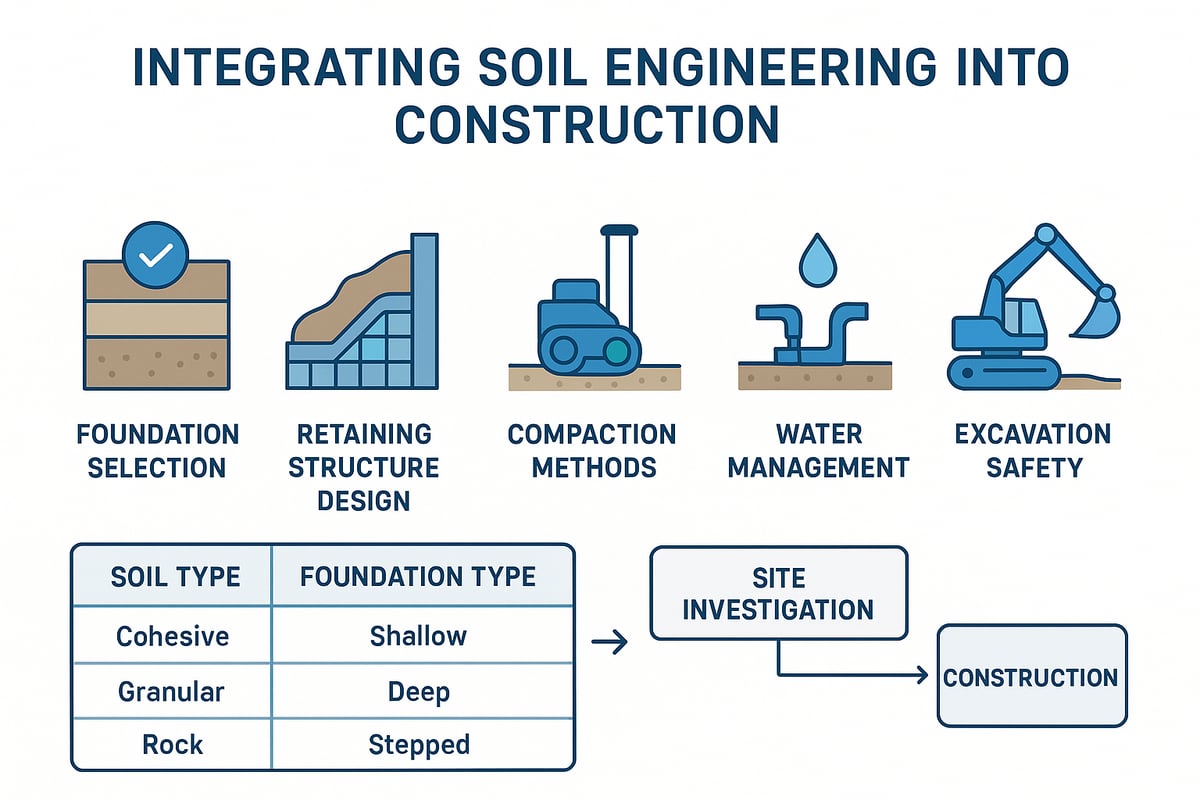
Effective integration of soil engineering into project design and construction is vital for safe, resilient, and sustainable infrastructure. Every phase, from foundation selection to excavation safety, depends on reliable soil data and best practices. By addressing each step systematically, professionals can minimize risk and optimize performance in 2026.
Foundation Design and Settlement Control
Foundation choice is a cornerstone of soil engineering. The main types include shallow (spread footings, mats), deep (piles, caissons), and specialized foundations for unique soil conditions. Selecting the right foundation relies on accurate assessment of soil properties, load requirements, and site constraints.
Settlement control is crucial. Engineers must evaluate potential settlement risks by analyzing compressibility, bearing capacity, and groundwater conditions. Design modifications, such as increasing foundation size or switching to piles, are often required if initial soil engineering analysis reveals high settlement potential.
Allowable settlement limits are defined by standards and project specifications. If unexpected settlement occurs, foundation redesign may involve underpinning or soil improvement. For example, a major urban transit project in 2025 succeeded only after engineers switched from shallow to deep foundations due to unforeseen compressibility in organic soils.
Earth Pressure and Retaining Structures
Calculating earth pressures is central to soil engineering. Engineers determine lateral pressures—active, passive, and at-rest—based on soil type, slope, and wall height. These calculations guide the design of retaining walls, basements, and bracing systems.
Water presence greatly influences earth pressures. High groundwater can increase lateral forces, requiring careful drainage and waterproofing. Proper backfill compaction is also essential to stability.
Failure data show that a significant number of retaining walls collapse each year due to inadequate soil engineering and misjudged earth pressures. Modeling and simulation tools help predict and prevent such failures, ensuring safer and longer-lasting structures.
Soil Compaction and Field Control
Compaction is a fundamental aspect of soil engineering for controlling settlement and increasing stability. Engineers use various methods depending on soil type, including vibratory rollers for sands and kneading compactors for clays. Laboratory tests, such as the Proctor test, establish optimal moisture and density, while field tests verify compliance.
Advances in automation and real-time monitoring have improved quality assurance. Acceptance criteria in 2026 are increasingly stringent, with digital records and sensor data supporting compliance. Freeze-thaw cycles and shrink-swell behavior are considered in design to prevent future issues.
For more on modern stabilization techniques, see Soil stabilization and ground improvement. These approaches enhance soil properties, reduce project delays, and support long-term performance.
Water Management in Soil Engineering
Managing water is a critical challenge in soil engineering. Engineers measure soil permeability and design drainage systems to control seepage and prevent instability. Dewatering techniques—such as well points, sump pumps, and cutoff walls—are selected based on site conditions and construction needs.
Buoyancy effects must be considered for structures below the water table. Inadequate management can lead to uplift, instability, or flooding. A recent high-rise basement project in Toronto succeeded due to an integrated dewatering system, which maintained dry working conditions and prevented excessive uplift.
Monitoring and adaptive management are now standard, using sensors and predictive analytics to anticipate and mitigate water-related risks.
Excavation Support and Safety
Soil stability is paramount during excavation. Engineers assess stability using slope analysis, soil strength data, and groundwater conditions. Support systems, such as sheet piles, soldier piles, and bracing, are designed to maintain safety and compliance.
Advanced monitoring technologies provide real-time feedback, alerting teams to potential instability. In one case, a major trench collapse was prevented after sensor data indicated early movement, enabling timely reinforcement.
Thorough documentation, safety training, and adherence to updated protocols ensure that excavation work meets both regulatory and project standards. Ongoing vigilance is essential for protecting workers and infrastructure.
Sustainable and Innovative Soil Engineering Solutions
Sustainable and innovative solutions are transforming soil engineering in 2026. The industry is shifting toward eco-friendly materials, smart technology, and advanced remediation, ensuring that project outcomes support both infrastructure and the environment. Staying ahead with these methods is vital for soil engineering professionals committed to resilient and responsible design.
Use of Geosynthetics and Modern Materials
Geosynthetics have become foundational in soil engineering for 2026. These materials—such as geotextiles, geomembranes, and geogrids—are used for reinforcement, separation, filtration, and erosion control. The latest standards require rigorous testing for durability and environmental compatibility.
Projects in flood-prone and high-traffic areas now routinely specify geosynthetics to boost stability and lifespan. For example, reinforced embankments with geogrids have successfully reduced maintenance cycles in urban transit projects.
Emerging materials, including recycled polymers and hybrid composites, align with circular economy goals. The importance of these advances is highlighted at major industry events like the Soft Soils 2026 Conference Overview, which showcases the latest research and field applications. Soil engineering teams leverage these innovations for safer, more sustainable construction.
Biochar and Soil Amendments
Biochar is making a significant impact on soil engineering by improving soil structure, porosity, and moisture retention. When added as an amendment, biochar increases aggregate stability and reduces bulk density, which benefits both load-bearing capacity and plant growth.
Recent studies show that biochar can also enhance nutrient retention and immobilize heavy metals, making it an attractive option for contaminated sites. This dual benefit supports both civil and environmental engineering objectives.
In 2026, specifications for biochar use are more standardized, requiring thorough testing to ensure consistency. Soil engineering projects that incorporate biochar often report improved resilience to climate variability and lower maintenance costs.
Environmental and Regulatory Considerations
Sustainability is at the core of modern soil engineering. Projects must comply with evolving environmental regulations, which increasingly emphasize soil reuse, waste minimization, and lifecycle assessment. Circular economy approaches are now standard for large developments.
Innovative remediation technologies are also gaining ground. One example is the MP Cocoon® Soil Remediation System, which uses robotics and AI to treat contaminated soils in situ. This system minimizes carbon emissions and accelerates project delivery, setting a new benchmark for sustainable soil engineering solutions.
Comprehensive documentation and transparent stakeholder reporting are essential in meeting both regulatory and community expectations.
Digital and Smart Soil Technologies
Digital transformation is reshaping soil engineering through real-time monitoring and data-driven design. IoT sensors are now embedded in soils to track moisture, stress, and movement, providing immediate feedback to engineers and project managers.
Predictive analytics, powered by machine learning, enable early detection of instability or failure risks. Integration with BIM and digital twins supports lifecycle management, allowing teams to optimize maintenance and extend asset life.
Smart soil engineering technology not only improves safety but also drives efficiency and sustainability. These tools are now integral to both new construction and long-term infrastructure management.
Future Challenges and Opportunities in Soil Engineering
Soil engineering is evolving rapidly as new challenges and opportunities emerge on the horizon. The next few years will demand innovative approaches, advanced technology, and collaborative expertise to ensure resilient, sustainable infrastructure worldwide.
Adapting to Climate Change and Extreme Events
Climate change is intensifying rainfall, drought, and temperature extremes, directly impacting soil engineering decisions. Engineers must design flexible foundations and adaptive drainage systems to address shifting conditions.
Recent data suggests a projected rise in soil-related failures, especially in areas prone to landslides or flooding. Incorporating slope stability assessment and solutions is vital for risk mitigation and resilience.
By prioritizing proactive soil engineering strategies, projects can better withstand extreme weather and reduce long-term maintenance costs.
Advances in Modeling and Simulation
The future of soil engineering relies heavily on advanced modeling and simulation techniques. Next-generation numerical methods, such as coupled Thermo-Hydro-Mechanical-Chemical (THMC) modeling, allow for deeper insight into soil-structure interactions.
Discrete element methods are being used to analyze complex behaviors under real-world conditions. Simulation-driven design has already prevented mass-movement failures in several large infrastructure projects.
These tools enable soil engineering professionals to predict outcomes and optimize designs with greater confidence and efficiency.
Workforce Development and Collaboration
As soil engineering becomes more complex, the industry faces a growing skills gap. There is an urgent need for professionals skilled in geotechnical analysis, environmental science, and digital technologies.
Collaboration across disciplines is increasingly essential, especially for large-scale projects. Training, certification, and ongoing education are critical to equipping the workforce for tomorrow’s challenges.
By fostering teamwork and investing in professional development, organizations can ensure soil engineering remains at the forefront of innovation.
Global Perspectives and Local Adaptations
Soil engineering practices vary significantly between regions due to climate, geology, and regulatory differences. Adapting global best practices to local soil conditions is essential for project success.
In Alberta, for example, successful adaptation of international standards has led to improved infrastructure resilience. Local expertise ensures that soil engineering solutions are both effective and context-specific.
Understanding regional nuances helps mitigate risks and maximizes the long-term performance of built assets.
Research and Innovation Frontiers
Ongoing research is expanding the horizons of soil engineering. Emerging fields include the use of nanomaterials for soil stabilization and AI-driven soil classification systems.
Collaboration between academia, industry, and government is accelerating innovation and improving project outcomes. Studies such as Enhanced Weathering in U.S. Agriculture reveal new ways to enhance soil performance and sustainability.
Continued investment in soil engineering research is crucial to meet evolving demands and environmental goals.
The Role of Trusted Engineering Partners
Partnering with experienced geotechnical consultants is essential for complex projects in soil engineering. The right partner brings technical expertise, local knowledge, and relevant certifications to the table.
Successful collaborations often involve multidisciplinary teams, ensuring comprehensive solutions. For example, a recent infrastructure upgrade succeeded due to close cooperation between soil engineers and other specialists.
Selecting a trusted partner is a strategic advantage that supports safe, efficient, and sustainable project delivery.
As you explore the evolving landscape of soil engineering practices for 2026, it becomes clear that staying ahead—whether through adopting new technologies, meeting regulatory standards, or integrating sustainable solutions—is key to project success. At ZALIG Consulting Ltd, we’re dedicated to helping you navigate these changes with confidence, offering expert geotechnical and materials testing services tailored to Alberta’s unique environments. If you’re looking to ensure your next project is built on a solid foundation, let’s connect and discuss how we can support your goals.
Contact Us: info@zalig.ca or +1 800 515 0497