

Slope failures can devastate communities, disrupt infrastructure, and threaten lives. As urban growth accelerates and climate patterns shift, the need for robust slope stability analysis becomes more urgent than ever.
Modern techniques are evolving rapidly, offering engineers new ways to anticipate and prevent costly disasters. These advancements promise safer designs and more resilient projects in every sector.
This comprehensive guide delivers the latest methods, principles, and best practices in slope stability analysis for 2026. You will discover essential fundamentals, learn to recognize failure mechanisms, explore analytical and numerical approaches, and gain insights into cutting-edge technologies, regulations, and real-world applications.
Ready to advance your expertise and ensure safer, more efficient designs? Read on to become a leader in slope stability analysis.
Fundamentals of Slope Stability Analysis
Slope stability analysis is central to geotechnical engineering, shaping the safety and reliability of structures built on or within slopes. In civil, mining, and environmental projects, understanding why slopes fail and how to prevent instability is vital. The core purpose of slope stability analysis is to evaluate whether a slope will remain stable under expected loading and environmental conditions, thereby protecting people, assets, and the environment.
Understanding Slope Stability: Definitions and Key Concepts
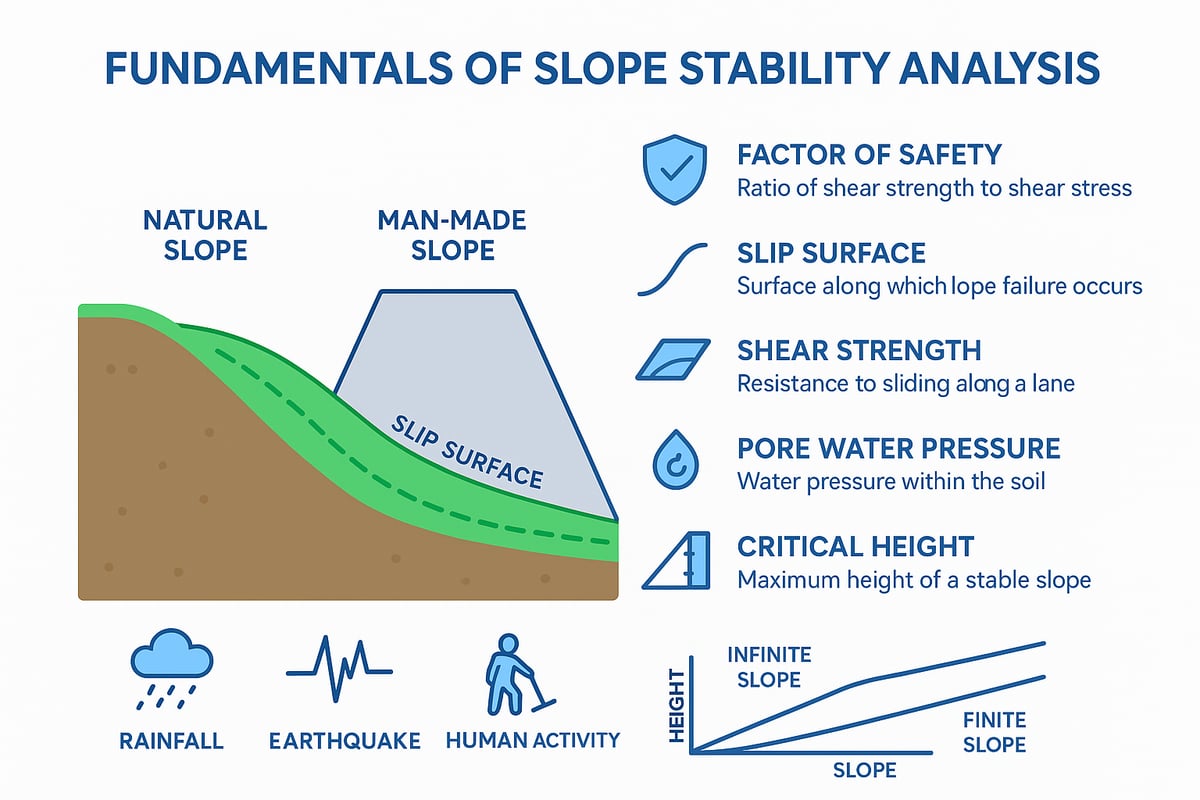
Slope stability analysis evaluates the ability of a soil or rock slope to withstand movement or failure. It is fundamental in civil engineering for the design and maintenance of embankments, road cuts, open-pit mines, and landfill sites. The main goal is to determine if a slope will stay intact or experience sliding.
A key parameter is the factor of safety (FS), calculated as the ratio of available shear strength to the shear stress required for equilibrium. If FS is greater than 1, the slope is considered stable. Terms like slip surface (the potential sliding surface), shear strength (soil or rock's resistance to shearing), pore water pressure (water pressure in soil pores), and critical height (maximum safe slope height) are essential.
Slope stability analysis considers both natural slopes, like hillsides, and man-made slopes, such as highway embankments. The geometry of the slope, along with the properties of the soil or rock, directly influence stability. By understanding these relationships, engineers can predict and mitigate potential failures.
Types of Slopes and Slope Failures
Slopes are broadly classified into infinite and finite types. Infinite slopes have uniform soil layers and extend far beyond the failure zone, often seen in natural hillsides or long embankments. Finite slopes, such as cut slopes or quarry faces, have defined boundaries and are common in construction.
Slope failures manifest in several forms:
- Translational: Movement along a planar surface, typical in layered soils.
- Rotational: Curved slip surfaces, often circular, seen in homogeneous materials.
- Flow: Soil or debris behaves like a fluid, common in saturated conditions.
- Compound: Combination of different movement types.
Slip surfaces can be planar, circular, or irregular, depending on the material and geometry. Globally, slope failures cause thousands of fatalities and billions in damages each year, highlighting the importance of robust slope stability analysis in infrastructure planning.
Factors Affecting Slope Stability
Several internal and external factors control slope stability analysis outcomes. Internal factors include soil type, layering, and groundwater conditions. External influences involve rainfall, earthquakes, surface erosion, and human activities like excavation or loading.
Pore water pressure and seepage are especially influential on stability. Elevated pore water pressure reduces effective stress, weakening soil and triggering failures. For a deeper understanding, see Pore Water Pressure in Slopes. Rainfall-induced landslides and construction-triggered collapses are common case examples, emphasizing the need to assess both material and environmental conditions during slope stability analysis.
Analytical Methods for Slope Stability Assessment
Analytical methods form the backbone of effective slope stability analysis. These techniques help engineers assess the safety, performance, and risk of both natural and engineered slopes. By understanding the mechanics and assumptions behind each method, professionals can choose the right approach for any given site condition.
Limit Equilibrium Methods (LEM)
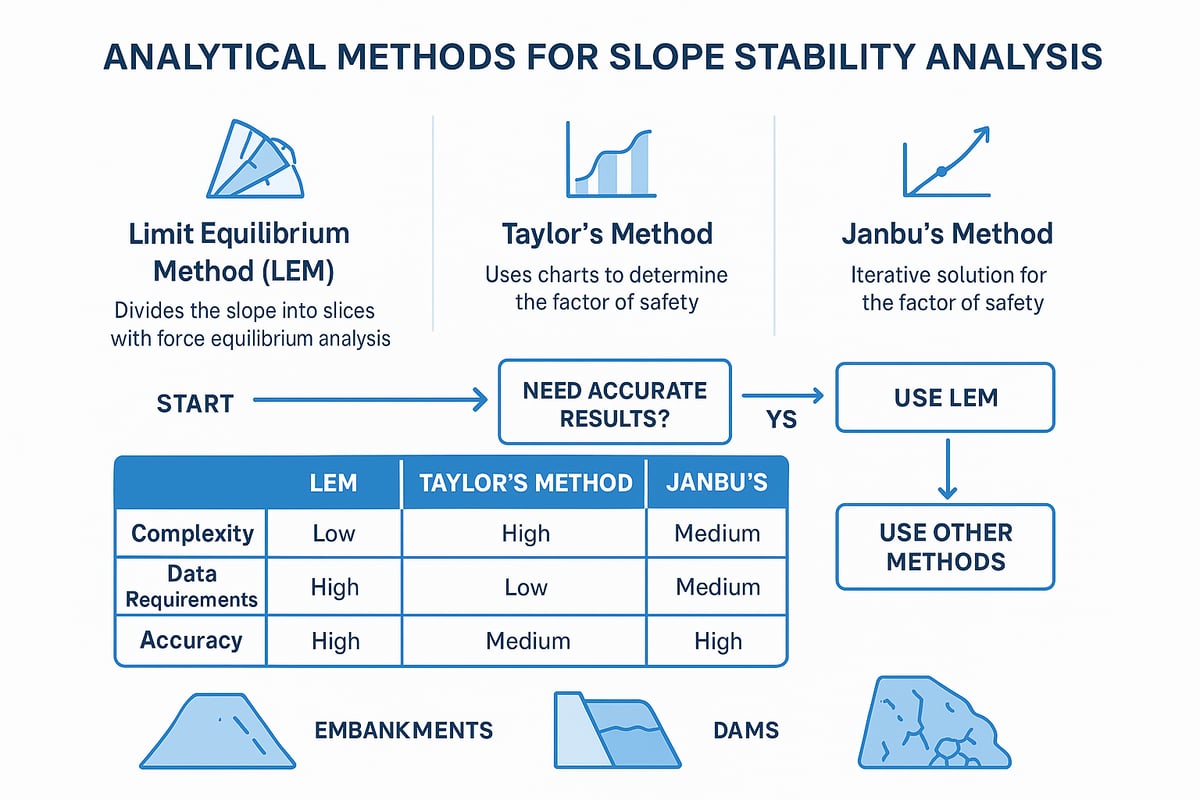
Limit Equilibrium Methods (LEM) are the most widely used approaches in slope stability analysis. These methods are based on the principle of balancing the forces and moments along a potential slip surface to determine whether a slope is stable or at risk of failure.
The two main LEM approaches are the method of slices and whole-body analysis. The method of slices divides the slope into vertical sections to evaluate equilibrium conditions for each slice, while whole-body analysis considers the slope as a single unit.
Common LEM methods include:
- Swedish Slip Circle (Fellenius Method): Assumes a circular slip surface and equal interslice forces.
- Ordinary/Fellenius Method: Simplified approach, ideal for preliminary designs.
- Bishop’s Simplified Method: Accounts for interslice forces, providing higher accuracy for circular failures.
- Modified Bishop: Expands on Bishop by considering more complex loading.
- Spencer Method: Allows for both force and moment equilibrium, suitable for non-circular slip surfaces.
- Sarma Method: Handles multi-wedge, non-circular, or composite slip surfaces.
- Lorimer Method: Specialized for layered soils and complex geometries.
Here is a comparison of key LEM methods:
| Method | Slip Surface Shape | Equilibrium Type | Typical Use Case | Limitations |
|---|---|---|---|---|
| Fellenius | Circular | Force | Simple slopes | Conservative, less accurate |
| Bishop’s Simplified | Circular | Moment | Embankments, dams | Assumes circular failure |
| Spencer | Any | Force & Moment | Complex slopes | More computation required |
| Sarma | Non-circular | Force & Moment | Rock slopes, multi-layer | Complex, needs expertise |
Factor of safety is a key output in slope stability analysis. It is calculated as the ratio of resisting to driving forces or moments along the slip surface. LEM methods provide both this critical value and the probable slip surface location.
LEM remains popular for its reliability, simplicity, and regulatory acceptance. For example, embankment and dam projects worldwide rely on LEM for initial design and safety checks. According to industry data, over 70% of practitioners use LEM as their primary slope stability analysis tool.
For readers seeking a comprehensive overview of professional approaches and analytical methods, the Slope Stability Services Overview page provides detailed insights into current best practices.
Other Analytical Methods
In addition to LEM, several other analytical methods support robust slope stability analysis. These alternatives are valuable for specific scenarios or rapid preliminary assessments.
Taylor’s Stability Number is a chart-based method used for homogeneous slopes. By relating slope height, soil strength, and slope angle, it helps estimate the critical height for failure.
Friction Circle Method visualizes the balance between driving and resisting forces for circular slip surfaces. It is especially useful for teaching or quick checks.
Chart-based methods, such as stability charts and nomograms, allow engineers to estimate safety factors without complex calculations. These are often applied in early design phases or where detailed data is limited.
For rock slopes, kinematic analysis employs stereographic projection to assess potential failure modes like planar, wedge, and toppling failures. This method is favored for steep rock faces, quarries, and road cuts, where the orientation of rock joints is critical.
Situations where these methods excel include:
- Steep rock faces with complex joint patterns
- Homogeneous soil slopes requiring rapid checks
- Preliminary design stages with limited data
Although these methods may not capture all complexities, they provide valuable guidance and screening in early project phases. When combined with more detailed numerical or laboratory analysis, they enhance the overall reliability of slope stability analysis.
Numerical and Advanced Computational Methods
The field of slope stability analysis has evolved rapidly with the integration of numerical and advanced computational methods. These techniques offer geotechnical engineers powerful tools to model complex soil and rock behaviors, predict failures, and design safer, more resilient slopes.
Finite Element and Finite Difference Methods
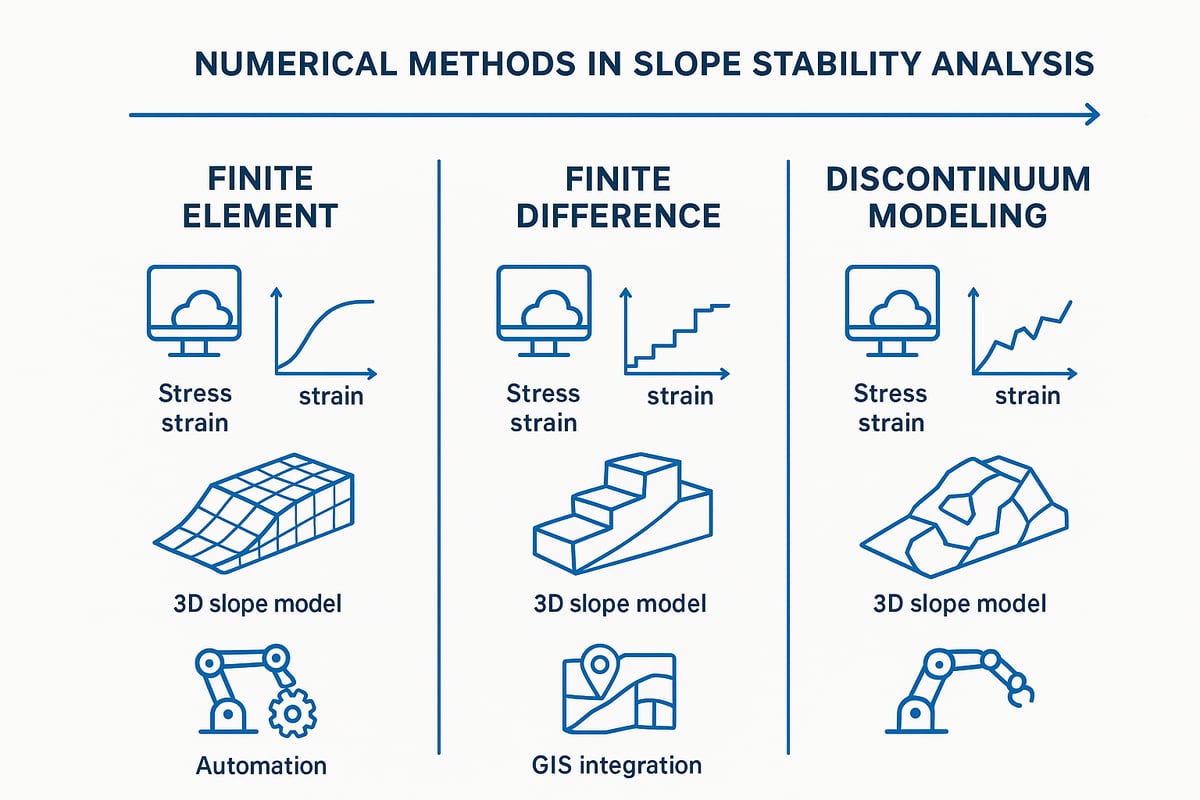
Finite element (FE) and finite difference (FD) methods are the backbone of advanced slope stability analysis. Both approaches simulate the stress-strain behavior of soils and rocks, allowing engineers to assess how slopes respond to natural and human-made changes.
FE methods divide the slope into small, interconnected elements, solving equations that represent material behavior across the model. FD methods use a grid to approximate how stresses and displacements evolve over time. Both approaches excel at capturing complex geometries, layered materials, and staged construction sequences.
Key advantages of these numerical techniques in slope stability analysis include:
- Ability to model heterogeneous soils and rocks.
- Simulation of construction stages and time-dependent effects.
- Prediction of deformations and progressive failure mechanisms.
However, these methods require extensive input data, advanced soil models, and significant computational resources. Calibration and validation against field data are essential for reliable results.
Typical applications range from large infrastructure projects and urban excavations to landslide risk mapping. FE methods, in particular, can automatically identify critical slip surfaces and model reinforcement, seepage, and dynamic loading. For a deeper dive into these modeling techniques, see Geotechnical Numerical Analysis Methods.
Discontinuum and Hybrid/Coupled Modeling
Discontinuum modeling, such as the distinct element method (DEM), is essential for analyzing slopes with blocky or jointed rock masses. Unlike continuum methods, DEM represents the slope as an assembly of discrete blocks, capturing sliding, rotation, and separation between units.
Hybrid and coupled approaches combine the strengths of different modeling techniques. For example, integrating limit equilibrium, FE, and discontinuum methods allows for a more comprehensive assessment of slopes with both soil and rock components. These approaches are invaluable in scenarios involving complex rock-soil interfaces or seismic loading, where traditional models may fall short.
The growing use of 3D modeling in slope stability analysis provides an enhanced understanding of spatial variability and failure mechanisms. In 2026, high-risk and high-value projects increasingly rely on these advanced simulations to inform design and mitigation strategies.
Despite their sophistication, hybrid models demand careful parameter selection, robust calibration, and expertise in multiple analytical frameworks. The payoff is a more accurate and nuanced prediction of slope performance under varied conditions.
Software and Automation in Slope Stability Analysis
The adoption of specialized software has revolutionized slope stability analysis, making advanced methods accessible to practitioners worldwide. Leading tools include:
- SLOPE/W (LEM and FE analysis)
- PLAXIS (advanced FE modeling)
- FLAC (finite difference modeling)
- Rocscience suite (varied analytical and numerical tools)
These platforms streamline the process by automating slip surface searches, conducting risk mapping, and integrating with Geographic Information Systems (GIS). Automation reduces design time, improves accuracy, and allows for rapid scenario analysis.
Recent years have seen a surge in the use of real-time data integration and cloud-based platforms. Engineers can now update models with monitoring data, refine predictions, and respond quickly to changing site conditions. Adoption rates for advanced software in slope stability analysis continue to rise, driven by the demand for more reliable and efficient project delivery.
In summary, software and automation have become indispensable for modern slope stability analysis. They enable multidisciplinary teams to collaborate, manage large datasets, and deliver robust, data-driven solutions for challenging projects.
Practical Steps in Slope Stability Analysis
A systematic approach is essential for effective slope stability analysis. By following these five practical steps, professionals can ensure reliable, accurate, and safe outcomes across diverse projects.
Step 1: Site Investigation and Data Collection
The foundation of any slope stability analysis lies in thorough site investigation. Gathering accurate data ensures all subsequent steps are based on real-world conditions.
Key data to collect include:
- Soil and rock properties (e.g., cohesion, friction angle, density)
- Groundwater conditions (levels, flow direction)
- Slope geometry (height, angle, length)
- Historical performance and previous failures
Field techniques such as boreholes, standard penetration tests, and geophysical surveys are commonly used. Laboratory tests like triaxial compression and direct shear provide detailed material parameters. Comprehensive data collection reduces uncertainty in the analysis.
Step 2: Failure Mode Identification and Preliminary Assessment
Identifying likely failure mechanisms is crucial in slope stability analysis. This step uses collected data to assess the potential ways a slope could fail.
Professionals often utilize flowcharts or decision trees to evaluate:
- Slope geometry and material type
- Groundwater influence and seepage patterns
- Signs of distress or previous movement
Experience and engineering judgment play a vital role, especially in complex or ambiguous situations. Early identification of hazards streamlines the subsequent analytical process.
Step 3: Selection of Analysis Method
Choosing the right method is a pivotal part of the slope stability analysis process. The decision depends on site complexity, available data, regulatory guidelines, and project risk profile.
Common approaches include:
- Analytical methods (e.g., Limit Equilibrium Methods, kinematic analysis)
- Numerical methods (e.g., finite element, finite difference)
For projects requiring enhanced efficiency and accuracy, advanced algorithms such as those described in An efficient slope stability algorithm with physically consistent parametrisation of slip surfaces can be valuable. Matching the method to the project's needs ensures robust, defensible results.
Step 4: Model Development and Analysis Execution
Building a representative model is the heart of slope stability analysis. This involves translating site data and chosen methods into a computational or analytical framework.
Key steps include:
- Inputting material properties and slope geometry
- Defining boundary and loading conditions
- Calibrating the model using field or historical data
Verification and validation are critical to confirm the model's accuracy. Iterative adjustments may be needed to refine results and account for uncertainties.
Step 5: Interpretation of Results and Factor of Safety Evaluation
The final step in slope stability analysis is interpreting outputs to inform decision-making. The factor of safety is assessed to determine if the slope meets project and regulatory criteria.
Engineers analyze:
- Calculated factors of safety and their sensitivity to input changes
- Displacement, stress, and pore pressure distributions (in advanced models)
- Risk implications and recommended mitigation measures
Clear reporting and communication of findings support safe, cost-effective, and sustainable project outcomes.
Innovations and Trends in Slope Stability Analysis for 2026
Modern slope stability analysis is transforming rapidly as technology and regulations advance. Engineers and geoscientists are leveraging new tools and data-driven insights to address increasingly complex geotechnical challenges. The following innovations are shaping the future of slope stability analysis, making it more accurate, proactive, and sustainable.
Integration of Remote Sensing and Monitoring Technologies
Remote sensing is revolutionizing slope stability analysis by providing comprehensive, real-time data on slope conditions. Drones, LiDAR, and satellite imagery allow engineers to create detailed topographic models and monitor surface changes with high precision.
Real-time monitoring systems are now standard on critical slopes. Technologies such as inclinometers, piezometers, and IoT-enabled sensors deliver continuous updates on ground movement, pore water pressure, and other vital parameters. This enables early detection of instability and supports rapid response.
Early warning systems built on these technologies have significantly reduced risk for infrastructure projects. For example, transportation corridors and dam embankments now benefit from automated alerts, helping to prevent costly failures. Slope stability analysis is increasingly reliant on these integrated sensing networks for both design and ongoing risk management.
Advances in Material Modeling and Data Analytics
Recent advances in material modeling are enhancing the accuracy of slope stability analysis. Engineers now use sophisticated soil and rock models that account for unsaturated conditions, time-dependent behavior, and complex material heterogeneity. These models enable more realistic predictions of slope performance under variable loads.
Data analytics and artificial intelligence are driving a new era of predictive analysis. Machine learning algorithms identify patterns in large datasets, supporting failure prediction and automated hazard classification. For instance, Elastic-plastic cell-based smoothed finite element method solving geotechnical problems presents a cutting-edge approach that improves stress accuracy and reduces mesh sensitivity in complex geotechnical scenarios.
Case studies show that advanced analytics improve decision-making and efficiency. In the coming years, expect even greater synergy between traditional engineering and data science in slope stability analysis.
Regulatory and Sustainability Considerations
Regulatory frameworks are evolving to keep pace with new technologies in slope stability analysis. Updated standards in Canada, the US, and the EU emphasize risk-based design, lifecycle performance, and rigorous documentation.
Sustainability is a growing priority. Engineers are now required to minimize environmental impact, optimize earthwork volumes, and prioritize the use of recycled materials. Slope stability analysis must consider both immediate safety and long-term ecological effects.
Compliance with these regulations demands a holistic approach. Teams must balance technical, economic, and environmental objectives, ensuring that solutions are robust and resilient under changing climate conditions.
Future Directions: Digital Twins and Integrated Design
The next frontier in slope stability analysis is the adoption of digital twins and integrated digital platforms. Digital twins are virtual replicas of physical slopes, continuously updated with sensor and survey data. They enable real-time performance assessment, scenario testing, and proactive maintenance planning.
Integration with Building Information Modeling (BIM) and smart infrastructure systems is becoming standard on large projects. Digital twins support collaboration among engineers, owners, and regulators, making slope stability analysis a central part of asset management.
Looking ahead, these tools will drive further innovation, allowing for adaptive, data-driven responses to evolving geotechnical risks. The result will be safer, more sustainable infrastructure worldwide.
Real-World Applications and Case Studies
Understanding real-world applications of slope stability analysis is essential for engineers, contractors, and decision-makers. These case studies illustrate how theory translates into practice, highlighting challenges, solutions, and lessons learned across diverse sectors.
Slope Stability in Infrastructure Projects
Slope stability analysis is a fundamental aspect of infrastructure development. Highways, railways, dams, and urban excavations all require thorough evaluation to ensure long-term safety. For example, embankment failures can lead to significant transportation disruptions and economic loss.
Recent projects have shown the importance of proactive design and monitoring. In Canada, the stabilization of highway slopes has prevented costly repairs and protected public safety. One notable example is the Stabilization of Moving Dantzer Hill Slope, where advanced assessment and remediation techniques restored stability to a critical transportation corridor.
Lessons learned from these projects emphasize early detection, ongoing maintenance, and the integration of real-time monitoring systems. These practices help reduce risk and optimize resource allocation. Slope stability analysis remains an indispensable tool for infrastructure resilience.
Mining and Large-Scale Earthworks
Mining operations present unique challenges for slope stability analysis. Open-pit mines, tailings dams, and quarry slopes are often subject to dynamic loading, varying geology, and operational changes. Inadequate assessment can result in catastrophic slope failures, environmental damage, and financial loss.
Advanced analytical and numerical approaches are being used to model complex mine geometries and predict failure mechanisms. The Q-slope method is frequently applied to rock slopes, providing a systematic approach for assessing stability and support needs. For further insights, see Case studies on Q-slope method use for slope stability analyses, which details real-world examples of this method in challenging mining environments.
Continuous monitoring, combined with adaptive management, has improved safety outcomes in large-scale earthworks. Slope stability analysis supports decision-making at every stage, from design to closure.
Climate Change and Extreme Events
Climate change is increasing the frequency and intensity of rainfall, freeze-thaw cycles, and extreme weather events. These factors directly impact slope stability analysis by altering groundwater conditions, increasing pore water pressure, and accelerating erosion.
Recent landslide statistics reveal a rise in rainfall-induced failures, particularly in mountainous and coastal regions. Engineers are adapting by incorporating climate data into their models and designing for greater resilience. Mitigation strategies include improved drainage, vegetation management, and the use of geosynthetics to reinforce slopes.
Slope stability analysis now extends beyond initial construction, supporting ongoing risk assessments as climate patterns evolve. Early warning systems and remote sensing technologies play a growing role in protecting communities and infrastructure.
Geotechnical Consulting and Testing Services in Alberta
Specialized geotechnical consulting firms are critical to effective slope stability analysis in Alberta and Western Canada. These teams offer comprehensive site investigations, laboratory testing, and engineering expertise tailored to local soil and geological conditions.

Certified, multidisciplinary professionals ensure that analysis reflects regional challenges, including permafrost, glacial tills, and variable groundwater regimes. Their services support public, industrial, and private sector projects throughout the lifecycle, from planning and permitting to construction and monitoring.
The value of local knowledge cannot be overstated. Understanding Alberta’s unique terrain enables consultants to deliver reliable, cost-effective, and sustainable solutions. Slope stability analysis performed by experienced teams is essential for regulatory compliance and risk reduction.
Emerging Best Practices and Lessons Learned
Recent projects and research have shaped emerging best practices in slope stability analysis. Key takeaways include:
- Early and continuous site monitoring to detect change
- Adaptive management to respond to evolving risks
- Stakeholder engagement to align project goals and community needs
- Multidisciplinary collaboration for comprehensive solutions
A summary table of lessons learned:
| Best Practice | Benefit |
|---|---|
| Real-time monitoring | Early warning, rapid response |
| Advanced modeling techniques | Improved accuracy, risk reduction |
| Local expertise | Context-specific solutions |
| Sustainability focus | Reduced environmental impact |
Continuous improvement in slope stability analysis is driven by technology, regulation, and collaboration. By applying these lessons, engineers can better protect infrastructure, the environment, and public safety.
As you’ve seen throughout this guide, tackling slope stability challenges requires a blend of technical expertise, advanced analysis methods, and a deep understanding of local conditions. Whether you’re planning new infrastructure, managing risks in mining, or ensuring compliance with evolving regulations, having the right support makes all the difference. If you have questions about applying these best practices to your own projects or want to discuss tailored solutions for Alberta’s unique landscapes, we’re here to help. Reach out today at Contact Us: info@zalig.ca or +1 800 515 0497—let’s build safer, more resilient slopes together.