

Shallow foundations represent one of the most fundamental and widely implemented structural elements in civil engineering. These foundation systems transfer building loads to near-surface soil layers, typically at depths less than the width of the footing itself. From residential buildings to commercial structures and transportation infrastructure, shallow foundations provide economical and constructible solutions when subsurface conditions allow. Understanding the design principles, bearing capacity considerations, and settlement characteristics of these systems is essential for engineers, developers, and project owners seeking to deliver safe, cost-effective projects that perform reliably throughout their service life.
Understanding Shallow Foundation Systems
Shallow foundations function by distributing structural loads across a relatively wide area of near-surface soil. The fundamental principle involves spreading concentrated column or wall loads to reduce bearing pressure to levels the soil can safely support without excessive settlement or shear failure.
The depth-to-width ratio distinguishes shallow foundations from deep foundation alternatives. Generally, foundations placed at depths less than their minimum width qualify as shallow systems. This geometric characteristic influences how loads transfer into the ground and how soil responds under applied stresses.
Key Performance Requirements
Several critical performance criteria govern shallow foundation design:
- Bearing capacity safety against shear failure in supporting soils
- Settlement control within tolerable limits for the structure
- Tilt and differential movement kept below serviceability thresholds
- Structural integrity of the foundation element itself
- Long-term durability against environmental exposure and freeze-thaw cycles
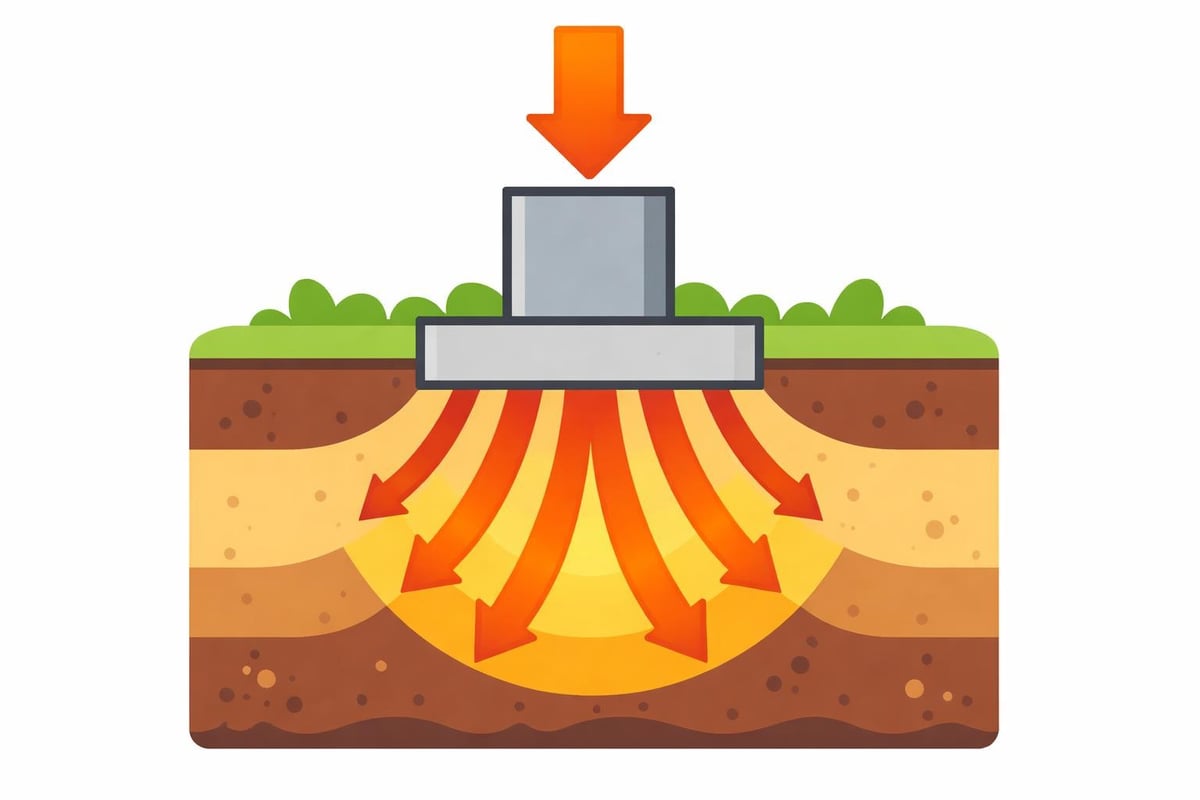
The design and construction of foundation systems requires careful integration of geotechnical investigation data, structural loading conditions, and local construction practices. Engineers must balance competing objectives of cost, constructability, and performance across varying site conditions.
Types of Shallow Foundation Systems
Different shallow foundation configurations serve distinct structural and site-specific needs. Selection depends on column spacing, load magnitude, soil variability, and construction constraints.
Spread Footings
Spread footings represent the most common shallow foundation type. These isolated pads support individual columns by spreading loads over a square, rectangular, or circular base area. Design involves sizing the footing to limit bearing pressure and reinforcing the concrete to resist bending and punching shear.
Typical applications include:
- Low to mid-rise buildings with regular column grids
- Industrial structures with isolated equipment loads
- Bridge piers and abutments on competent soils
- Residential construction supporting point loads
Strip Footings
Strip footings run continuously beneath load-bearing walls, distributing loads along their length. The continuous nature provides efficient support for closely spaced loads and helps bridge over minor soil variations. Width and reinforcement design follow similar principles to spread footings but account for the linear geometry.
These foundations excel in:
- Residential load-bearing wall construction
- Retaining walls and basement perimeters
- Industrial buildings with continuous structural walls
- Applications where excavation width must be minimized
Mat or Raft Foundations
Mat foundations extend beneath the entire building footprint, creating a continuous reinforced concrete slab. This approach distributes loads over the maximum possible area, making mats suitable for weak soils, heavy loads, or situations requiring strict differential settlement control.
| Foundation Type | Typical Depth Range | Best Soil Conditions | Relative Cost |
|---|---|---|---|
| Spread Footing | 0.5-2.0 m | Medium to dense sand, stiff clay | Low |
| Strip Footing | 0.5-1.5 m | Consistent bearing soils | Low-Moderate |
| Mat Foundation | 0.8-3.0 m | Weak or variable soils | Moderate-High |
Mat foundations prove particularly valuable when spread footings would cover more than 50 percent of the building area or when sensitive equipment requires uniform support. The increased concrete volume and reinforcement represent higher first costs, but these often prove economical compared to alternative deep foundation solutions.
Bearing Capacity Fundamentals
Bearing capacity defines the maximum pressure shallow foundations can safely apply to supporting soils. Both ultimate bearing capacity (the pressure causing shear failure) and allowable bearing capacity (ultimate capacity divided by an appropriate factor of safety) guide foundation sizing.
The classical bearing capacity theory, developed through contributions from Terzaghi, Meyerhof, and others, provides the foundation for modern design approaches. These methods account for soil shear strength, foundation geometry, embedment depth, and groundwater conditions.
Factors Influencing Bearing Capacity
Soil properties dominate bearing capacity determination:
- Internal friction angle for granular soils
- Undrained shear strength for cohesive soils
- Unit weight affecting overburden and failure wedge weight
- Groundwater location relative to foundation depth
Foundation geometry also significantly impacts capacity. Deeper embedment increases bearing capacity through surcharge effects, while shape factors adjust calculations for rectangular versus square footings. Eccentric or inclined loading reduces effective foundation area and bearing capacity accordingly.
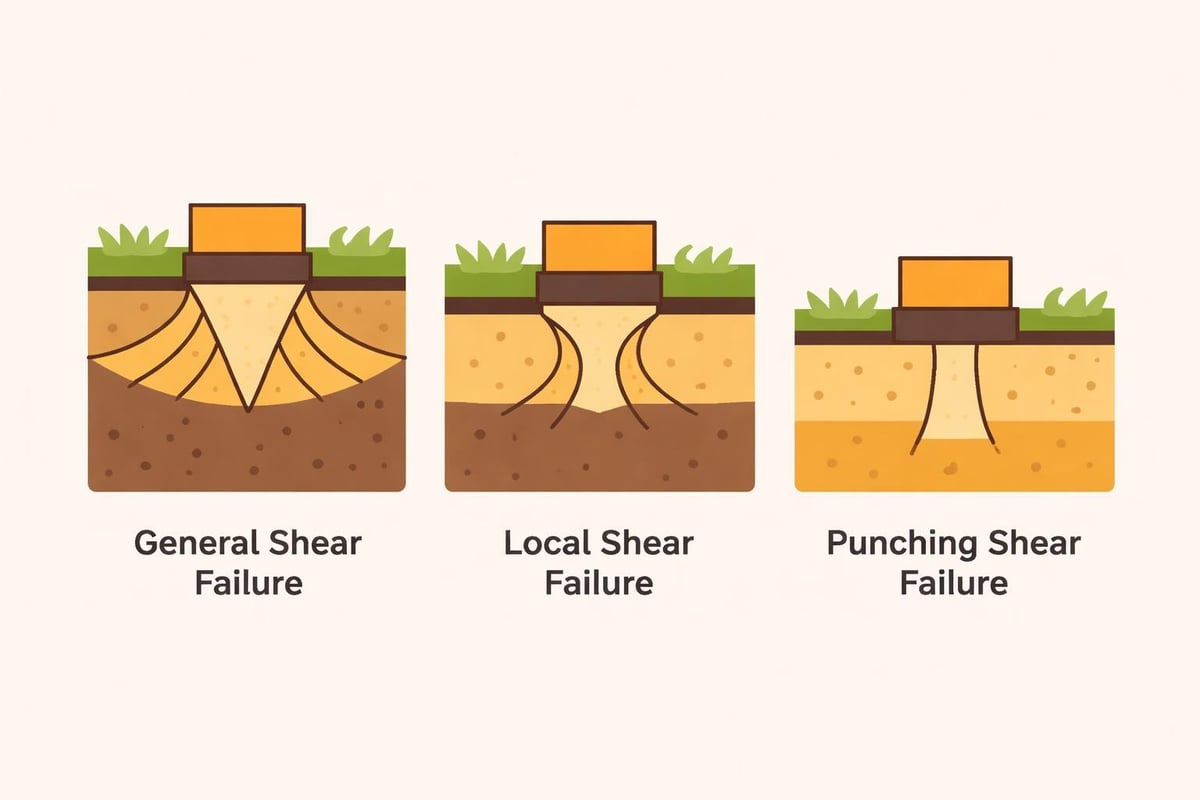
Understanding different foundation types and their applications helps engineers select appropriate systems and apply relevant bearing capacity theories. Dense sands typically exhibit general shear failure with well-defined failure surfaces, while loose sands may experience punching failure with less pronounced slip planes.
Settlement Analysis and Control
Even when bearing capacity provides adequate safety factors, excessive settlement can compromise structural performance and serviceability. Settlement analysis considers both immediate elastic compression and time-dependent consolidation in fine-grained soils.
Immediate Settlement
Immediate settlement occurs as soil compresses elastically under applied loads. Calculation typically employs elastic theory using soil modulus values derived from field or laboratory testing. Granular soils complete most immediate settlement during construction, while cohesive soils may continue settling as pore pressures dissipate.
Consolidation Settlement
Saturated clay and silt layers experience consolidation settlement as excess pore water pressures generated by loading gradually dissipate. This time-dependent process may continue for years or decades, depending on soil permeability and drainage path length.
Critical consolidation parameters include:
- Compression index describing virgin compression behavior
- Recompression index for previously loaded soils
- Coefficient of consolidation governing settlement rate
- Preconsolidation pressure indicating stress history
Differential settlement between foundation elements often governs design more stringently than total settlement magnitude. Structures tolerate uniform settlement relatively well, but differential movements induce stresses in superstructures, crack finishes, and impair functionality.
Design Methodology and Load Considerations
Modern shallow foundation design employs both allowable stress design (ASD) and load and resistance factor design (LRFD) methodologies. Recommended changes to bridge design specifications reflect ongoing evolution in LRFD approaches for geotechnical applications.
Load Combinations and Factors
Design loads include dead loads, live loads, environmental loads (wind, seismic, snow), and construction loads. Each load type carries different degrees of uncertainty, reflected in load factors that amplify characteristic values to design levels.
Structural engineers and geotechnical specialists collaborate to establish foundation loads, ensuring all relevant combinations receive evaluation. Critical combinations often involve maximum vertical load for bearing capacity checks and maximum moment for stability and structural design.
ZALIG Consulting Ltd provides comprehensive geotechnical engineering services including subsurface investigations, bearing capacity analyses, and foundation design recommendations tailored to specific project requirements. Our integrated approach combines field testing, laboratory analysis, and engineering evaluation to deliver defensible foundation solutions.
Geotechnical Investigation Requirements
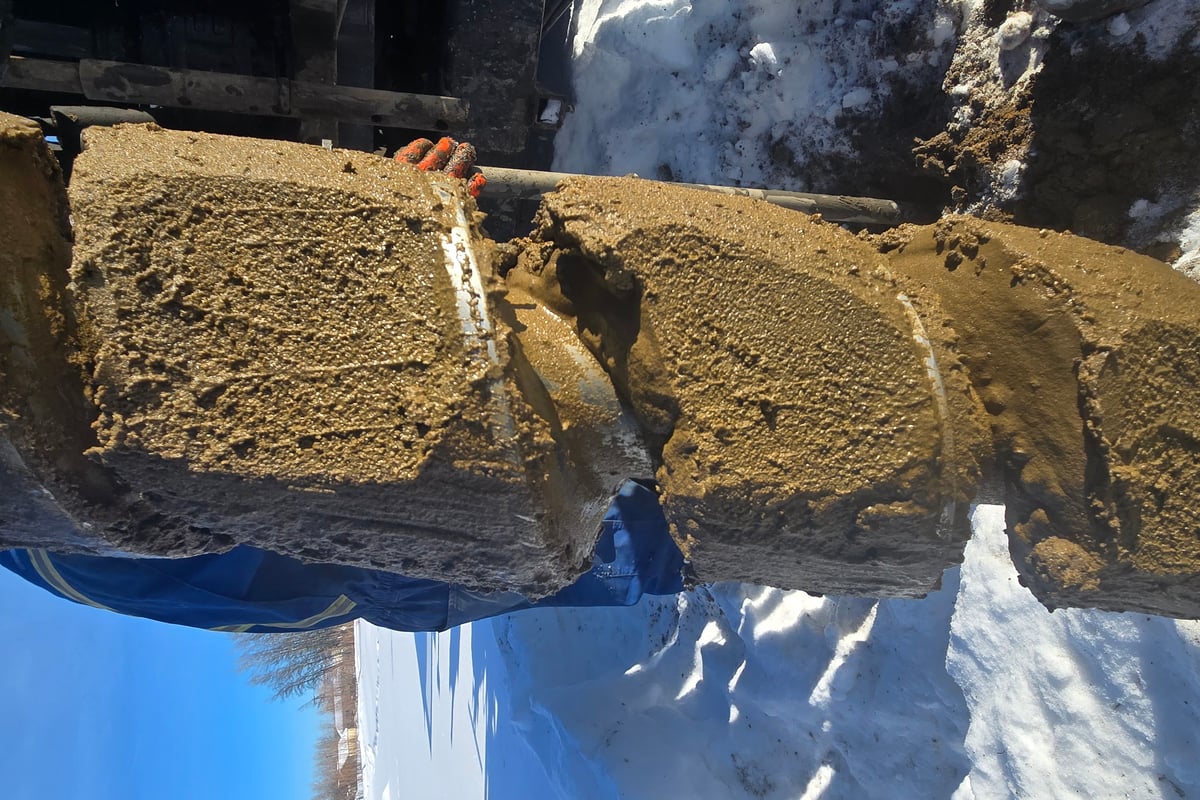
Reliable foundation design demands adequate subsurface characterization. Investigations typically include:
- Borehole drilling to define stratigraphy and sample soils
- Standard Penetration Tests (SPT) for soil density and strength
- Laboratory testing of moisture content, grain size, strength parameters
- Groundwater monitoring to establish seasonal high levels
- Field vane or cone penetration testing for detailed strength profiles
Investigation depth should extend below anticipated stress influence zones, generally 1.5 to 2 times the foundation width for bearing capacity evaluation and deeper for settlement analysis in compressible strata.
Dynamic Loading and Seismic Considerations
Shallow foundations supporting structures in seismic regions must withstand cyclic loading and potential liquefaction-induced ground deformation. Dynamic soil-structure interaction introduces complexity beyond static design considerations.
Earthquake loading can reduce soil bearing capacity through pore pressure buildup in saturated granular soils. Liquefaction susceptibility assessment examines soil gradation, density, and groundwater conditions relative to expected seismic demands. Mitigation options include ground improvement, deeper foundations bypassing liquefiable layers, or mat foundations providing greater resistance to differential movements.
Foundation Performance During Seismic Events
Shallow foundations exhibit several beneficial characteristics under seismic loading:
- Soil yielding beneath footings dissipates energy and limits force transmission
- Rocking and sliding mechanisms provide additional damping
- Conservative static design often provides reserve capacity for transient loads
- Distributed contact area resists concentrated damage
However, permanent foundation displacements and post-earthquake settlement require evaluation. Performance-based design approaches establish acceptable deformation limits and verify foundation systems meet project-specific objectives.
Construction Considerations and Quality Control
Even well-designed shallow foundations underperform if construction quality falters. Proper excavation, soil preparation, concrete placement, and inspection ensure design assumptions translate to field reality.
Excavation and Base Preparation
Foundation excavations must reach competent bearing material free from organic matter, loose fill, or frozen soil. Excavation bottom should be level, properly compacted, and protected from weather exposure prior to concrete placement.
Critical excavation practices:
- Verify bearing stratum matches geotechnical report descriptions
- Remove all disturbed or softened material from excavation base
- Maintain excavation stability through proper slopes or shoring
- Implement dewatering if groundwater interferes with construction
- Protect completed excavations from flooding or freezing
Soil stabilization and ground improvement techniques can enhance marginal bearing soils, potentially allowing shallow foundations where deep systems might otherwise be required. Chemical stabilization, compaction grouting, or structural fill replacement represent common improvement approaches.
Climate and Environmental Factors
Foundation performance depends heavily on environmental conditions over project life. Frost action, groundwater fluctuations, and soil chemistry influence long-term stability and durability.
Frost Protection
In cold climates, shallow foundations require sufficient depth below the frost penetration level to prevent frost heave. Freezing expands ice lenses in frost-susceptible soils (silts and fine sands), generating uplift forces that crack structures and cause differential movement.
| Location/Climate | Typical Frost Depth | Minimum Foundation Depth |
|---|---|---|
| Northern Canada | 2.0-3.0 m | 2.5-3.5 m |
| Prairie Provinces | 1.5-2.5 m | 2.0-3.0 m |
| Southern Canada | 0.8-1.5 m | 1.2-2.0 m |
Non-frost-susceptible backfill materials around foundations reduce heave potential in borderline depth situations. Insulated foundations or heated structures may allow reduced depths through thermal protection strategies.
Groundwater and Drainage
High groundwater reduces soil bearing capacity and effective stress while increasing hydrostatic pressures on foundation elements. Comprehensive analysis of shallow foundations includes groundwater effects on both geotechnical and structural performance.
Proper drainage design protects foundations through:
- Perimeter drainage systems collecting and conveying water away from structures
- Foundation drains relieving hydrostatic pressure on basement walls
- Surface grading directing precipitation away from buildings
- Waterproofing membranes preventing moisture intrusion
Special Design Situations
Certain project conditions demand modified shallow foundation approaches or supplementary measures beyond conventional designs.
Expansive Soils
Highly plastic clays undergo significant volume change with moisture fluctuations. Swell pressures can lift structures during wet periods, while shrinkage during droughts causes settlement. Post-tensioned slab-on-grade systems or structural floors elevated above grade on grade beams and piers provide alternatives to conventional shallow foundations.
Sloping Sites
Foundations on or near slopes require stability analysis ensuring the slope remains stable under foundation loads and that the foundation itself doesn't experience bearing capacity reduction from nearby free faces. Setback distances from slope crests depend on soil strength, slope angle, and foundation loads.
Adjacent Existing Structures
New foundations near existing buildings require careful evaluation of stress overlap zones and potential settlement impacts on adjacent structures. Underpinning existing foundations or ground improvement between old and new construction may prove necessary.
Integration with Project Delivery
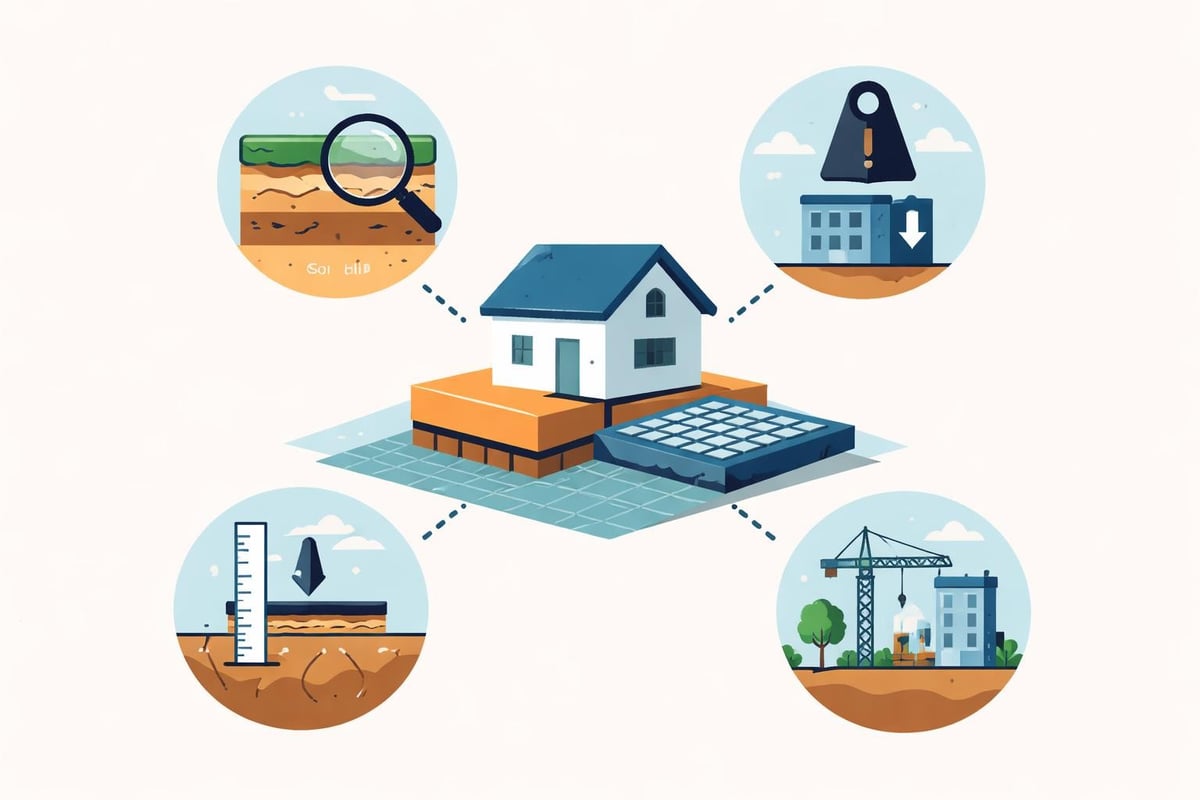
Successful shallow foundation implementation requires coordination across project phases from planning through construction closeout. Early geotechnical involvement informs site selection, grading strategies, and structural system decisions.
Design development integrates geotechnical recommendations with structural requirements, architectural constraints, and construction market capabilities. Transportation engineering projects often incorporate shallow foundations for bridge abutments, traffic signal poles, and retaining structures, requiring coordination between disciplines.
Inspection and Testing
Construction phase services verify field conditions match design assumptions and confirm workmanship meets specifications. Reinforced concrete design standards establish minimum requirements for materials, reinforcement placement, and concrete strength.
Inspection activities include:
- Excavation bottom examination by qualified personnel
- Bearing material confirmation against boring logs
- Formwork and reinforcement verification before concrete placement
- Concrete sampling and strength testing
- Final dimension and elevation surveys
Documentation creates permanent records supporting project closeout and future reference during building operation and maintenance.
Cost-Effectiveness and Value Engineering
Shallow foundations typically provide the most economical foundation solution when site conditions allow their use. Reduced excavation depths, elimination of deep foundation materials and equipment, and simplified construction logistics all contribute to cost advantages.
Value engineering efforts should consider total project costs rather than isolated foundation costs. Slightly higher foundation investment may enable more economical structural systems, reduced construction duration, or improved long-term performance.
Cost factors in foundation selection:
- Material quantities and unit prices
- Labor productivity and availability
- Equipment requirements and mobilization
- Construction duration and schedule impacts
- Risk allocation and contingency needs
- Long-term performance and maintenance costs
Early contractor involvement or design-build delivery methods can optimize foundation constructability and cost-effectiveness through collaborative planning and market knowledge integration.
Risk Management and Contingency Planning
Geotechnical conditions inherently involve uncertainty due to subsurface variability and limited sampling. Risk management strategies acknowledge this uncertainty and establish contingency approaches for unexpected conditions.
Differing site conditions clauses in contracts protect owners and contractors from unanticipated subsurface surprises. Allowance items for rock excavation, dewatering, or ground improvement provide budget flexibility without change order delays.
Geotechnical engineers should clearly communicate investigation limitations, identify areas of higher uncertainty, and recommend appropriate contingencies. Conservative assumptions in critical areas balance project risk against initial design costs.
Shallow foundations deliver reliable, economical support for countless structures when designed with careful attention to soil conditions, loading requirements, and environmental factors. Success depends on thorough geotechnical investigation, appropriate design methodology, and quality construction practices. Whether your project involves commercial development, civil infrastructure, or industrial facilities, ZALIG Consulting Ltd provides the integrated geotechnical, structural, and construction support needed to deliver foundation systems that perform safely and cost-effectively throughout their design life.