

Seepage analysis is becoming more crucial than ever in geotechnical engineering and infrastructure development as we head toward 2026. Inadequate assessment of seepage can lead to significant risks, including costly failures and environmental harm.
Recent advances in field measurement, data assimilation, and simulation are transforming how engineers approach these challenges. This comprehensive guide covers everything from core principles to the latest software and emerging trends, ensuring you have access to actionable, up-to-date information.
Whether you are an engineer, consultant, or project manager, this resource will help you optimize outcomes and reduce risk in your 2026 projects. Use this guide to stay ahead and make better decisions for your seepage analysis needs.
Fundamentals of Seepage Analysis
Seepage analysis forms the backbone of geotechnical engineering, shaping how professionals manage water movement in soil and rock. Understanding the fundamentals is crucial for predicting risks, optimizing designs, and ensuring the long-term safety of infrastructure. By mastering seepage analysis, engineers can anticipate problems before they arise and implement effective solutions across a range of projects.
Understanding Seepage and Its Impact
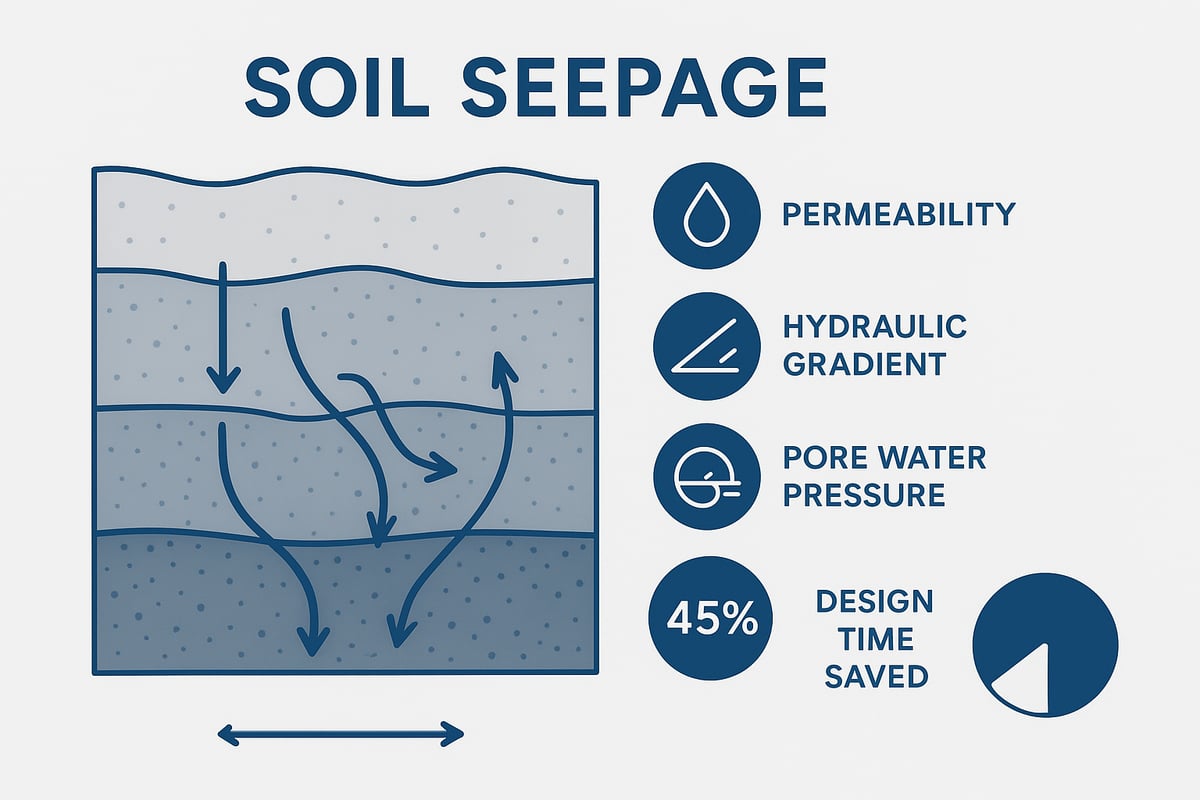
Seepage is the movement of water through soil and rock, driven by differences in hydraulic head. Within the context of seepage analysis, this process is fundamental for understanding how water interacts with geotechnical structures and natural landscapes.
The physical mechanisms behind seepage involve water traveling through pore spaces, influenced by the material’s permeability and the hydraulic gradient. Soil saturation levels, permeability coefficients, and hydraulic gradients all play a role in determining the rate and direction of seepage. Another critical parameter is pore water pressure, which directly affects soil stability and can be further explored in the Fundamentals of pore water pressure.
Seepage analysis enables engineers to assess risks such as:
- Loss of slope stability
- Reduced foundation safety
- Compromised infrastructure durability
Mismanaging seepage can have severe consequences. Erosion, piping (the internal removal of soil particles), ground settlement, and even catastrophic structural failure may result from inadequate control. For instance, consider a deep excavation project where unanticipated groundwater inflow causes rapid soil movement and endangers nearby buildings. In these cases, robust seepage analysis is not just beneficial but essential.
Advanced seepage analysis software, such as DeepEX, has been shown to reduce design time by up to 90 percent, allowing for quicker, more reliable project delivery. By understanding these core concepts, engineers lay the groundwork for safer and more efficient geotechnical designs.
Key Applications in Engineering
Seepage analysis is applied across a broad spectrum of engineering projects, each with unique challenges and requirements. Its versatility makes it indispensable in modern construction and environmental management.
Key applications include:
- Deep excavations for basements and underground structures
- Tunnels requiring groundwater control
- Retaining walls and embankments exposed to variable water pressures
- Dams, levees, and flood control systems that demand rigorous seepage management
- Urban infrastructure and transportation projects, where water movement affects longevity and safety
- Environmental containment, such as landfill liners and barriers
- Industrial site dewatering and regional groundwater management
In each scenario, seepage analysis helps engineers predict how water will move through and around structures. This insight enables the selection of materials, design of drainage systems, and implementation of mitigation measures that protect both infrastructure and the surrounding environment.
As cities grow and climate patterns shift, the importance of seepage analysis continues to increase. By applying these principles, engineers can address both immediate construction needs and long-term operational safety, ensuring that projects remain resilient for years to come.
Analytical Methods in Seepage Analysis
Analytical methods remain the backbone of seepage analysis. They provide engineers with foundational tools to evaluate water movement through soil and rock, supporting safe and cost-effective design decisions. As projects grow more complex, understanding both traditional and advanced approaches is essential for accurate seepage analysis outcomes.
Traditional Analytical Approaches
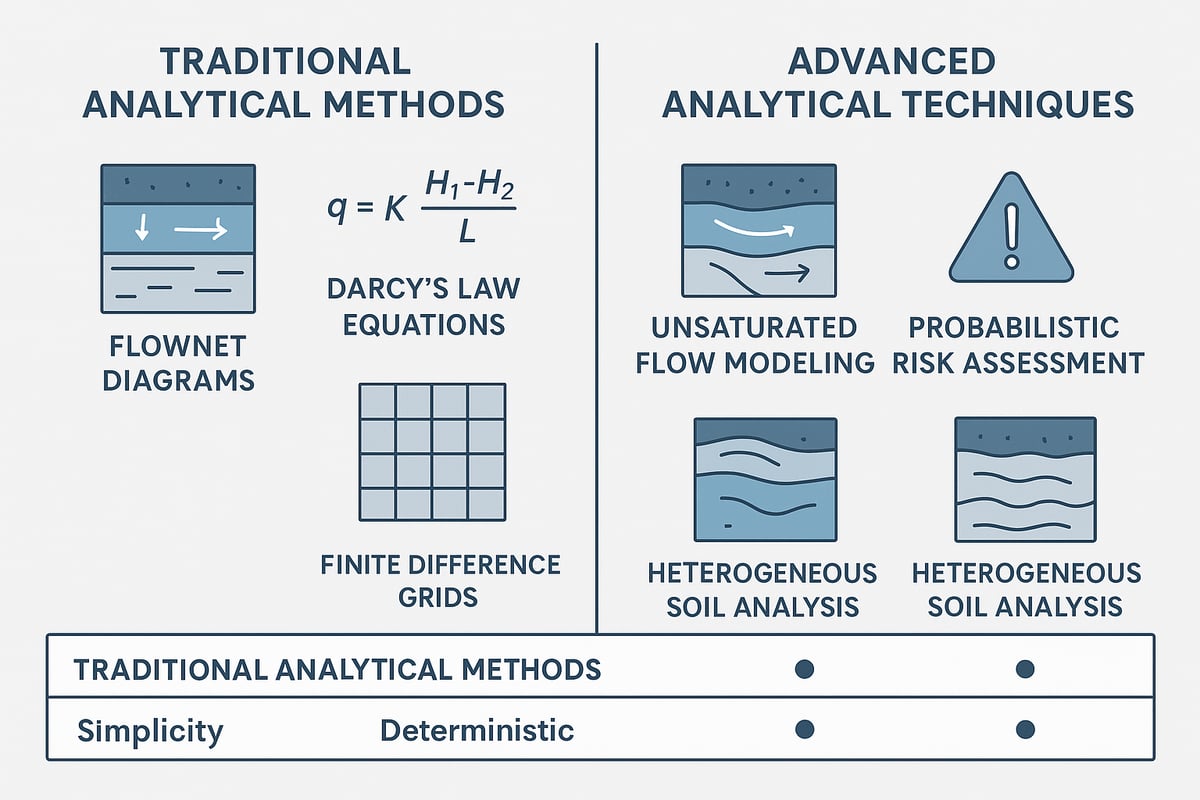
Traditional approaches to seepage analysis have shaped geotechnical engineering for decades. Flownet analysis is a classic method, where engineers draw equipotential lines and flow paths to visualize groundwater movement. This approach is especially useful for two-dimensional problems with simple boundaries.
Steps for flownet construction typically include:
- Sketching the soil profile and boundaries.
- Drawing equipotential and flow lines at regular intervals.
- Interpreting the flownet to estimate seepage quantities and gradients.
Finite difference methods also play a role in limit equilibrium analysis. By dividing the soil into a grid, engineers can approximate hydraulic gradients and seepage loads across each section. These calculations rely on fundamental equations such as Darcy’s Law, which relates flow rate to hydraulic gradient and soil permeability, and Laplace’s Equation, which governs steady-state groundwater flow.
Seepage analysis using these methods allows for the determination of critical parameters such as:
- Total seepage quantity through a section.
- Hydraulic gradients and potential for piping or heave.
- Safety factors against instability.
A common example is flownet analysis for a cut slope in permeable soils. Here, underestimating seepage loads can lead to slope failure or excessive deformation. Challenges often arise when dealing with complex stratigraphy or non-uniform boundary conditions, which may limit the accuracy of traditional methods.
Despite these limitations, traditional seepage analysis remains valuable for rapid assessments and preliminary design checks, especially when site conditions are relatively uniform.
Advances in Analytical Techniques
Recent years have seen significant advances in analytical techniques for seepage analysis. Modern methods now account for unsaturated–saturated flow conditions, which are crucial for modeling real-world scenarios such as rainfall infiltration or changing groundwater levels. Analytical solutions for heterogeneous and anisotropic soils have also expanded, enabling more accurate representation of layered or variable ground conditions.
Probabilistic risk assessment is increasingly integrated into seepage analysis to address uncertainties in soil properties and boundary conditions. Techniques like reliability analysis and scenario modeling help engineers evaluate a range of possible outcomes, supporting more resilient designs.
For unsaturated–saturated flow analysis, understanding the soil water retention curve is essential. This curve describes how water content varies with suction, influencing the hydraulic conductivity of soils under varying moisture conditions. For a detailed explanation, see soil water characteristic retention curves.
Analytical methods are now often used for rapid design checks, supplementing more detailed numerical simulations. By combining these tools, engineers achieve both efficiency and reliability in seepage analysis, even as projects grow in complexity.
Numerical Methods and Simulation Tools
Numerical methods are at the core of modern seepage analysis, enabling engineers to simulate complex groundwater flow scenarios with high accuracy. As geotechnical projects grow in scale and complexity, robust simulation tools have become indispensable for design, risk assessment, and regulatory compliance.
Finite Element and Finite Difference Methods
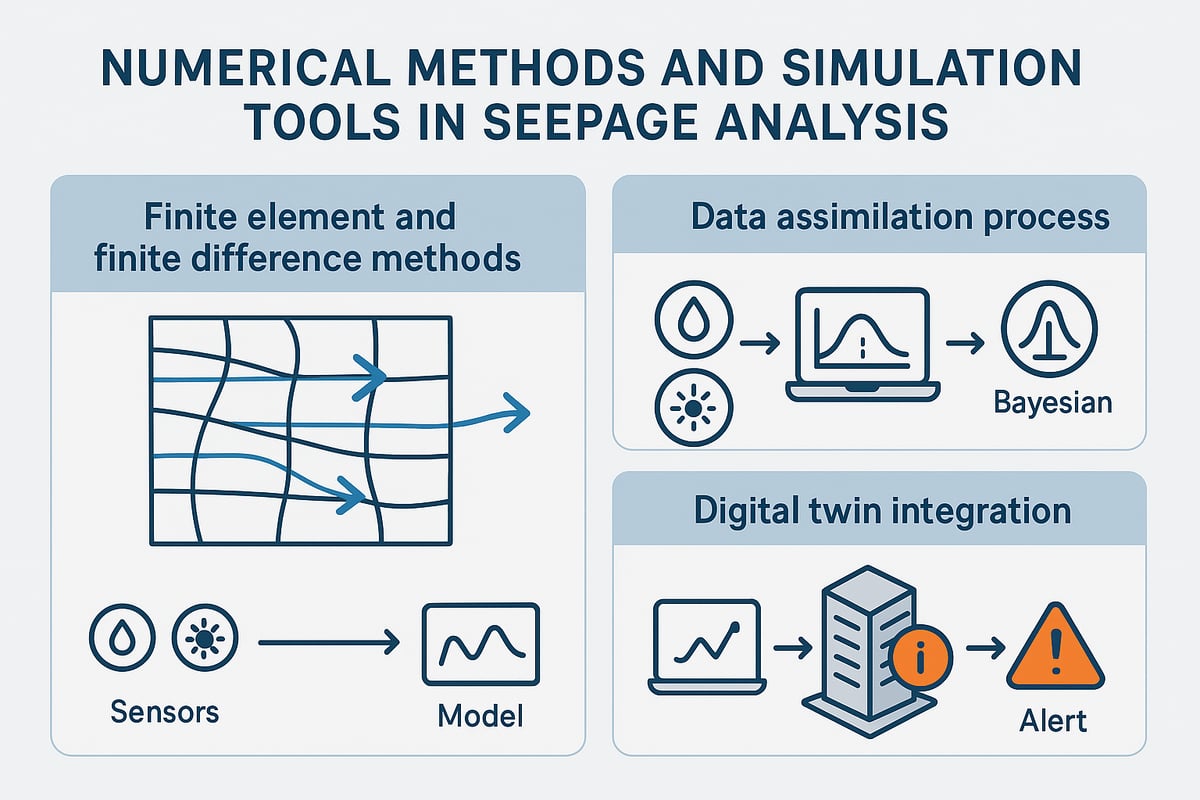
Finite element and finite difference methods are foundational approaches for seepage analysis, allowing engineers to solve groundwater flow equations in soils and rock. Both techniques discretize the domain into small elements or grids, but they differ in formulation and application.
The finite element method (FEM) excels in handling irregular boundaries, heterogeneous materials, and layered soils. It is particularly effective for modeling complex geometries, such as deep excavations with multiple strata and variable hydraulic properties. The finite difference method (FDM) offers simplicity and computational efficiency, making it suitable for regular domains and preliminary seepage analysis.
| Feature | Finite Element Method (FEM) | Finite Difference Method (FDM) |
|---|---|---|
| Geometry handling | Irregular, complex | Regular, simple |
| Material heterogeneity | Excellent | Moderate |
| Computational effort | Higher | Lower |
| Boundary flexibility | High | Moderate |
A typical application involves simulating groundwater flow beneath a deep excavation. Engineers define boundary conditions, assign material properties, and run simulations to predict seepage patterns and hydraulic gradients. Validation with field data ensures that the seepage analysis reflects real-world behavior.
For a comprehensive overview of these essential numerical methods, visit the geotechnical numerical analysis overview for further reading.
Data Assimilation and Inverse Analysis
Data assimilation has transformed seepage analysis by enabling real-time refinement of models using field measurements. This approach merges sensor data—such as pore water pressures and soil moisture—with simulation results, producing models that better reflect site-specific conditions.
Inverse analysis plays a critical role in estimating unknown hydraulic parameters from observed data. Methods like Bayesian updating, Kalman filters, and merging particle filters (MPF) allow engineers to continuously update seepage analysis models as new data becomes available. For example, MPF techniques have been successfully applied to field data from three different slopes, each with unique soil characteristics, improving the reliability of parameter estimates.
Probabilistic estimation methods help address uncertainty and spatial variability in soil properties. By considering a range of possible scenarios, engineers can better quantify risks associated with seepage, such as piping or slope instability. This process enhances the robustness of seepage analysis outcomes, resulting in safer and more resilient infrastructure.
Continuous calibration and validation are necessary to maintain model accuracy over the project lifecycle. Integrating data assimilation ensures that seepage analysis remains up-to-date, especially in changing environmental conditions.
Integration with Digital Twin Systems
The advent of digital twin technology has revolutionized seepage analysis by linking physical assets with virtual models in real time. Digital twins combine live field measurements with advanced numerical models, enabling proactive monitoring and management of seepage-related risks.
Key benefits of integrating digital twins in seepage analysis include:
- Real-time monitoring of groundwater levels and pore pressures
- Automated early warning systems for potential slope failures or excessive inflow
- Improved prediction accuracy through continuous data-model feedback
- Enhanced decision-making for risk mitigation and maintenance planning
For example, digital twin systems can issue alerts before surface failures occur, allowing engineers to intervene before damage escalates. This level of integration transforms seepage analysis from a static design exercise into a dynamic, adaptive process.
Digital twins also support collaboration among project teams by centralizing data and providing a shared platform for analysis. As regulations and project requirements evolve, digital twin integration is poised to become a standard practice in seepage analysis for 2026 and beyond.
Incorporating Field Measurement Data
Field measurement data are transforming how seepage analysis is performed on modern infrastructure projects. With advances in sensor technology and data integration, engineers can now achieve a higher degree of precision, reliability, and adaptability in their seepage analysis workflows.
Modern Field Monitoring Techniques
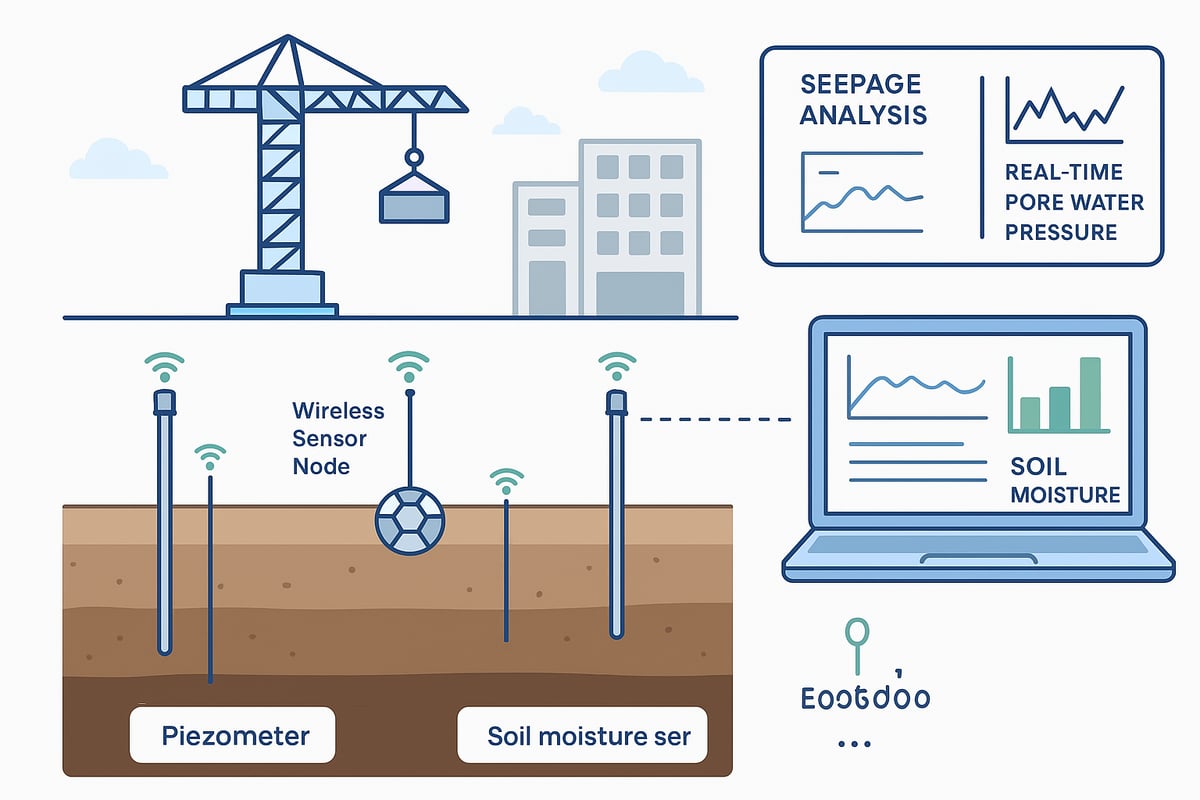
Accurate seepage analysis starts with robust field monitoring. Engineers install soil moisture sensors, piezometers, and inclinometers to capture real-time changes in water movement and ground deformation.
Wireless sensor networks have become essential, enabling continuous data collection without cumbersome manual readings. These networks transmit volumetric water content and pore water pressure data directly to analysis platforms, streamlining the seepage analysis process.
- Soil moisture sensors: Track variations in soil saturation, critical for predicting seepage paths.
- Piezometers: Measure pore water pressure, revealing hydraulic gradients across layers.
- Inclinometers: Detect ground movement, which may signal instability due to seepage.
For example, a deep excavation site in Japan used real-time data from these sensors to calibrate seepage models during heavy rainfall. This proactive approach allowed project teams to adjust dewatering strategies, minimizing risks and optimizing design. By integrating field data, seepage analysis becomes more adaptive and responsive to evolving site conditions.
Data Assimilation in Practice
Integrating field measurement data with seepage analysis models enhances predictive capabilities and supports risk-informed decisions. The process typically involves several steps:
- Collect and preprocess sensor data for quality and consistency.
- Merge data streams with numerical or analytical seepage analysis models.
- Update model parameters dynamically based on field observations.
A notable example is the application of the merging particle filter (MPF) technique. This approach estimates soil hydraulic properties by assimilating precipitation and soil moisture data, improving model accuracy for various soil types. For an in-depth look at MPF applications in seepage models, see this seepage analysis model using MPF.
Interpreting sensor outputs and updating model parameters on the fly can be challenging. Engineers must address issues such as optimal sensor placement, data gaps, and computational efficiency. However, these efforts pay off by reducing uncertainty and enabling more robust seepage analysis results for complex projects.
Enhancing Model Reliability
Continuous calibration and validation are vital for maintaining reliable seepage analysis models. Engineers frequently compare model predictions with ongoing field measurements, adjusting parameters as new data become available.
Monte Carlo simulations are widely used to quantify parameter uncertainty. By running hundreds or thousands of seepage analysis scenarios, practitioners can better understand the range of possible outcomes and design for safety.
To further boost reliability, consider these best practices:
- Regularly validate models with fresh field data.
- Use automated scripts for data assimilation and model updates.
- Document all parameter changes and rationale for traceability.
By integrating field and model data, engineers achieve more robust, defensible predictions. This holistic approach ensures that seepage analysis remains a cornerstone of safe, efficient, and resilient infrastructure development.
Seepage Analysis Software and Automation
Digital transformation has significantly advanced seepage analysis, making it faster, more reliable, and accessible for geotechnical professionals. Today’s engineers no longer rely solely on manual calculations or simplistic models. Instead, they leverage sophisticated seepage analysis tools that integrate analytical and numerical methods, streamlining the entire project workflow.
Leading Software Solutions
The current landscape of seepage analysis software is shaped by platforms such as DeepEX, PLAXIS, SEEP/W, and OPTUM GX. These tools offer powerful capabilities, including advanced 2D and 3D modeling, flownet analysis, and robust finite element simulations. User interfaces are designed for ease of use, allowing engineers to define stratigraphy, input parameters, and visualize results efficiently.
For instance, DeepEX stands out by integrating both analytical and numerical methods within a single environment. This enables rapid model setup, expert checks, and streamlined design iterations. Many software solutions also provide automated report generation, helping teams document their work and comply with regulatory requirements.
To explore additional industry options, review this comprehensive overview of seepage analysis software for engineers, which details capabilities for steady-state and transient modeling. Selecting the right seepage analysis tool is essential for tackling diverse project challenges, from simple flownet studies to complex 3D groundwater flow simulations.
Automation and Workflow Optimization
Automation has become a cornerstone of modern seepage analysis, enabling engineers to accelerate routine calculations and focus on critical design decisions. Leading software platforms support batch processing, allowing users to run multiple scenarios and sensitivity analyses with minimal manual intervention.
This approach streamlines design optimization, making it easier to compare alternative solutions and select the most effective strategies. Value engineering benefits from automated workflows, as teams can rapidly assess design changes and their impact on seepage behavior. The integration of seepage analysis software with broader project management tools further improves efficiency and collaboration.
Notably, customer feedback highlights remarkable time savings, with up to 90 percent reduction in design time reported for some software, such as DeepEX. By automating repetitive tasks, engineers can allocate more effort to interpretation, risk mitigation, and communication, ensuring that seepage analysis remains a value driver throughout the project lifecycle.
Quality Assurance and Risk Minimization
Quality assurance is central to every seepage analysis project. Modern software incorporates built-in checks for model consistency, regulatory compliance, and parameter validation. These features help minimize the risk of errors, ensuring that analysis results are robust and defensible.
Automated documentation and reporting tools generate detailed records for project approvals and audits. By reducing manual data handling, the likelihood of costly mistakes is significantly lowered. Seepage analysis software also supports scenario management, enabling teams to anticipate and address potential failure modes before construction begins.
Ultimately, leveraging advanced software and automation in seepage analysis not only saves time but also enhances project safety and reliability. With regulatory standards evolving and project complexity increasing, these digital solutions are becoming indispensable for engineers and project managers alike.
Future Trends and Innovations in Seepage Analysis
The landscape of seepage analysis is evolving rapidly as we approach 2026. Engineers and geotechnical professionals are adopting new technologies and methods to improve accuracy, efficiency, and risk mitigation. Let us explore the most impactful trends shaping the future of seepage analysis.
Emerging Technologies
Modern seepage analysis is transforming through the integration of artificial intelligence and machine learning. These tools allow engineers to automate parameter estimation, detect anomalies in real time, and predict seepage behaviors under changing site conditions. Advanced sensor technologies, including wireless IoT-enabled networks, are improving data collection. These sensors continuously monitor soil moisture, pore water pressure, and flow rates, feeding critical data directly into analysis platforms.
Cloud-based platforms now facilitate collaborative seepage analysis projects. Teams can share models, review results, and synchronize data from multiple sources, ensuring consistency and transparency. Recent research is also pushing the boundaries of simulation. For example, the Three-dimensional seepage analysis using PSBFEM introduces a polyhedral scaled boundary finite element method, enabling highly accurate modeling of complex 3D seepage scenarios.
These innovations are not just theoretical. They are being adopted in real-world projects, bringing a new level of precision to seepage analysis and risk management.
Digital Twins and Predictive Analytics
Digital twin systems are revolutionizing seepage analysis by linking physical assets with virtual models. These systems integrate real-time field measurements, such as groundwater levels and soil saturation, with sophisticated numerical simulations. The result is a live digital replica of a project site, capable of forecasting seepage trends and identifying risks before they escalate.
Predictive analytics within these digital twins enable early warnings for slope failures and groundwater upsets. Algorithms analyze historical and live data, flagging abnormal seepage patterns. When paired with robust seepage analysis models, these systems support proactive decision-making. For example, digital twins have successfully issued early warnings ahead of surface failures, minimizing damage and protecting public safety.
Engineers leveraging digital twin technology can optimize design, monitor construction, and ensure long-term performance of critical infrastructure.
Sustainability and Regulatory Drivers
Sustainability is a central theme in seepage analysis for 2026. Infrastructure projects must account for responsible water management, minimizing environmental impacts and supporting long-term resilience. Engineers are incorporating climate change scenarios into seepage analysis, assessing how increased precipitation or rising groundwater may affect project safety and performance.
Regulatory agencies are raising standards for groundwater protection and environmental compliance. New guidelines require more rigorous seepage analysis, with detailed documentation and transparent reporting. Cloud platforms and automated workflows make it easier to demonstrate compliance, generate audit trails, and adapt to evolving requirements.
Sustainable seepage analysis not only meets regulations but also supports community and environmental well-being, ensuring infrastructure remains safe and reliable under future conditions.
Case Studies and Lessons Learned
Recent case studies highlight both successes and challenges in seepage analysis. Projects that integrated field measurement data, such as wireless sensors and real-time monitoring, achieved more accurate predictions and timely interventions. Lessons from these projects emphasize the value of merging simulation with data assimilation, as well as close collaboration across disciplines.
Failures often stemmed from inadequate seepage analysis or delayed responses to changing site conditions. For example, insufficient monitoring led to unexpected slope instability in some cases. Resources like Slope stability and seepage risks provide valuable insights into the interplay between seepage, soil behavior, and stability assessment.
Best practices for 2026 include regular model updates, continuous professional development, and adopting emerging software tools. By learning from past experiences, engineers can improve outcomes and reduce risks on future projects.
If you're looking to apply the latest seepage analysis methods and ensure your 2026 projects are built on solid ground, we've covered the essentials—everything from advanced field data integration to cutting-edge simulation tools. At ZALIG Consulting Ltd, we understand how critical accurate seepage analysis is for the integrity and safety of your infrastructure. Whether you need expert guidance, tailored testing, or support with regulatory compliance, we’re here to help you achieve the best outcomes. Let’s move forward together—reach out to us at Contact Us: info@zalig.ca or +1 800 515 0497 to discuss your project needs.