

Did you know that over 30% of deep foundation problems in modern construction are linked to soil settlement? For engineers and builders, negative skin friction is a critical yet often overlooked factor that can jeopardize the safety and service life of piles and foundations.
This comprehensive guide explains negative skin friction, revealing why it develops and how it impacts pile-supported structures. As construction projects in 2026 face new challenges, understanding this phenomenon is more important than ever.
By mastering the causes, effects, and practical solutions for negative skin friction, you can ensure safer and more cost-effective outcomes. Ready to future-proof your projects? Read on and turn this hidden risk into a manageable part of your foundation strategy.
What is Negative Skin Friction?
Negative skin friction is a critical concept in geotechnical engineering that refers to a downward drag force acting on deep foundation elements when the surrounding soil settles more than the pile or shaft itself. Unlike positive skin friction, which helps support structural loads by transferring them from the pile shaft to the soil, negative skin friction works in the opposite direction and can add significant stress to the foundation.
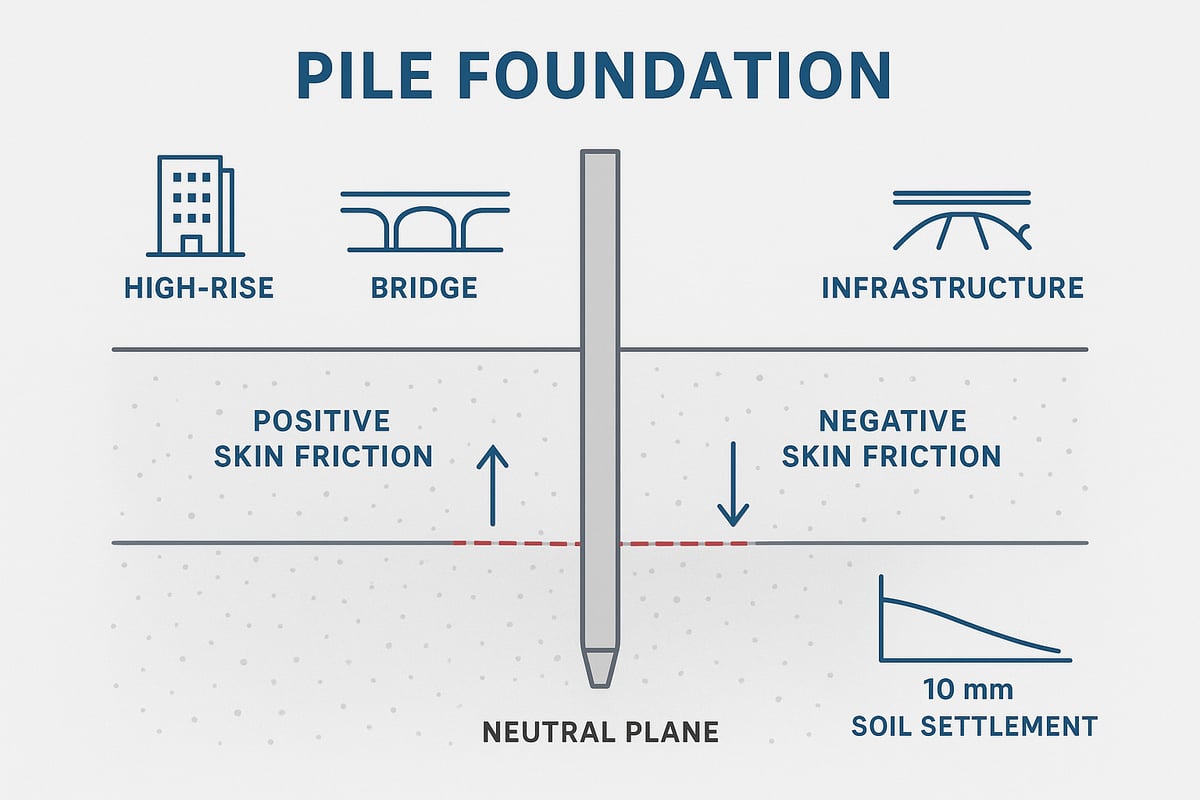
Even minor soil movements, sometimes as little as 10mm, are enough to trigger the full development of negative skin friction. This phenomenon is often overlooked in design but can have substantial implications for the safety and performance of deep foundations.
Definition and Basic Concept
Negative skin friction develops when the surrounding soil settles relative to a stationary pile or shaft. In normal circumstances, positive skin friction occurs as the soil grips the pile and helps transfer the building load downward. With negative skin friction, the soil moves down faster than the pile, exerting a downward force known as downdrag.
Key terms to understand include:
- Downdrag: The additional load applied to the pile due to negative skin friction.
- Neutral plane: The point along the pile where the relative movement between soil and pile is zero.
- Pile shaft: The vertical structural element embedded in the ground.
Imagine a scenario where a new layer of fill is placed over soft clay. As the clay consolidates, it settles, dragging the pile with it. The negative skin friction generated can be substantial, and even a 10mm differential movement is enough to fully mobilize this force.
Mechanisms of Development
The primary mechanism behind negative skin friction is the settlement of compressible soil layers around a foundation element. When soft clay or organic soils consolidate under new loads, they move downward relative to the pile. This movement generates a downward shear force along the pile shaft, known as negative skin friction.
A key concept is the neutral plane. Above this plane, the soil moves downward faster than the pile, causing negative skin friction. Below the neutral plane, the pile moves relative to the soil, and positive skin friction may occur.
A typical diagram would show a pile embedded in layered soil, with arrows indicating upward positive skin friction beneath the neutral plane and downward negative skin friction above it. The direction and magnitude of these forces depend on soil properties, settlement rates, and the type of foundation element used.
Types of Structures Affected
Negative skin friction can impact a variety of deep foundation systems, including:
- Piles (driven, bored, or CFA)
- Caissons
- Shafts and piers
Structures most at risk are those built on soft, compressible, or reclaimed soils. Examples include high-rise buildings on clay-rich ground, bridges crossing river valleys, and infrastructure projects on recently filled land.
Urban redevelopment projects, where new fill is placed over existing soft soils, are especially prone to negative skin friction challenges. For a closer look at how this phenomenon affects foundation elements and the engineering solutions available, see the detailed overview of specialized deep foundation piles.
Understanding the range of structures susceptible to negative skin friction is essential for designing safe, durable foundations in modern construction.
Primary Causes of Negative Skin Friction
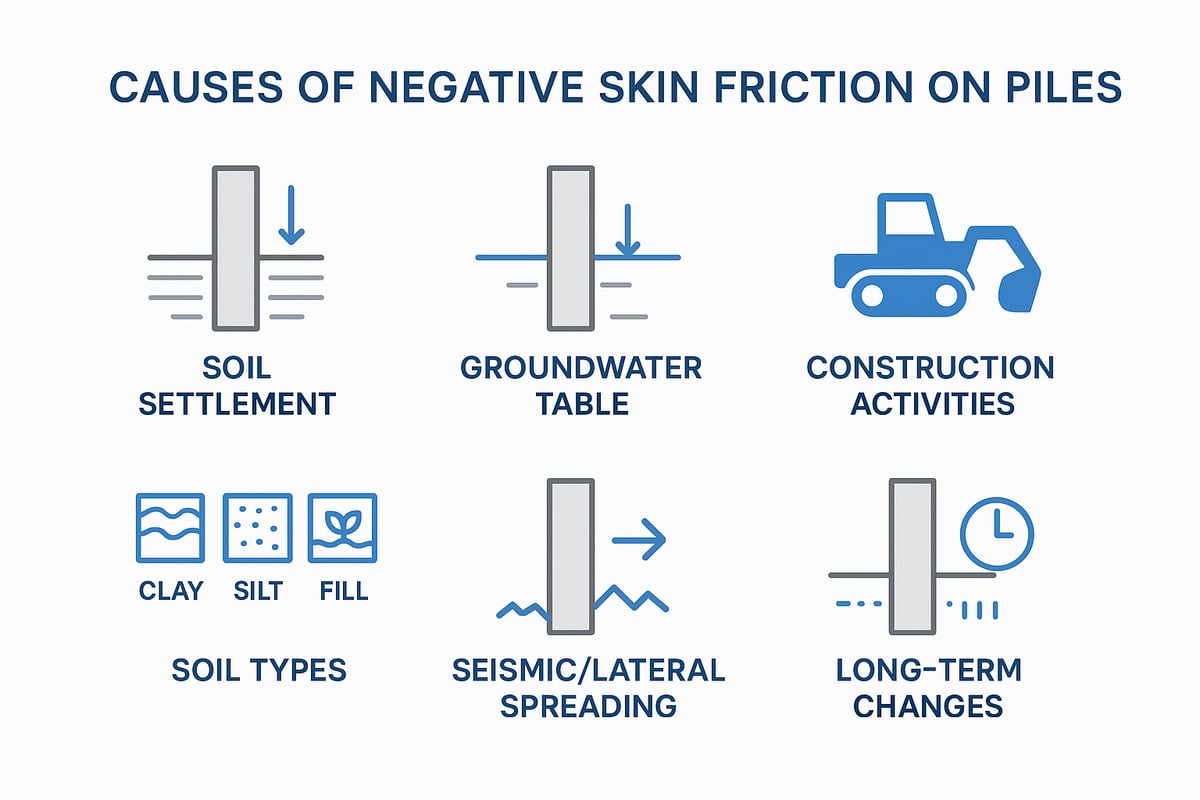
Understanding the primary causes of negative skin friction is essential for geotechnical engineers and construction professionals. This phenomenon arises from a combination of soil behavior, groundwater movement, construction practices, and long-term site changes. Each contributing factor can significantly influence the safety, performance, and cost of deep foundation projects.
Soil Settlement and Consolidation
The most common trigger for negative skin friction is soil settlement and consolidation. When new fill is placed or embankments are constructed, the underlying soil is compressed. This process causes the soil to move downward relative to the pile, which in turn creates a downward drag force along the pile shaft. Even a small relative movement, as little as 10mm, is enough for full negative skin friction to develop.
Primary consolidation is particularly significant in organic or clay-rich soils. When these compressible layers are loaded, water is squeezed out over time, leading to settlement. This settlement transfers additional load to the pile, which must be accounted for in design. In urban developments, negative skin friction often appears after major landscape changes or new construction fills.
Groundwater Table Changes
Changes in the groundwater table can also cause negative skin friction. When groundwater is lowered for construction, such as during dewatering for deep excavations, it increases the effective stress in the soil. This increase leads to further settlement of compressible layers, which then drags down adjacent piles.
Seasonal fluctuations or project-induced changes in groundwater levels can have the same effect. For example, after a rainy season, a drop in the water table may cause soils to consolidate, initiating negative skin friction on existing foundations. Engineers must consider these variations during both design and construction phases.
Construction Activities
Several construction activities can accelerate the development of negative skin friction. Surcharging and preloading are common techniques used to speed up soil consolidation before the main structure is built. While these methods help stabilize the ground, they can also cause settlement that induces negative skin friction.
Pile driving itself can generate excess pore water pressure in clay soils. As this pressure dissipates, the soil consolidates and settles, possibly leading to negative skin friction along the pile shaft. Staged loading, where structures are built in phases, can also create cycles of settlement and drag forces on piles.
Soil Types Prone to NSF
Certain soils are more susceptible to negative skin friction. Soft, compressible clays and silts are the most vulnerable, as they tend to settle significantly under load. Loose fills and organic soils also pose a risk, while stiff clays and dense sands are generally less problematic.
Urban redevelopment on reclaimed land often encounters these challenging soil types. For instance, construction on soft clay deposits or areas with organic layers may experience significant downdrag. Negative skin friction can also be a concern in permafrost regions, where freeze-thaw cycles affect soil movement, as discussed in causes of negative skin friction in permafrost.
Lateral Spreading and Seismic Events
Lateral spreading and seismic activity are critical causes of negative skin friction in certain locations. Earthquakes can induce rapid ground movement, especially in sloping areas or near riverbanks. This movement leads to differential settlement between the soil and the pile, creating additional drag forces.
Lateral spreading occurs when soil layers move horizontally, often due to liquefaction or slope instability. In these cases, negative skin friction can be unevenly distributed along the pile, increasing the risk of structural damage. Seismic zones require special attention to these effects during foundation design.
Long-Term Site Changes
Finally, ongoing site changes can contribute to negative skin friction over many years. Natural consolidation of soft soils continues long after initial construction, gradually increasing settlement and drag on foundation elements. Infrastructure upgrades, such as adding new loads or adjacent construction, can disturb soil equilibrium and trigger additional negative skin friction.
It is crucial to monitor sites for evolving conditions, as long-term settlement can compromise foundation performance. Proactive planning and regular assessment help manage these risks throughout the lifespan of a structure.
Effects and Risks of Negative Skin Friction
Understanding the effects and risks of negative skin friction is essential for any geotechnical engineer or project manager working with deep foundations. This phenomenon can silently undermine the safety, performance, and economics of a structure if not properly addressed. By exploring each risk, you can make more informed decisions and design safer, more reliable foundations.

Increased Axial Load on Foundations
One of the most critical effects of negative skin friction is the addition of extra axial load on foundation elements. When negative skin friction develops, it exerts a downward drag along the pile shaft, increasing the total load that reaches the pile toe.
This additional load can push the pile closer to its ultimate bearing capacity, raising the risk of overstressing the foundation. As a result, the net shaft resistance is reduced, and the pile may no longer be able to support the intended structural loads safely.
| Effect | Description | Risk Level |
|---|---|---|
| Axial Load Increase | Added compressive force due to NSF | High |
| Shaft Resistance Loss | Reduction or negation of shaft capacity | Moderate |
| Overstress | Potential to exceed pile material strength | High |
Even minor soil movements can fully mobilize negative skin friction, making this risk especially significant in soft or settling soils.
Settlement and Structural Performance
Negative skin friction can cause uneven settlement within pile groups, leading to differential movement across the foundation. This differential settlement often results in serviceability issues such as tilting, cracking, or misalignment of structural components.
For example, if one side of a building experiences greater negative skin friction, it may settle more than the other, causing visible and potentially hazardous structural distortions. Over time, these performance issues can compromise both the safety and the usability of the structure.
Monitoring and early detection are key to preventing long-term damage from negative skin friction-related settlement.
Impact on Pile Design and Safety
Accounting for negative skin friction is a fundamental aspect of modern pile design. Both ultimate and serviceability limit states must consider the increased load and reduced shaft resistance caused by this phenomenon.
If negative skin friction is underestimated during design, piles may be pushed beyond their material strength or allowable settlement limits. Many design codes and regulations, such as those outlined in international standards, now require explicit consideration of negative skin friction effects.
Advanced analysis, including Evaluation of Negative Skin Friction Effects in Pile Foundations Using 3D Nonlinear Analysis, shows that accurate modeling of this behavior is essential for safe and cost-effective foundation solutions.
Economic and Project Implications
The presence of negative skin friction can dramatically impact project budgets and timelines. To counteract its effects, engineers may need to specify longer or stronger piles, which increases material and construction costs.
Unexpected settlement can lead to costly remediation efforts, project delays, or even legal disputes. In regions with soft soils, a significant percentage of pile failures are attributed directly to negative skin friction, underlining the importance of thorough risk assessment.
Careful planning and design that account for negative skin friction can help avoid these financial and operational setbacks.
Long-Term Maintenance Concerns
Negative skin friction does not always stabilize immediately after construction. In many cases, ongoing settlement continues as soils consolidate over years or decades, requiring regular monitoring of foundation performance.
Maintenance programs should include periodic checks for additional settlement, tilting, or other indicators of negative skin friction activity. Adaptive management strategies may be needed to address changes in site conditions, especially in areas with a history of deep soil consolidation or adjacent construction.
Long-term vigilance helps to safeguard both the structure and investment from the evolving risks associated with negative skin friction.
Identifying and Calculating Negative Skin Friction
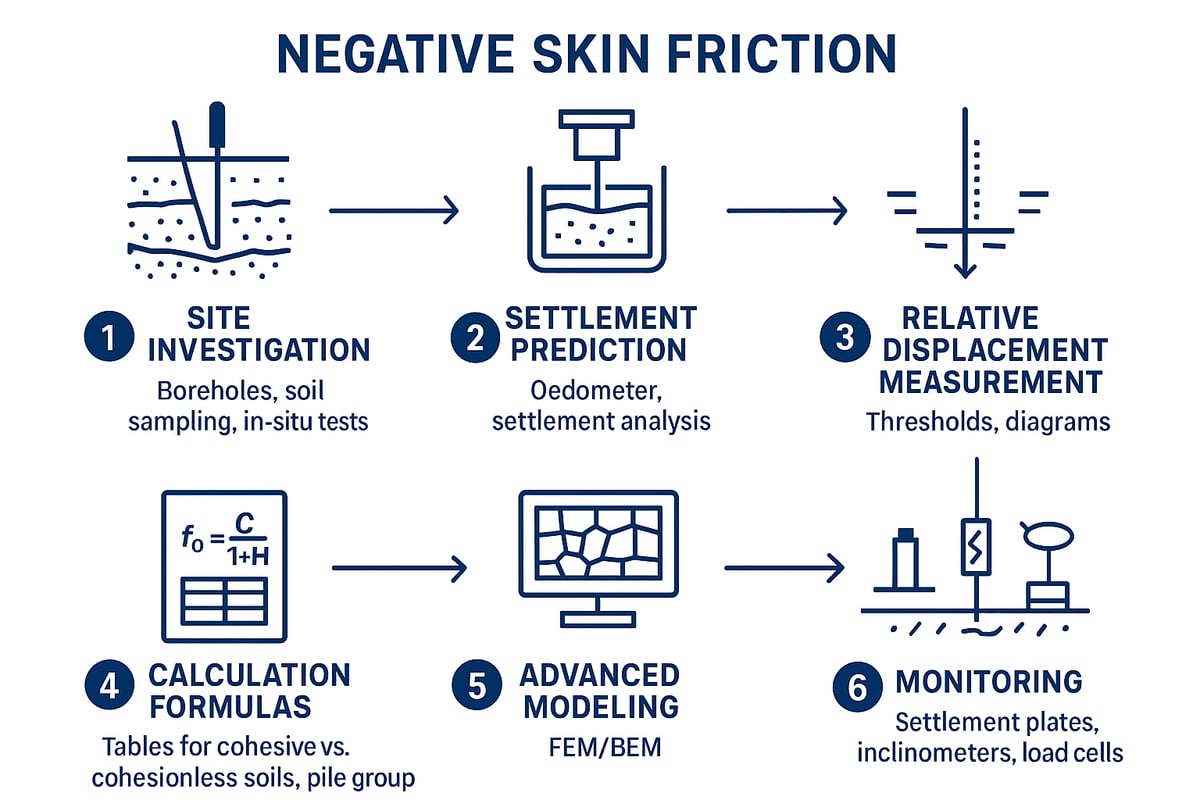
A precise understanding of negative skin friction is vital for safe foundation design. Identifying and quantifying this phenomenon requires a combination of field investigation, analytical calculations, and ongoing monitoring. Let’s break down the process step by step.
Site Investigation and Soil Profiling
A thorough geotechnical investigation is the foundation of any negative skin friction assessment. Engineers begin by drilling boreholes, collecting soil samples, and mapping compressible layers. Identifying zones prone to settlement, such as soft clays or organic soils, is crucial.
Field and laboratory tests, including standard penetration tests, cone penetration tests, and oedometer tests, provide data on soil strength and compressibility. Understanding groundwater conditions is equally important, as changes in water table levels can trigger negative skin friction. For more on field techniques, see In-situ geotechnical testing methods.
Predicting Soil Settlement
Accurately predicting soil settlement is a core step in evaluating negative skin friction. Settlement analysis uses data from laboratory consolidation tests, like the oedometer, to estimate primary and secondary compression in compressible strata.
Engineers calculate expected settlement due to new loads, such as fill placement or surcharge. Analytical models and empirical correlations help forecast how much the soil will move over time. This prediction is essential for determining the onset and magnitude of negative skin friction effects on foundations.
Determining Relative Displacement
Negative skin friction fully develops when the soil settles relative to the pile by a threshold amount, often as little as 10mm. Engineers must compute the differential movement between soil and pile to assess risk.
This involves comparing predicted soil settlement with expected pile movement. If the soil moves downward more than the pile, negative skin friction acts along the shaft above the neutral plane. Identifying the neutral plane, where pile and soil move together, is a key part of the assessment.
Calculation Formulas and Approaches
Calculating negative skin friction involves applying distinct formulas for different soil types. For cohesive soils, the downdrag force (Fn) is often found with:
Fn = P × Lc × ca
with ca = α × cu
where P is pile perimeter, Lc is the length in compressible soil, α is adhesion factor, and cu is undrained shear strength.
For cohesionless soils:
Fn = 0.5 × P × Lc² × γ × k × tan(δ)
where γ is unit weight, k is lateral earth pressure coefficient, and δ is friction angle.
Pile groups require group perimeter or area-based formulas for accuracy. Example calculations ensure safe pile design under negative skin friction conditions.
Advanced Modeling Techniques
Complex projects may demand advanced modeling to capture negative skin friction behavior. Engineers use numerical methods like finite element or boundary element modeling to simulate soil-pile interaction under varying conditions.
Simulation tools provide insight into stress distribution, settlement, and downdrag over time. These models can incorporate site-specific data, nonlinear soil behavior, and staged construction effects. Modern software allows for robust scenario testing, refining the assessment of negative skin friction risks.
Monitoring and Field Verification
After construction, verifying predictions of negative skin friction is essential. Instrumentation such as settlement plates, inclinometers, and load cells track real-time movements and loads on piles.
Continuous monitoring reveals if settlement rates match forecasts or if unexpected downdrag develops. Field data enables timely intervention and adjustment of maintenance plans. This proactive approach ensures long-term foundation performance and safety.
Solutions and Mitigation Strategies for Negative Skin Friction
Mitigating negative skin friction is essential for ensuring the long-term performance and safety of deep foundation systems. Engineers have developed a range of strategies to minimize the risks associated with this phenomenon. The following solutions address both the root causes and practical challenges of negative skin friction in modern construction.
Foundation Design Adaptations
One of the most effective ways to combat negative skin friction is through thoughtful foundation design. By extending pile length, engineers can ensure piles reach stable, non-compressible layers beneath problematic soils. This method minimizes the exposure of the pile shaft to settling soils.
Switching from friction piles to end-bearing piles is another key adaptation. End-bearing piles transfer loads directly to strong strata, bypassing compressible zones where negative skin friction develops. In some cases, engineers may opt for larger diameter piles or pile groups to distribute loads more effectively.
Designing with negative skin friction in mind ensures that foundations can safely accommodate additional downdrag forces. Careful selection of pile type and length can significantly reduce the potential for excessive settlement or structural distress.
Surface Treatments and Barriers
Surface treatments are widely used to mitigate negative skin friction along the pile shaft. Low-friction coatings such as bitumen or specialized paints create a slippery interface, reducing the drag forces from settling soil. Alternatively, sleeves made from plastic or steel can be installed over compressible layers to physically separate the pile from the surrounding ground.
Engineers must balance the extent of coverage. Partial coverage targets only the most problematic zones, while full coverage offers maximum protection but may reduce beneficial shaft resistance in stable soils. Selecting the appropriate surface treatment depends on site-specific conditions and the severity of negative skin friction risk.
Ground Improvement Techniques
Improving the ground before pile installation is a proven way to address negative skin friction at its source. Techniques such as preloading and surcharging accelerate the consolidation of soft soils, reducing post-construction settlement. Wick drains and deep soil mixing further enhance soil properties, enabling faster dissipation of excess pore water pressure.
A successful example is the use of vertical drains in soft clay to expedite consolidation and minimize long-term downdrag. For more details on these methods, explore Soil stabilization and ground improvement.
These strategies not only limit negative skin friction but also improve overall soil stability, making them essential for challenging sites.
Load Management and Structural Solutions
Accounting for negative skin friction in structural design is critical. Engineers must include anticipated downdrag forces in load calculations, ensuring that piles and pile caps are strong enough to handle increased demands. Using high-strength materials or composite piles can provide additional safety margins.
Pile groups and compressible inclusions, such as geofoam or engineered fill, can help accommodate soil movement and reduce differential settlement. By distributing loads and allowing controlled deformation, these solutions protect against the adverse effects of negative skin friction.
Proactive load management leads to more resilient foundation systems and extends the lifespan of critical infrastructure.
Construction Sequencing and Site Management
Proper sequencing of construction activities can significantly reduce the risk of negative skin friction. Staged loading, where fill or structures are added incrementally, allows time for soil consolidation between phases. This approach helps limit sudden settlement that could otherwise trigger negative skin friction.
Coordinating with adjacent projects is also vital. Activities such as deep excavations, dewatering, or pile driving on neighboring sites can influence ground behavior and increase the risk of downdrag. Effective site management includes monitoring nearby works and scheduling foundation installation at optimal times.
A strategic approach to construction sequencing is essential for minimizing long-term settlement and negative skin friction.
Monitoring and Maintenance Programs
Continuous monitoring is a cornerstone of managing negative skin friction risks. Installing settlement plates, inclinometers, and load cells allows engineers to track foundation performance in real time. Early detection of excessive settlement or unexpected downdrag enables timely intervention.
Establishing a maintenance program ensures ongoing site stability. Regular inspections and adaptive management strategies help address changes in soil conditions or unforeseen events. Monitoring not only verifies the success of mitigation measures but also safeguards the structure throughout its service life.
A robust monitoring and maintenance plan is indispensable for sites susceptible to negative skin friction.
Real-World Examples and Case Studies
Real-world projects provide essential insight into how negative skin friction can impact foundation performance. By examining a range of case studies, engineers and developers gain a deeper understanding of the practical challenges and effective mitigation strategies when dealing with negative skin friction.
Urban Redevelopment and Downdrag
Urban redevelopment projects on reclaimed land frequently encounter negative skin friction. When new fill is placed over compressible soils, the added load causes the underlying soil to settle. As a result, piles supporting buildings experience downdrag, increasing axial loads and risking overstress.
A prime example is the construction of high-rise buildings in city centers where old industrial zones are converted for new use. In these cases, measured settlements of 15 mm or more have been recorded, leading to significant negative skin friction loads. Experimental research, such as the Experimental Study on Negative Skin Friction of Piles in Collapsible Loess, has demonstrated how soil type and fill placement can accelerate the development of negative skin friction, guiding engineers toward more resilient designs.
Infrastructure Upgrades and Embankment Effects
Infrastructure improvements, such as highway widening or bridge expansion, often require new embankments that increase ground pressure. When these embankments are constructed near existing pile-supported structures, the underlying soil consolidates, triggering negative skin friction on the piles.
A notable case involved a major bridge where embankment loading during highway expansion induced additional settlement. This resulted in increased compressive forces on the pile shafts, highlighting the need for careful prediction and monitoring of negative skin friction during infrastructure upgrades. Engineers addressed the challenge by installing instrumentation to track settlement, allowing timely adjustments to construction sequencing and pile design.
Groundwater Drawdown and Its Consequences
Groundwater management is another critical factor influencing negative skin friction. Dewatering for deep basement excavations can lower the groundwater table, causing effective stress in the soil to rise and leading to consolidation settlement.
In one urban project, aggressive dewatering for a multi-level basement caused adjacent pile foundations to experience unexpected negative skin friction. The resulting settlement and increased shaft loads necessitated immediate mitigation, including ground improvement and enhanced monitoring. This example underscores the importance of anticipating groundwater table changes and their impact on negative skin friction in urban construction.
Seismic Events and Differential Settlement
Seismic activity can dramatically affect soil behavior, leading to differential settlement and negative skin friction. During earthquakes, lateral spreading and ground movement can cause compressible soil layers to settle unevenly around piles.
A well-documented incident occurred in a riverbank area where seismic shaking resulted in rapid settlement of soft clay, imposing negative skin friction on bridge piles. The outcome included uneven structural movement and serviceability concerns. This case emphasizes the need for seismic hazard assessment and pile design that accounts for the effects of negative skin friction, especially in regions with high seismic risk.
Lessons from Failures and Successes
Lessons learned from both failures and successful mitigation efforts shape current best practices for managing negative skin friction. In some projects, underestimating negative skin friction led to unacceptable settlements, foundation tilting, and costly remediation.
Conversely, projects that implemented thorough site investigations, predictive modeling, and real-time monitoring achieved long-term stability. Advanced analysis methods, including numerical modeling and field validation, are now standard for high-risk sites. These lessons reinforce that proactive planning and adaptive management are crucial for addressing negative skin friction and ensuring the safety and durability of deep foundations.
Frequently Asked Questions on Negative Skin Friction
What is negative skin friction?
Negative skin friction is a downward force acting on pile foundations when surrounding soil settles more than the pile itself. This can increase structural load and reduce foundation capacity.
What causes negative skin friction and how does it affect piles?
It results from soil consolidation, fill placement, groundwater changes, or seismic events. These conditions can lead to extra compressive forces on piles, requiring careful design and assessment.
How can negative skin friction be reduced?
Engineers use ground improvement, pile coatings, and proper foundation design to limit negative skin friction. Analytical and computational methods, such as BEM and FEM approaches, help predict and address its impact.
Is negative skin friction ever beneficial?
Generally, it is not desirable, as it adds stress to foundations. However, understanding its behavior can lead to safer and more efficient designs.
How long does negative skin friction persist after construction?
It typically lasts until soil settlement stabilizes, which can take months or years depending on site conditions and soil type. Following 2026 standards ensures best practices are met.
Now that you have a clear understanding of what negative skin friction is, why it matters, and how to address it, you might be considering the next step for your own foundation projects. Whether you are planning a new build, managing an upgrade, or facing challenging soil conditions, getting expert insight can make all the difference. At ZALIG Consulting Ltd, we combine deep geotechnical expertise with practical, Alberta-based experience to help you navigate even the most complex foundation concerns. If you’re ready to discuss your site’s unique needs or want tailored solutions, Contact Us: info@zalig.ca or +1-800-515-0497.