

Construction projects require rigorous quality control measures to ensure safety, durability, and regulatory compliance. A materials testing laboratory serves as the backbone of quality assurance throughout the construction lifecycle, verifying that concrete, asphalt, aggregates, and other construction materials meet engineering specifications and industry standards. Whether you're developing civil infrastructure, commercial buildings, or transportation networks, laboratory testing provides the defensible data needed to manage risk, support design assumptions, and deliver long-term performance. Understanding the role, capabilities, and accreditation requirements of testing laboratories helps project stakeholders make informed decisions from design through commissioning.
The Role of Materials Testing in Construction Quality Control
Construction materials must perform under specific loads, environmental conditions, and service lives. A materials testing laboratory evaluates physical, mechanical, and chemical properties to verify compliance with project specifications and building codes. This independent verification protects owners, contractors, and engineers from costly failures while ensuring public safety.
Testing begins during design when engineers establish performance criteria based on anticipated loads and environmental factors. Laboratory analysis of proposed materials confirms their suitability before construction begins. During construction, ongoing field sampling and laboratory testing verify that materials delivered to site match approved specifications. This continuous quality assurance process catches deficiencies early when corrections cost less than post-construction remediation.
Field Services Integration
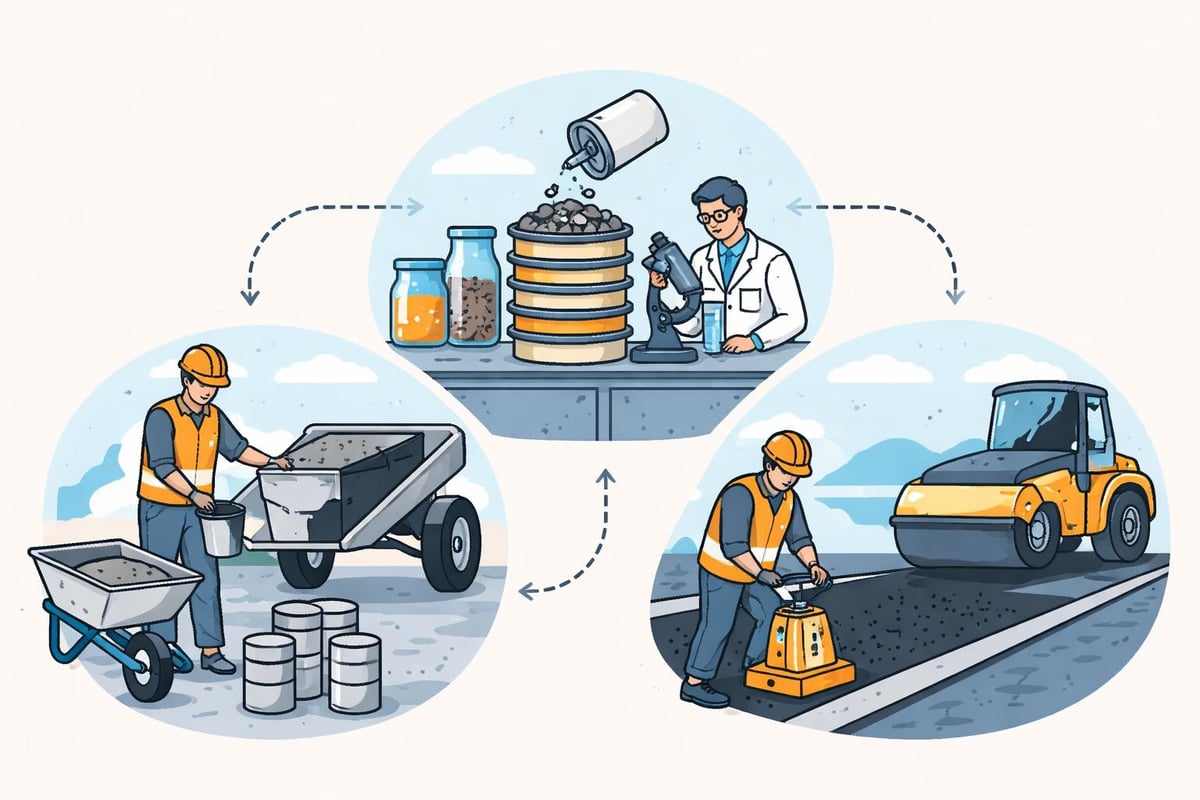
Modern materials testing integrates field and laboratory services into a seamless quality management system. Field technicians collect representative samples using standardized protocols that preserve material properties during transport. They also conduct on-site testing for parameters like concrete slump, air content, and asphalt temperature that must be measured immediately after placement.
The connection between field and laboratory operations determines data quality. Proper sample handling, labeling, and chain-of-custody procedures ensure test results accurately represent installed materials. Many laboratories now use digital platforms that link field collection data with laboratory test results, providing real-time quality dashboards for project teams.
Laboratory Accreditation and Standards Compliance
Accreditation demonstrates that a materials testing laboratory operates according to recognized quality management systems. In Canada, the Canadian Construction Innovations Lab (CCIL) provides accreditation for construction materials testing laboratories, ensuring they meet ISO/IEC 17025 requirements for competence, impartiality, and consistent operation.
Accredited laboratories must maintain documented procedures for every test method, calibrate equipment regularly, train personnel systematically, and participate in proficiency testing programs. These requirements create confidence that test results are accurate, reproducible, and defensible for regulatory approvals or dispute resolution. The National Institute of Standards and Technology outlines technical requirements that align with federal standards for construction materials testing accreditation.
| Accreditation Element | Purpose | Verification Method |
|---|---|---|
| Quality Management System | Ensure consistent procedures | Annual audits |
| Equipment Calibration | Maintain measurement accuracy | Scheduled calibration against traceable standards |
| Personnel Competency | Verify technician skills | Training records and proficiency testing |
| Method Validation | Confirm test procedure accuracy | Comparison with reference materials |
International Standards Organizations
Materials testing relies on standardized test methods published by organizations like ASTM International, CSA Group, and AASHTO. These consensus standards define sample preparation, test procedures, calculation methods, and reporting formats. Using recognized standards ensures that test results can be compared across projects and laboratories.
Engineers specify which standards apply to their projects based on jurisdictional requirements and project-specific needs. A materials testing laboratory must maintain current versions of relevant standards and train personnel in their proper application. Many standards are updated periodically to reflect improved testing technology or material innovations.
Core Testing Services for Construction Materials
Construction materials testing encompasses multiple material categories, each requiring specialized equipment and expertise. The breadth of testing services determines how effectively a laboratory can support diverse project types.
Concrete Testing and Quality Assurance
Concrete represents the most commonly tested construction material. Laboratory services include compressive strength testing of field-cured cylinders, which verifies that concrete achieves design strength at specified ages. Additional tests evaluate concrete workability, air content for freeze-thaw resistance, and chloride penetration resistance for durability.
ZALIG provides CCIL-certified construction materials testing for civil, transportation, and industrial projects, including concrete sampling and strength testing that ensures compliance with CSA, ASTM, and AASHTO standards. Our field and laboratory teams deliver defensible results that manage construction risk and support long-term structural performance.
Mix design verification represents another critical concrete service. Before construction, laboratories test proposed concrete mixes to confirm they meet strength, durability, and workability requirements. This pre-qualification process reduces the risk of field failures and supports value engineering opportunities.
- Cylinder strength testing at 7, 14, and 28 days
- Air content analysis for freeze-thaw durability
- Slump and workability measurements
- Chloride permeability testing for corrosion resistance
- Petrographic examination for failure analysis
Aggregate Testing and Characterization
Aggregates form the structural backbone of concrete and asphalt mixes, making their quality essential to overall performance. A materials testing laboratory evaluates gradation, which affects workability and void content, as well as durability properties like freeze-thaw resistance and abrasion resistance.
Source approval testing ensures aggregate sources produce materials meeting project specifications consistently. This involves comprehensive testing of physical properties, deleterious substances, and reactivity potential. Ongoing production testing verifies continued compliance throughout material extraction and processing.
Asphalt Testing and Performance Verification
Asphalt pavements require testing at multiple stages from mix design through construction. Laboratory services include binder testing to verify grade and performance properties, mix design optimization for specific traffic and climate conditions, and field sample analysis to confirm installed materials match design specifications.
Density testing represents a critical field measurement that connects directly to laboratory analysis. Core samples extracted from completed pavement undergo laboratory density testing to verify compaction meets specifications. This relationship between in-situ testing and laboratory verification ensures pavement durability.
Specialized Testing Capabilities
Beyond routine construction materials, many projects require specialized testing for unique materials or conditions. A full-service materials testing laboratory maintains equipment and expertise for these less common but equally important analyses.
Soil and Geotechnical Testing
Soil properties govern foundation design, earthwork specifications, and pavement subgrade requirements. Laboratory testing determines grain size distribution, moisture-density relationships, shear strength parameters, and consolidation characteristics. These properties inform geotechnical engineering recommendations for foundations, slopes, and earth structures.
Classification testing identifies soil types using unified soil classification or AASHTO systems. Engineering property testing then quantifies behavior under loading conditions. Common tests include:
- Proctor compaction testing to establish optimum moisture and maximum density
- California Bearing Ratio (CBR) for pavement subgrade evaluation
- Direct shear or triaxial testing for strength parameters
- Consolidation testing for settlement prediction
- Permeability testing for drainage design
Environmental and Chemical Analysis
Construction projects involving contaminated sites or waste materials require chemical testing capabilities. Laboratories analyze soil and water samples for metals, hydrocarbons, and other contaminants to support environmental site assessments and remediation verification. Understanding materials testing systems in regulated environments helps ensure compliance with environmental standards.
Material composition analysis identifies constituent materials in concrete, asphalt, or other composites. This forensic capability supports failure investigations, dispute resolution, and quality verification when documentation is missing or questionable.

Quality Management and Data Integrity
Laboratory operations depend on robust quality management systems that ensure accurate, reproducible results. Every aspect of testing from sample receipt through report delivery must follow documented procedures that maintain data integrity.
Sample Management and Chain of Custody
Proper sample handling begins with unique identification at collection and continues through testing and disposal. Laboratories use barcode systems or database platforms that track sample location, testing status, and technician assignments. This traceability supports audits and provides confidence in result authenticity.
Storage conditions must preserve sample properties until testing occurs. Temperature-sensitive materials require controlled environments, while moisture-sensitive samples need sealed containers. Chain-of-custody documentation proves samples weren't compromised between collection and testing.
Equipment Calibration and Maintenance
Testing equipment must maintain accuracy through regular calibration against traceable standards. Compression machines require annual calibration with certified load cells, balances need weekly verification with certified masses, and thermometers require calibration against NIST-traceable references.
| Equipment Type | Calibration Frequency | Traceable Standard |
|---|---|---|
| Compression Machines | Annual | NIST-certified load cell |
| Analytical Balances | Weekly | Certified mass set |
| Thermometers | Semi-annual | NIST-traceable thermometer |
| Sieves | Annual | Certified reference sieves |
Preventive maintenance schedules ensure equipment remains operational and accurate. Documentation of calibration results, maintenance activities, and equipment repairs creates an audit trail supporting quality assurance.
Leveraging Laboratory Data for Project Success
Test results become valuable only when properly interpreted and applied to project decisions. A materials testing laboratory serves as a technical resource beyond just generating numbers.
Real-Time Quality Dashboards
Modern laboratories provide web-based portals where project teams access test results immediately upon completion. These platforms often include visual dashboards showing compliance trends, non-conformance alerts, and statistical summaries. Early identification of quality issues allows corrective action before problems compound.
Statistical process control charts help identify trends before materials fall outside specification limits. This proactive approach improves quality outcomes compared to reactive responses after failures occur.
Technical Support and Problem Solving
Experienced laboratory personnel offer interpretation assistance when results are unusual or borderline. They can recommend additional testing to clarify marginal results or suggest material modifications to achieve compliance. This collaborative problem-solving approach adds value beyond routine testing services, particularly when projects encounter unexpected conditions or non-standard materials. Resources like ScienceDirect’s materials testing overview provide additional context for laboratory capabilities and best practices.
Selecting a Materials Testing Laboratory Partner
Choosing the right laboratory impacts project quality, schedule, and risk management. Several factors distinguish laboratories beyond basic accreditation and equipment capabilities.
Geographic Coverage and Responsiveness
Laboratories with field staff near project sites provide faster sampling response and reduced transportation time for time-sensitive materials. This proximity becomes critical for concrete testing where cylinders must reach the laboratory within specific timeframes. Multiple locations also support clients with projects across broad geographic areas.
Turnaround time commitments matter when test results drive construction sequencing. Some projects require 24-hour strength test results to maintain paving schedules, while others can tolerate standard reporting timelines. Understanding laboratory capacity and priority service options helps align testing with construction schedules.
Industry Experience and Project Understanding
Laboratories serving specific market sectors develop expertise in common challenges and requirements. Experience with transportation projects, for example, brings familiarity with municipal and state specifications, typical testing frequencies, and regulatory approval processes. This sector knowledge reduces miscommunication and anticipates client needs.
Personnel qualifications extend beyond certification to include practical problem-solving experience. Senior technicians and engineers who have worked in field construction understand the practical constraints affecting sampling and testing, leading to more realistic recommendations.
Integrated Service Offerings
Many engineering firms integrate materials testing with complementary services like geotechnical engineering, environmental assessment, and construction observation. This integration streamlines communication, reduces coordination overhead, and enables holistic problem-solving when issues span multiple disciplines. For complex projects involving soil stabilization or foundation design, coordinated geotechnical and materials testing services improve efficiency.
Regulatory Compliance and Documentation
Construction projects must satisfy building officials, regulatory agencies, and contract requirements through comprehensive testing documentation. A materials testing laboratory provides the evidence supporting regulatory approvals and contract compliance.
Building Code Requirements
Building codes specify minimum testing frequencies and acceptance criteria for various materials. Concrete structures typically require strength testing for each 50 to 150 cubic yards placed, depending on structural importance. Laboratory reports demonstrating compliance become part of the permanent building record required for occupancy permits.
Documentation must clearly identify the project, material location, sampling date, test date, and applicable specifications. Ambiguous or incomplete reports create approval delays and potential liability concerns.
Owner and Contractor Quality Programs
Many owners implement quality assurance programs requiring independent third-party testing. These programs specify testing frequencies, acceptance criteria, and reporting formats. Contractors also use laboratory services to verify supplier materials and support their internal quality control programs, creating distinct testing needs that laboratories must differentiate through sample identification and reporting.
Emerging Technologies in Materials Testing
Laboratory capabilities continue advancing through automation, digitization, and new testing methodologies. Staying current with these developments helps laboratories provide better service while maintaining competitiveness.
Automated Testing Systems
Robotic sample handling and automated test equipment reduce human error and increase throughput for high-volume testing. Compression machines with automatic sample loading, centering, and testing improve result reproducibility while freeing technicians for more complex analyses. Digital data capture eliminates transcription errors and accelerates reporting.
Non-Destructive Testing Integration
While traditional materials testing relies on destructive testing of samples, emerging non-destructive evaluation techniques complement laboratory services. Ground-penetrating radar, ultrasonic testing, and other field methods provide continuous quality assessment that supplements laboratory verification. The materials testing resources cataloged by various organizations show the breadth of available testing approaches and standards.
Advanced Material Characterization
New construction materials like ultra-high-performance concrete, warm-mix asphalt, and recycled content aggregates require testing methods beyond traditional standards. Laboratories investing in advanced characterization equipment can support innovative materials while helping clients achieve sustainability goals. This capability becomes increasingly important as the construction industry adopts circular economy principles and low-carbon materials.
Materials testing laboratories provide the independent verification and quality assurance that construction projects require to achieve performance, durability, and regulatory compliance objectives. By integrating field sampling, laboratory analysis, and technical interpretation, testing services transform raw data into actionable information that manages risk throughout project delivery. ZALIG Consulting Ltd combines CCIL-certified materials testing with geotechnical, environmental, and construction engineering services to support your projects from planning through commissioning. Our integrated approach delivers the practical, defensible solutions you need to navigate regulatory requirements, manage construction quality, and achieve long-term project success.