

Grain size analysis represents one of the most fundamental testing procedures in geotechnical engineering, materials science, and environmental consulting. This analytical technique determines the distribution of particle sizes within a soil, sediment, or aggregate sample, providing critical data that influences design decisions, regulatory compliance, and construction quality control. Understanding particle size distribution helps engineers classify soils, predict drainage characteristics, assess foundation behavior, and evaluate material suitability for specific applications. For multidisciplinary firms working across civil infrastructure and land development projects, grain size analysis serves as a cornerstone of both field investigation and laboratory testing programs.
Understanding Grain Size Distribution Fundamentals
Grain size analysis quantifies how particles of different sizes are distributed within a sample. The results are typically presented as a gradation curve plotting the percentage of material passing through progressively finer sieve sizes. This distribution curve reveals whether a soil is well-graded (containing a wide range of particle sizes) or poorly-graded (uniform size or gap-graded), which directly impacts engineering properties such as permeability, compressibility, and shear strength.
The classification of soil particles follows standardized size ranges. Gravel particles exceed 4.75 mm, sand ranges from 0.075 mm to 4.75 mm, silt spans 0.002 mm to 0.075 mm, and clay includes particles smaller than 0.002 mm. These divisions align with the Unified Soil Classification System (USCS) and other recognized frameworks used throughout North America.
Why Particle Distribution Matters
Soil behavior under load, water flow characteristics, and construction performance all depend heavily on grain size distribution. Coarse-grained soils with larger particles typically exhibit higher permeability and greater shear strength but may be more susceptible to settlement under load. Fine-grained soils containing significant silt and clay fractions often demonstrate lower permeability, higher compressibility, and sensitivity to moisture changes.
Engineers rely on grain size data to:
- Classify soils according to standardized systems
- Design drainage and filtration systems
- Evaluate foundation bearing capacity
- Assess slope stability conditions
- Specify compaction requirements
- Determine material suitability for embankments and fills

Laboratory Methods for Grain Size Analysis
Multiple testing methods exist for grain size analysis, each suited to specific particle size ranges and material types. The selection of appropriate methods depends on sample characteristics, project requirements, and applicable standards.
Sieve Analysis for Coarse Fractions
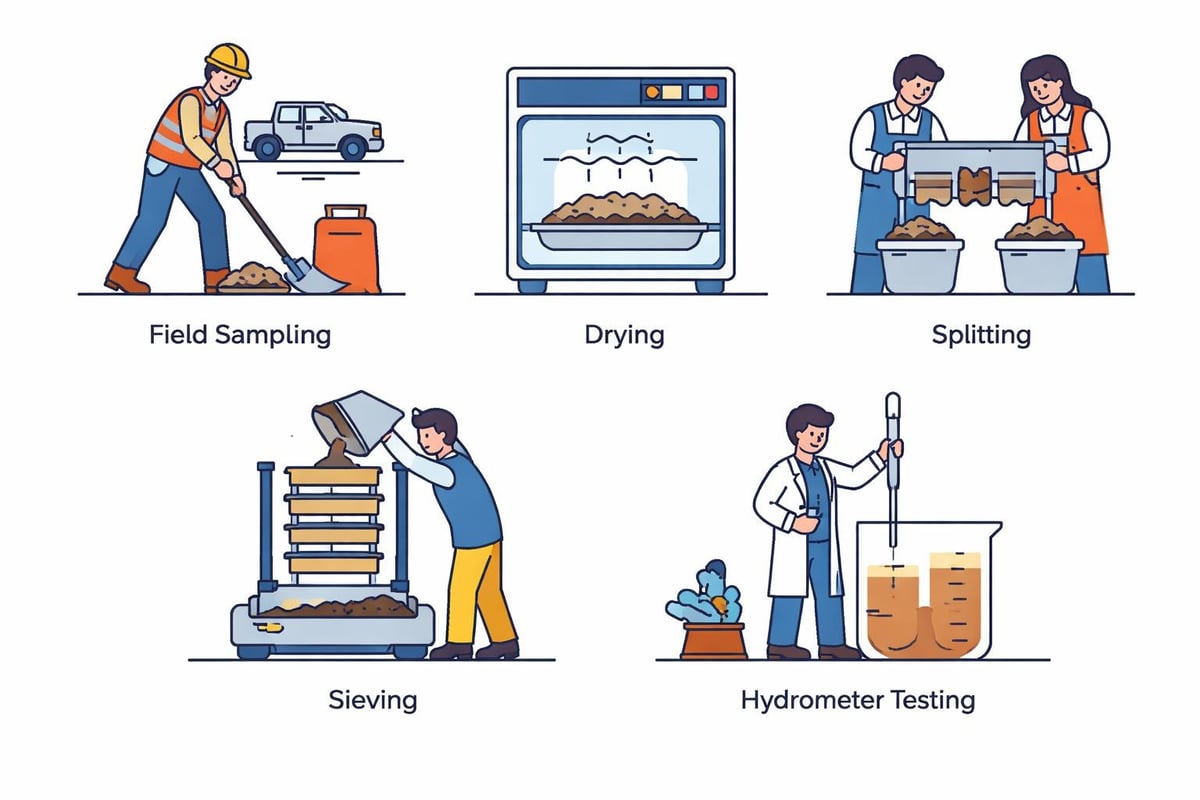
Sieve analysis represents the most common method for characterizing coarse-grained soils and aggregates. This mechanical separation technique uses a stack of sieves with progressively smaller openings. Standard sieve sizes in North America include 75 mm, 50 mm, 37.5 mm, 25 mm, 19 mm, 12.5 mm, 9.5 mm, 4.75 mm, 2.36 mm, 1.18 mm, 600 μm, 300 μm, 150 μm, and 75 μm.
The procedure involves:
- Drying the sample to constant mass
- Determining the initial sample mass
- Passing material through nested sieves using mechanical shaking
- Weighing the material retained on each sieve
- Calculating the percentage passing each sieve size
- Plotting the gradation curve
Wash sieve analysis combines mechanical sieving with water washing to separate fines from coarser particles. This variant proves particularly useful for soils containing both sand and significant fine fractions, ensuring accurate separation at the 75 μm threshold.
Hydrometer Analysis for Fine Particles
Hydrometer testing determines the size distribution of fine-grained particles smaller than 75 μm. This method applies Stokes' Law, which relates settling velocity to particle size in a suspension. As particles settle through a water column at rates proportional to their diameter, hydrometer readings at specific time intervals indicate the density of the remaining suspension.
The hydrometer procedure requires careful temperature control, proper dispersion of particles using chemical agents, and precise timing of measurements. Readings typically span from two minutes to 24 hours or longer, capturing the settling behavior of silt and clay fractions. The resulting data extends the grain size distribution curve into the fine particle range, completing the characterization of mixed soils.
| Method | Particle Size Range | Advantages | Limitations |
|---|---|---|---|
| Sieve Analysis | 75 μm to 100 mm | Direct measurement, simple, cost-effective | Limited to coarse fractions |
| Hydrometer | 0.001 mm to 0.075 mm | Extends into fine range, standardized | Time-consuming, assumes spherical particles |
| Laser Diffraction | 0.01 μm to 3 mm | Rapid, covers wide range, repeatable | Equipment cost, interpretation complexity |
| Pipette Method | 0.002 mm to 0.075 mm | High accuracy for clays | Labor-intensive, skilled technician required |
Advanced Techniques and Image Analysis
Laser diffraction technology offers rapid grain size analysis across a broad particle size spectrum. This optical method measures the angle and intensity of light scattered by particles suspended in liquid or air. Advanced algorithms convert scattering patterns into particle size distributions within minutes, providing detailed resolution and excellent repeatability.
Image analysis methods have gained prominence in metallurgical applications and increasingly appear in sedimentology studies. These techniques capture microscopic images of particles and use software algorithms to measure dimensions, calculate equivalent diameters, and generate size distributions. While powerful for certain applications, image analysis requires careful sample preparation and appropriate calibration to ensure accuracy.
Applications in Geotechnical Engineering Practice
Grain size analysis informs nearly every aspect of geotechnical investigation and design. When conducting subsurface exploration programs, engineers collect soil samples at various depths and locations to characterize site stratigraphy. Laboratory testing of these samples, including grain size analysis, establishes the foundation for classification, parameter selection, and design recommendations.
Foundation Design and Soil Classification
Understanding particle size distribution is essential for foundation engineering. Coarse-grained soils with favorable gradations typically provide excellent bearing capacity and minimal settlement, making them ideal for shallow foundations. Fine-grained soils require more detailed evaluation of consolidation characteristics and may necessitate deep foundation systems or ground improvement.
The advanced geotechnical laboratory testing performed by specialized firms includes grain size analysis as a fundamental component alongside Atterberg limits, moisture content, and density determinations. Together, these tests enable proper soil classification according to USCS or AASHTO systems, which guides subsequent design decisions.
Drainage and Permeability Assessment
Particle size directly controls soil permeability. Well-graded gravels and clean sands exhibit high hydraulic conductivity, while silts and clays demonstrate very low permeability. Engineers use grain size curves to estimate permeability coefficients, design subsurface drainage systems, and evaluate groundwater flow conditions.
Filter design depends critically on grain size compatibility between the filter material and the soil being protected. Properly designed filters prevent migration of fine particles while allowing water passage. The grain size distributions of both the base soil and filter material must satisfy specific criteria to ensure long-term performance. For projects requiring detailed permeability testing, grain size analysis provides the foundation for test method selection and results interpretation.

Construction Materials Testing Applications
Beyond geotechnical site characterization, grain size analysis plays a vital role in construction materials quality control. Aggregate testing for concrete and asphalt production relies heavily on gradation analysis to ensure mix designs meet specifications and achieve desired performance characteristics.
Aggregate Gradation Control
Concrete aggregate gradations influence workability, strength development, durability, and economy. Specifications typically require combined coarse and fine aggregate gradations to fall within prescribed limits. Regular gradation testing during production ensures consistency and allows adjustments before non-conforming material reaches the jobsite.
Key parameters derived from aggregate grain size analysis include:
- Fineness modulus (FM) for sand characterization
- Nominal maximum aggregate size
- Percent passing critical sieve sizes
- Gap-graded versus continuously-graded designation
- Conformance to specification bands
Asphalt mix design similarly depends on precise aggregate gradation control. The combined gradation of all aggregate sizes, including mineral filler, must be carefully balanced to achieve target air voids, stability, and durability. Construction materials testing programs incorporate frequent gradation analysis to maintain quality throughout production and placement operations.
Base and Subbase Evaluation
Roadway base and subbase materials require specific gradations to provide adequate load distribution, drainage, and resistance to frost action. Dense-graded granular materials typically perform best, with grain size distributions designed to maximize density and load-bearing capacity while maintaining sufficient permeability.
Quality assurance testing verifies that imported borrow materials and processed aggregates meet project specifications. Grain size analysis conducted during construction allows real-time adjustments and prevents costly rework or premature pavement failure.
Sediment Analysis and Environmental Applications
Grain size analysis serves important roles in sedimentology, environmental assessments, and contamination investigations. Particle size distribution provides insights into depositional environments, transport mechanisms, and contaminant mobility.
Environmental Site Assessment Integration
During Phase II Environmental Site Assessments, soil samples collected from test pits and boreholes undergo various analytical procedures. While chemical analysis identifies contaminants, grain size analysis helps characterize site geology, interpret stratigraphy, and assess contaminant migration potential. Fine-grained soils with high clay content may retard contaminant movement, while coarse sands and gravels facilitate rapid transport.
Understanding subsurface conditions through combined geological and geotechnical investigation supports effective remediation planning. Grain size data influences technology selection for soil vapor extraction, groundwater pump-and-treat systems, or excavation and disposal programs.
Sediment Transport and Deposition Studies
Hydrological and coastal projects require grain size analysis to understand sediment transport dynamics, erosion potential, and deposition patterns. The size distribution of bed material influences channel stability, scour susceptibility, and habitat quality in aquatic systems.
Research has demonstrated that measurement method selection and sample preparation procedures can significantly affect grain size results, particularly when comparing data from different sources or time periods. Consistency in methodology ensures reliable trend analysis and meaningful comparisons across sites or monitoring events.
Quality Control and Data Interpretation
Accurate grain size analysis demands rigorous quality control throughout sample collection, preparation, testing, and data reporting. Field sampling procedures must obtain representative materials that reflect in-situ conditions without segregation or contamination. Chain of custody protocols maintain sample integrity from field to laboratory.
Laboratory Standards and Procedures
North American laboratories conducting grain size analysis typically follow ASTM, AASHTO, or Canadian standards. Common specifications include:
- ASTM D422: Standard Test Method for Particle-Size Analysis of Soils
- ASTM D6913: Standard Test Methods for Particle-Size Distribution of Soils
- ASTM C136: Standard Test Method for Sieve Analysis of Fine and Coarse Aggregates
- AASHTO T88: Particle Size Analysis of Soils
- ASTM D7928: Standard Test Method for Particle-Size Distribution of Fine-Grained Soils by Laser Diffraction
Accredited laboratories maintain calibrated equipment, follow documented procedures, participate in proficiency testing programs, and employ qualified technicians. Regular calibration of balances, verification of sieve opening sizes, and hydrometer calibration checks ensure measurement accuracy.
Common Interpretation Challenges
Grain size data interpretation requires understanding of both testing limitations and soil behavior principles. Particle shape affects sieving results, as elongated or flat particles may pass or be retained differently than spherical particles of equivalent volume. Organic content can interfere with hydrometer measurements if not properly removed through pretreatment.
The transition between sieve and hydrometer methods at the 75 μm size sometimes produces discontinuities in the combined gradation curve. Experienced engineers recognize these artifacts and apply appropriate judgment when using results for design purposes. Additionally, grain size alone cannot fully characterize fine-grained soil behavior; Atterberg limits and other plasticity tests provide essential complementary information.
Integrating Results into Engineering Design
Effective use of grain size analysis requires integration with other site investigation data, regulatory requirements, and project-specific performance criteria. Engineering judgment connects laboratory measurements to field conditions and anticipated loading scenarios.
Parameter Selection for Analysis
Grain size distributions inform selection of design parameters for numerical modeling and analytical calculations. Permeability coefficients estimated from gradation curves guide groundwater flow analysis and drainage design. Friction angles for granular soils correlate with relative density and particle size distribution. Compaction specifications depend on maximum particle size and fines content.
For slope stability analysis, grain size data helps classify materials and select appropriate strength parameters. Coarse rockfill requires different analytical approaches than fine-grained embankment soils, with grain size analysis distinguishing these materials and supporting defensible parameter selection.
Specification Development
Construction specifications must clearly define gradation requirements, testing frequency, and acceptance criteria. Well-written specifications reference appropriate standards, establish meaningful control limits, and provide guidance for addressing non-conforming materials. Grain size requirements should align with performance objectives rather than imposing unnecessarily restrictive limits.
Quality assurance plans typically specify testing frequency based on material volume, production rate, and variability. Critical applications may require daily testing, while routine fill placement might involve weekly verification. The testing program should generate sufficient data to demonstrate compliance without imposing excessive costs or schedule delays.
Forensic Applications and Problem Investigation
When structures experience distress or construction materials fail to perform as expected, grain size analysis often contributes to forensic investigations. Forensic applications extend beyond typical engineering uses to include trace evidence analysis and source identification studies.
Construction Defect Investigation
Foundation settlement, pavement failure, or embankment instability investigations frequently include grain size analysis of existing materials. Comparing field conditions to original specifications may reveal substitutions, contamination, or segregation during placement. Settlement analysis requires accurate characterization of compressible layers, with grain size analysis distinguishing dense sands from loose silts.
Drainage system failures often stem from incompatible grain size distributions between soil and filter materials. Forensic investigation includes testing of both components to verify filter design criteria and identify mechanisms of clogging or piping failure. Recommendations for remediation depend on understanding the size relationships that contributed to the original problem.
Material Source Verification
When material quality issues arise, grain size testing can help trace aggregate sources or identify unauthorized substitutions. Each geological deposit exhibits characteristic gradation patterns reflecting depositional history and subsequent weathering. Statistical comparison of questionable materials against approved source samples may confirm or refute supply chain concerns.
Documentation from the original construction materials testing program establishes baseline data for comparison with later samples. Proper record retention enables meaningful forensic analysis years after project completion.
Emerging Technologies and Future Directions
Grain size analysis methodology continues evolving with advancing technology and increasing automation. Modern laser diffraction instruments provide rapid measurements with minimal operator intervention, though traditional sieve and hydrometer methods remain the reference standards for many applications. The U.S. Geological Survey has documented various analytical approaches and their comparative strengths.
Digital image analysis using automated particle recognition software shows promise for specialized applications. Optical granulometry techniques capture detailed particle shape information alongside size measurements, potentially improving correlation with field behavior.
Integration of grain size data with broader site characterization databases enables more sophisticated analysis and visualization. Geographic information systems (GIS) platforms can map particle size distributions across sites, revealing spatial patterns and supporting interpolation between investigation points. Three-dimensional geological modeling incorporates grain size data as key attributes defining subsurface units.
Machine learning algorithms are beginning to assist with grain size prediction based on other readily measured parameters. While not replacing direct testing, these tools may reduce testing requirements for routine projects or help identify anomalous conditions warranting detailed investigation.
Grain size analysis remains an indispensable tool for characterizing soils, sediments, and construction materials across diverse engineering applications. The combination of standardized testing methods, proper quality control, and experienced interpretation transforms raw particle size data into actionable engineering intelligence that supports safe, economical design and construction. Whether you need comprehensive geotechnical investigation, construction materials testing, or environmental site characterization, ZALIG Consulting Ltd delivers accredited laboratory services integrated with field expertise and engineering analysis to support your project from initial investigation through successful completion.