
Geotechnical solutions are at the core of building safe, sustainable, and resilient infrastructure for 2026 and beyond. With the global geotechnical engineering market expected to see significant growth, the right approach can make the difference between project success and costly setbacks.
This guide provides actionable insights from industry experts and the latest strategies to tackle the most urgent geotechnical challenges today. You will find up-to-date advice on emerging technologies, regulatory trends, practical methodologies, risk management, sustainability, and what the future holds.
Whether you are navigating rapid urbanization or adapting to climate change, discover practical geotechnical solutions and a clear path to project excellence.
The Evolving Landscape of Geotechnical Engineering in 2026
The landscape of geotechnical engineering is rapidly transforming. As we approach 2026, industry leaders are navigating a complex blend of market shifts, regulatory demands, and environmental challenges. The need for robust geotechnical solutions has never been greater.
Global and North American Market Trends
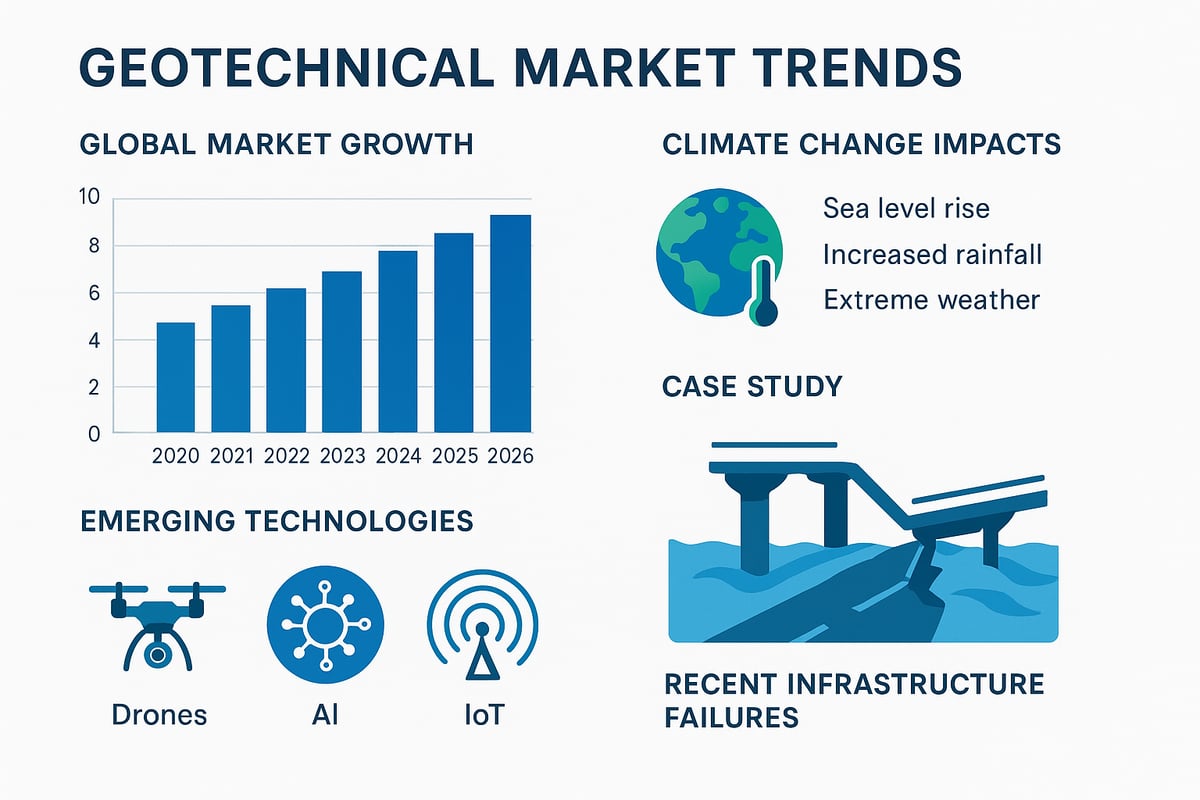
Geotechnical solutions are seeing significant growth worldwide. North America, in particular, is experiencing increased investment in infrastructure renewal and expansion. Urbanization, aging assets, and the demand for sustainable design are pushing the market forward. According to recent Geotechnical Engineering Market Trends 2026, the sector is projected to achieve steady annual growth, driven by both public and private investment.
A comparison of current and projected market data:
| Region | 2023 Market Value (USD Bn) | 2026 Projected Value (USD Bn) | Growth Rate (%) |
|---|---|---|---|
| North America | 13.2 | 16.8 | 9.1 |
| Europe | 10.5 | 13.0 | 7.4 |
| Asia-Pacific | 9.9 | 15.4 | 15.7 |
This growth underscores the increasing reliance on advanced geotechnical solutions for modern development.
Climate Change and Extreme Weather
Climate change is directly impacting soil stability and foundation integrity. Extreme weather events, such as heavy rainfall and flooding, are becoming more frequent and severe. These changes increase the risk of landslides, erosion, and ground subsidence.
Geotechnical solutions must now account for unpredictable site conditions. Engineers are adapting foundation design and slope stabilization methods to withstand these dynamic forces. This shift is leading to a greater emphasis on resilience and flexibility in every phase of project planning.
Advances in Site Investigation and Data Analysis
Emerging technologies are revolutionizing how geotechnical professionals conduct site investigations. Remote sensing, drones, and 3D modeling provide detailed subsurface data with unprecedented accuracy. Digital twins and predictive analytics allow for proactive risk identification and mitigation.
Real-time monitoring systems are now standard in many geotechnical solutions. These tools enable continuous assessment of ground movement, water levels, and settlement, reducing uncertainty and improving decision-making on complex sites.
Demand for Resilient Infrastructure
Urban and remote environments alike are demanding more resilient infrastructure. Population growth in cities and the expansion of critical facilities in remote areas require robust geotechnical solutions that can handle diverse soil and climate conditions.
In urban centers, engineers must address subsurface congestion and legacy site issues. In remote regions, logistical challenges and limited access drive innovation in modular foundation systems and ground improvement. The result is a broader application of adaptable, site-specific geotechnical solutions.
Regulatory Changes and Compliance
Regulatory frameworks for geotechnical engineering are evolving quickly. Governments are introducing stricter standards for environmental protection and public safety. Compliance now requires thorough documentation, advanced modeling, and transparent reporting practices.
Geotechnical solutions must align with both local and international standards. This includes integrating environmental impact assessments and lifecycle analysis from the earliest project stages. New regulations are also encouraging the adoption of sustainable materials and construction practices.
Integration of Environmental and Geotechnical Considerations
Project planning now demands a holistic view of environmental and geotechnical factors. Engineers are working closely with environmental scientists to evaluate the long-term impacts of development on soil health, groundwater, and ecosystems.
This integrated approach leads to more sustainable geotechnical solutions. For example, using recycled materials in embankment construction or implementing green infrastructure to manage stormwater reduces both environmental impact and lifecycle costs.
Learning from Infrastructure Failures
Recent infrastructure failures have served as a wake-up call for the industry. High-profile incidents, such as dam collapses and bridge failures, have prompted a reevaluation of design standards and risk management practices.
Case studies reveal that early-stage geotechnical oversights often contribute to these failures. The industry is responding by implementing more rigorous site investigations, real-time monitoring, and contingency planning in all geotechnical solutions.
Growth Projections and Industry Outlook
The outlook for geotechnical solutions is strong. By 2026, the global market for geotechnical engineering services is expected to reach nearly $50 billion. This growth reflects the rising complexity of construction projects and the essential role of geotechnical expertise in delivering safe, resilient, and sustainable infrastructure.
As challenges evolve, so too will the strategies and technologies that define the future of geotechnical solutions.
Core Geotechnical Challenges and Solutions for Modern Projects
Modern infrastructure projects face complex ground conditions, regulatory shifts, and increasing performance demands. Addressing these realities requires robust geotechnical solutions that anticipate and mitigate risks from the outset. Below, we explore the most pressing challenges and the innovative approaches that define project success today.
Common Geotechnical Risks and Their Impacts
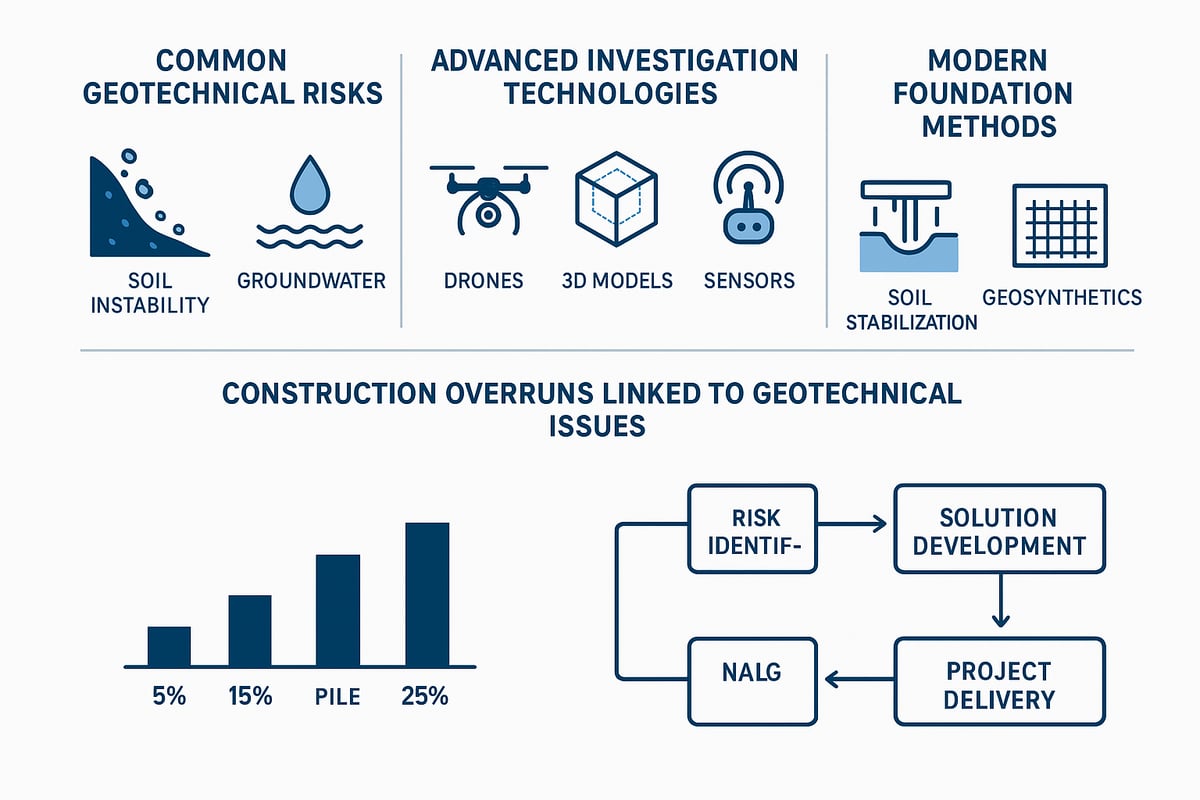
Every project begins with the ground beneath it, yet the earth poses a variety of risks. Among the most significant are soil instability, excessive settlement, and liquefaction, which can undermine structural integrity. Groundwater management is also critical, as fluctuating water tables often disrupt foundation works or cause unexpected delays.
Urbanization intensifies these risks by placing new loads and vibrations on previously undisturbed sites. In hilly or mountainous terrain, slope stability and landslide prevention become central concerns. High-profile project delays, such as those caused by undetected weak soils or unanticipated groundwater, highlight the cost of overlooking geotechnical solutions early on.
Consider this: Over 50% of construction cost overruns are directly linked to geotechnical issues. This number underscores the value of thorough site assessments and proactive design. By understanding these risks, project teams can better plan for success.
Innovative Solutions for Site Investigation and Analysis
Cutting-edge site investigation has transformed how teams approach geotechnical solutions. Remote sensing tools, including drones and satellite imagery, now offer detailed subsurface mapping before the first shovel breaks ground. 3D modeling and digital twins allow engineers to visualize soil layers and predict ground behavior with remarkable accuracy.
Advanced laboratory testing and in-situ methods provide data on soil strength, composition, and response to loading. Real-time monitoring systems, such as automated inclinometers and piezometers, track ground movement and water levels during construction. These technologies enable fast, data-driven decisions, reducing the likelihood of surprises.
A recent infrastructure project successfully applied 3D geotechnical modeling to identify a hidden layer of compressible clay, allowing for timely design adjustments. This case demonstrates how innovative geotechnical solutions can prevent costly setbacks and keep projects on track.
Ground Improvement and Foundation Technologies
Today's projects rely on advanced ground improvement and foundation technologies to overcome challenging soil conditions. Modern soil stabilization techniques, such as deep soil mixing and jet grouting, transform weak ground into a reliable base. Pile foundation advancements and modular systems offer additional flexibility for complex urban sites.
The use of geosynthetics and reinforced earth structures has expanded, delivering more sustainable and cost-effective geotechnical solutions, especially on brownfield or contaminated sites. Lifecycle costs are reduced when ground improvement is tailored to the specific soil and project needs.
For a detailed look at these techniques, see this comprehensive resource on Soil Stabilization and Ground Improvement. As a case in point, a recent urban high-rise project overcame soft ground by combining deep mixing with modular foundation elements, demonstrating how integrated geotechnical solutions drive innovation and resilience.
Integrating Sustainability and Resilience in Geotechnical Solutions
Sustainability and resilience are now central to modern geotechnical solutions. As infrastructure demands rise, professionals must deliver projects that respect environmental limits and withstand future uncertainties. This section explores how the industry is integrating eco-friendly practices, designing for long-term durability, and navigating evolving regulatory landscapes.
Sustainable Materials and Construction Practices
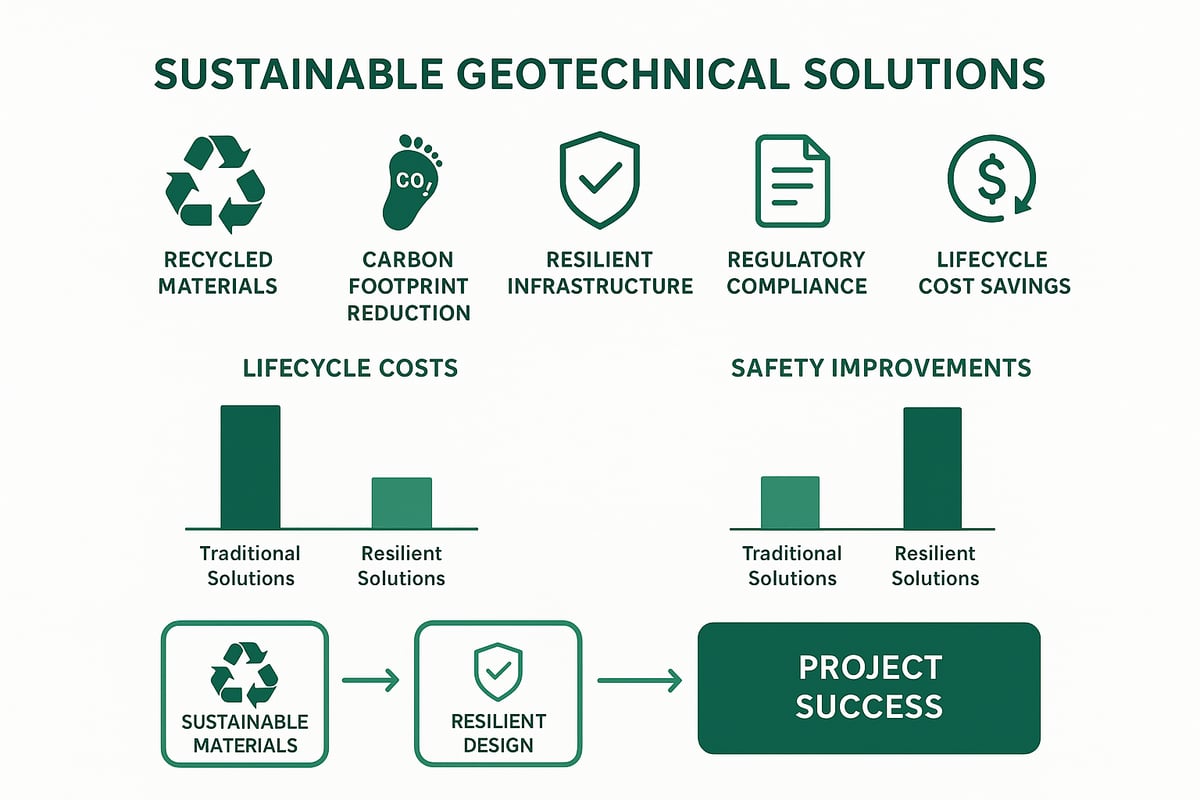
The use of sustainable materials is transforming geotechnical solutions. Engineers are increasingly turning to recycled aggregates, fly ash, and other eco-friendly alternatives to minimize environmental impact. These choices not only reduce the carbon footprint but also support the circular economy.
For example, using recycled aggregates in embankment stabilization lessens the demand for new resources and cuts transportation emissions. Lifecycle analysis is now standard practice for geotechnical structures, helping teams compare the long-term impacts of material choices.
Optimized design further enhances sustainability. By sourcing materials locally and minimizing waste, geotechnical solutions become more efficient and less resource-intensive. Innovations such as in-situ remediation, highlighted by systems like MP Cocoon®: In-Situ Soil Remediation Innovation, are enabling low-carbon approaches to challenging sites.
Key benefits of sustainable geotechnical solutions include:
- Lower overall project emissions
- Reduced reliance on virgin materials
- Enhanced social license for infrastructure projects
These practices are now essential for clients seeking both environmental responsibility and long-term value.
Designing for Long-Term Resilience
Resilience is a defining feature of advanced geotechnical solutions. Climate change and shifting hydrological patterns demand robust strategies that go beyond traditional design.
Modern geotechnical solutions incorporate redundancy and flexibility, ensuring structures can adapt to unforeseen events. This includes designing with safety margins, using adaptive materials, and planning for future monitoring.
Key strategies for long-term resilience:
- Incorporating real-time monitoring systems for early detection of ground movement or water level changes
- Scheduling proactive maintenance to extend the lifespan of geotechnical structures
- Using predictive modeling to assess and address potential risks
The impact is measurable. Data shows that investing in resilience can reduce lifecycle costs and prevent expensive failures. Geotechnical solutions built for adaptability are more likely to deliver safe, reliable performance over decades.
Regulatory and Environmental Compliance
Navigating complex regulations is a core part of delivering effective geotechnical solutions. Environmental standards are evolving rapidly, and compliance is non-negotiable for project success.
To meet these demands, teams prioritize thorough environmental impact assessments and integrate compliance into every phase of design and construction. Best practices include:
- Early engagement with regulatory agencies
- Transparent documentation of environmental mitigation
- Ongoing monitoring to verify performance
A recent project demonstrated that proactive compliance under new frameworks not only avoided delays but also improved public trust. Staying ahead of regulations ensures geotechnical solutions remain viable and respected in the marketplace.
Expert Insights: Best Practices for Project Success
Success in today's geotechnical solutions landscape depends on embracing best practices that blend technical expertise, collaboration, and innovation. By adopting proven strategies and leveraging advanced technologies, teams can navigate complex challenges while delivering safe, resilient infrastructure.
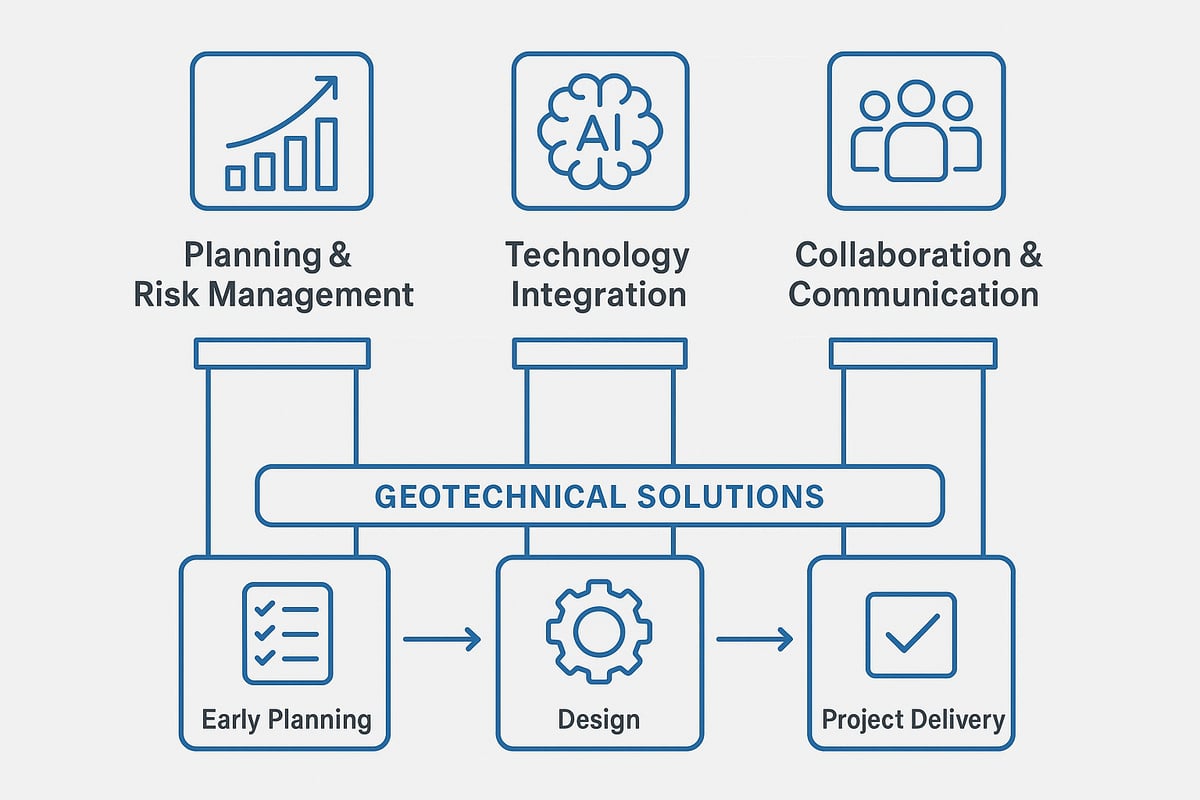
Effective Project Planning and Risk Management
Early and comprehensive planning is the cornerstone of successful geotechnical solutions. Involving geotechnical experts from the start reduces uncertainties, identifies risks, and paves the way for cost-effective outcomes.
Project teams should prioritize:
- Detailed site assessments and early-stage geotechnical investigation
- Collaborative risk identification sessions with all stakeholders
- Regular updates to risk registers and contingency plans
A robust risk management framework helps prevent delays and budget overruns. For instance, integrating geotechnical considerations into the design phase minimizes unforeseen soil or groundwater issues. According to industry data, projects with early geotechnical involvement experience up to 30% fewer delays related to subsurface conditions.
Collaboration between engineers, contractors, and regulatory bodies ensures all perspectives are accounted for. Leveraging comprehensive Geotechnical Engineering Services Overview can streamline planning, enhance communication, and increase project resilience. By embedding geotechnical solutions into every project phase, teams build a strong foundation for success.
Leveraging Technology for Smarter Solutions
Adopting the latest technologies is key to optimizing geotechnical solutions. Building Information Modeling (BIM) allows for seamless integration of geotechnical data with structural and civil models, improving accuracy and coordination.
Artificial intelligence and machine learning are revolutionizing soil behavior prediction, enabling teams to analyze vast datasets and forecast performance with greater precision. Tools like GeoSim.AI: AI Assistants in Geomechanics streamline numerical simulations, accelerating decision-making and reducing human error.
Key technology-driven practices include:
- Real-time monitoring systems for ground movement and water levels
- Digital collaboration platforms for cross-disciplinary teamwork
- Predictive modeling to assess risk and optimize design
The adoption of digital solutions has led to measurable efficiency gains in geotechnical projects, with some firms reporting a 20% reduction in design time. Integrating these innovations into geotechnical solutions ensures teams remain agile and responsive to evolving site conditions.
Collaboration and Communication Strategies
Effective communication is vital for delivering successful geotechnical solutions. Establishing clear channels between project teams, clients, and regulatory agencies helps align expectations and resolve issues swiftly.
Best practices for collaboration include:
- Regular project briefings and transparent reporting
- Ongoing training and upskilling to keep pace with industry advancements
- Participation in professional networks for knowledge sharing
Multi-disciplinary collaboration has proven essential for large-scale infrastructure projects. For example, when geotechnical engineers, structural designers, and environmental consultants work together, projects benefit from diverse perspectives and innovative problem-solving.
Investing in team development and fostering a culture of open communication supports the long-term success of geotechnical solutions. By prioritizing knowledge transfer and building strong partnerships, organizations position themselves to meet future challenges head-on.
Future-Ready Geotechnical Innovations and Industry Outlook
The future of geotechnical solutions is defined by rapid innovation and shifting industry priorities. As 2026 approaches, engineers and project leaders are embracing new technologies, market dynamics, and professional competencies to deliver safer, more resilient infrastructure.
Emerging Technologies Shaping the Field
Cutting-edge technologies are propelling geotechnical solutions into a new era of efficiency and precision. Robotics and automation are transforming site investigation, allowing for safer and faster data collection in challenging environments. Autonomous drilling rigs, for example, are being piloted to increase safety and minimize human error on complex sites.
IoT-enabled sensors now provide real-time monitoring of ground movement, moisture, and stress, giving project teams early warnings and actionable insights. These advances help prevent failures and reduce costly surprises during construction.
Smart materials, such as adaptive geosynthetics, respond to changing loads and environmental conditions. Digital twins and advanced modeling tools allow for virtual testing before breaking ground. For those seeking to stay at the forefront, Advanced Geotechnical Laboratory Testing offers a glimpse into how innovative laboratory methods are validating these new materials and designs.
By integrating these technologies, geotechnical solutions become more reliable, adaptable, and sustainable, addressing the demands of modern infrastructure projects.
Anticipated Market and Regulatory Shifts
The demand for geotechnical solutions is expanding across infrastructure, energy, and residential sectors. As cities grow and climate risks intensify, investments in resilient ground engineering are projected to rise steadily through 2026. Recent data shows that infrastructure commands the largest market share, but energy and residential development are quickly gaining ground.
Regulatory landscapes are also evolving. New environmental standards and construction codes require greater transparency and accountability in geotechnical practices. Project leaders must stay agile, adapting to updates in permitting, reporting, and environmental impact assessments.
Investment trends indicate increased funding for research and implementation of advanced geotechnical solutions. Public and private sectors are prioritizing projects that demonstrate resilience, sustainability, and compliance with the latest regulations.
The convergence of market growth and regulatory change means that forward-thinking organizations are better positioned to deliver successful outcomes and maintain a competitive edge.
Preparing for the Next Generation of Geotechnical Challenges
As the industry evolves, so do the skills required to deliver future-ready geotechnical solutions. Workforce development is a top priority, with a focus on upskilling in data analytics, automation, and sustainable design.
Diversity and multidisciplinary collaboration are essential, enabling teams to tackle increasingly complex challenges from multiple perspectives. Ongoing professional development, including certification and active participation in industry organizations, ensures that engineers remain adaptable and informed.
Looking ahead, geotechnical solutions will play a central role in advancing global sustainability and resilience, shaping the infrastructure of tomorrow.
As you look ahead to 2026 and consider the evolving demands of geotechnical engineering, it’s clear that success depends on staying informed and making strategic choices. We’ve explored emerging technologies, regulatory shifts, and practical solutions to help you build safer, more resilient projects across Alberta. If you’re ready to take the next step or have questions about tailoring these insights to your unique needs, let’s connect. You deserve guidance from a team that understands the nuances of both industry standards and local conditions. Reach out to us today at Contact Us info@zalig.ca or +1 800 515 0497—we’re here to help you build with confidence.