
Geotechnical services form the critical foundation for safe and economical infrastructure development across civil, commercial, industrial, and residential projects. These specialized engineering services evaluate subsurface conditions, assess soil and rock properties, and provide design recommendations that directly influence project feasibility, construction methods, and long-term structural performance. From high-rise buildings and transportation corridors to pipeline installations and environmental remediation sites, geotechnical engineering delivers the technical insight necessary to manage ground-related risks and optimize construction outcomes. Understanding the scope, methodologies, and applications of professional geotechnical services enables project owners, developers, and contractors to make informed decisions that protect investments and ensure regulatory compliance.
Understanding the Scope of Geotechnical Services
Geotechnical services encompass a broad range of field investigations, laboratory testing, engineering analysis, and design activities focused on understanding and managing soil, rock, and groundwater conditions. These services begin during the earliest planning stages and continue through construction completion and post-construction monitoring. The Canadian Geotechnical Society provides extensive resources that define professional standards and best practices across the discipline.
Site characterization represents the foundational element of geotechnical work. Engineers conduct subsurface explorations using drill rigs, excavators, and specialized sampling equipment to retrieve soil and rock specimens from various depths. These investigations reveal stratigraphy, groundwater levels, soil strength parameters, and potential geologic hazards such as expansive clays, collapsible soils, or organic deposits.
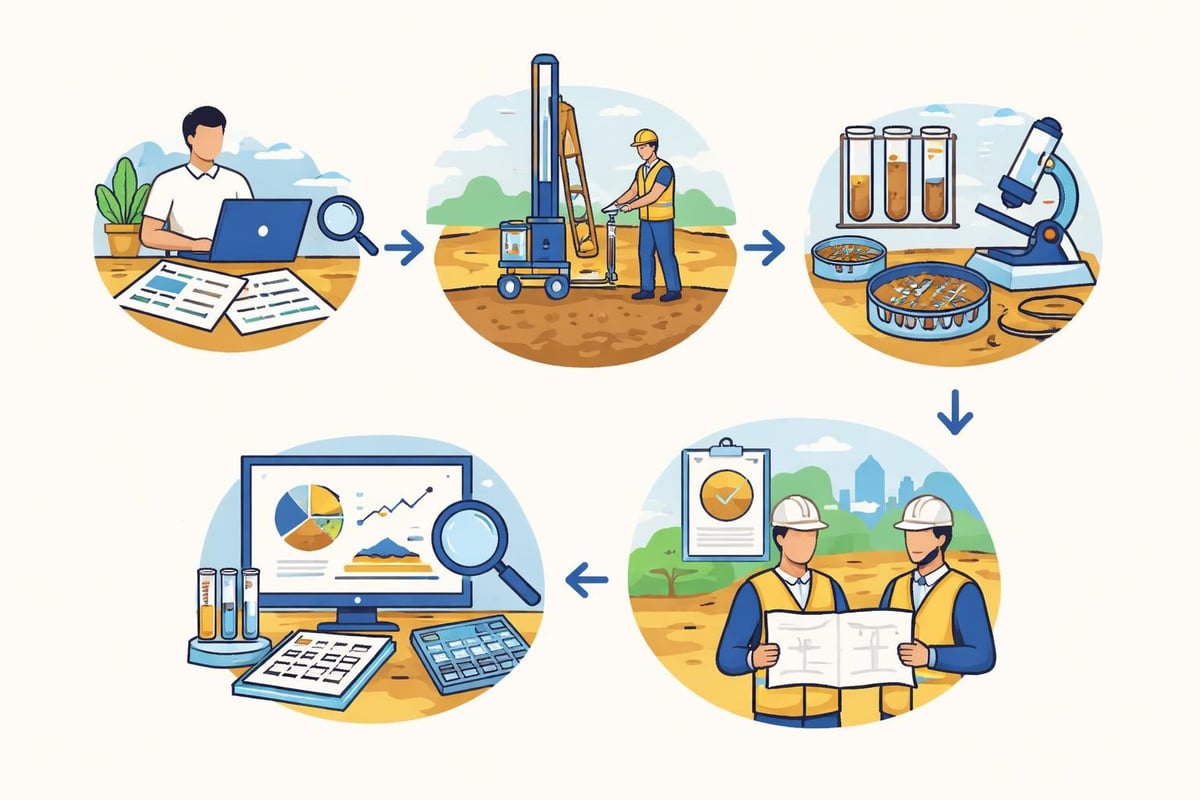
Laboratory testing programs support field investigations by quantifying physical and mechanical properties. Standard tests include grain size analysis, Atterberg limits, moisture content, unit weight, consolidation, and shear strength. Advanced testing such as permeability measurements, chemical analysis for corrosivity, and dynamic testing for seismic response provide additional data for specialized applications.
Field Investigation Techniques
Multiple exploration methods serve different project requirements and site conditions:
- Boreholes and test pits: Provide direct access to subsurface materials for visual classification and undisturbed sampling
- Standard Penetration Testing (SPT): Measures soil resistance and provides samples for classification
- Cone Penetration Testing (CPT): Delivers continuous subsurface profiling with electronic sensors
- Geophysical surveys: Non-invasive methods including seismic refraction and ground-penetrating radar
- Groundwater monitoring: Piezometers and observation wells track water levels and hydraulic gradients
Project-specific conditions dictate the investigation depth, spacing, and methodology. Dense urban sites may require noise-restricted equipment or limited-access drilling rigs, while remote locations demand self-sufficient mobilization strategies.
Foundation Design and Engineering Analysis
Following site characterization, geotechnical engineers develop foundation recommendations tailored to structural loads, subsurface conditions, and project constraints. Foundation design considers bearing capacity, settlement performance, lateral stability, and constructability. ZALIG’s geotechnical engineering services integrate field data with structural requirements to deliver optimized foundation solutions across diverse applications.
Engineers select foundation types based on soil stratigraphy, structural loading, and economic factors. Shallow foundations including strip footings, spread footings, and mat foundations suit competent near-surface soils. Deep foundations such as driven piles, drilled shafts, screw piles, and micropiles transfer loads through weak surface layers to stronger bearing strata or derive capacity through side friction.
| Foundation Type | Typical Application | Soil Condition | Load Range |
|---|---|---|---|
| Spread Footings | Low-rise buildings | Dense sand, firm clay | Light to moderate |
| Mat Foundations | Large structures | Weak surface soils | Heavy, uniform |
| Driven Piles | Bridges, towers | Deep competent layer | Heavy, concentrated |
| Screw Piles | Residential, light commercial | Variable conditions | Light to moderate |
| Drilled Shafts | High-rise, heavy industrial | Rock or dense soil | Very heavy |
Settlement analysis distinguishes between immediate elastic compression, primary consolidation, and secondary compression. Engineers calculate total and differential settlement magnitudes and compare predictions against structural tolerances. Time-dependent settlement in compressible soils requires staged construction or ground improvement interventions.
Lateral Earth Pressure and Retaining Structures
Geotechnical services address lateral earth pressure challenges through retaining wall design, shoring systems, and excavation support. Active, passive, and at-rest earth pressure coefficients depend on soil properties, wall movement, and groundwater conditions. Design considerations include:
- Wall type selection: Gravity walls, cantilever walls, mechanically stabilized earth (MSE), soil nail walls, or anchored systems
- Internal stability: Structural capacity of wall elements, connections, and reinforcement
- External stability: Sliding, overturning, bearing capacity, and global slope stability
- Drainage design: Relief of hydrostatic pressure through weep holes, drainage geocomposites, or relief wells
- Construction sequencing: Temporary support requirements and staged excavation protocols
Permanent retaining structures require long-term durability considerations including corrosion protection for metallic components and material specifications for freeze-thaw resistance in northern climates.
Slope Stability and Geohazard Assessment
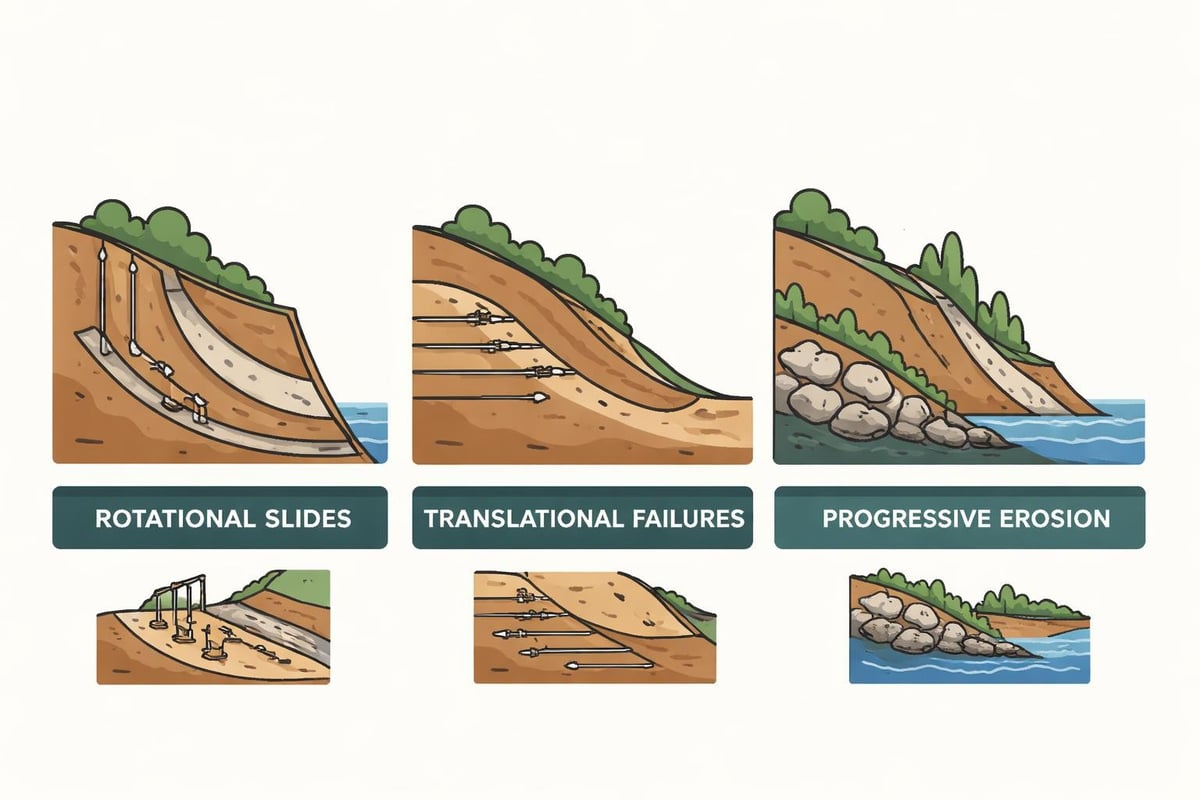
Geotechnical services evaluate natural and constructed slopes for stability under static and dynamic loading conditions. Slope failures result from adverse geology, groundwater pressure, external loading, weathering, or seismic activity. Engineers perform limit equilibrium analyses and numerical modeling to determine factors of safety and design stabilization measures.
Slope stabilization techniques address specific failure mechanisms. Surface erosion control employs vegetation, erosion blankets, or shotcrete. Deep-seated instability may require drainage improvements, buttress fills, soil nails, anchors, or structural elements. Monitoring programs using inclinometers, piezometers, and survey points track movements and validate performance.
Geohazard assessments identify risks from landslides, rockfall, debris flows, liquefaction, seismic ground motion, karst features, or mine subsidence. These evaluations inform land use planning, setback requirements, and risk mitigation strategies. The study “GeoMCP: A Trustworthy Framework for AI-Assisted Analytical Geotechnical Engineering” demonstrates how emerging technologies enhance analytical capabilities for complex geohazard scenarios.
Ground Improvement and Soil Stabilization
Ground improvement modifies unfavorable soil properties to enhance bearing capacity, reduce compressibility, increase shear strength, or improve permeability. Geotechnical services recommend improvement methods based on soil type, depth of treatment, required performance, and project economics. Soil stabilization and ground improvement techniques transform marginal sites into buildable land.
Common Ground Improvement Methods
Mechanical densification increases soil density through compaction, vibration, or dynamic loading:
- Vibratory rollers and tampers for shallow lifts
- Deep dynamic compaction for cohesionless soils
- Vibro-compaction and stone columns for granular deposits
- Rapid impact compaction for near-surface improvement
Chemical stabilization alters soil properties through additives:
- Lime treatment for clayey soils reduces plasticity and improves workability
- Cement stabilization creates cemented soil mass with higher strength
- Fly ash or slag amendments provide sustainable alternatives
- Polymer and chemical grouting fills voids and reduces permeability
Reinforcement systems introduce tensile elements into soil masses:
- Geosynthetic reinforcement in embankments and retaining structures
- Soil nailing for slope stabilization and excavation support
- Mechanically stabilized earth (MSE) systems for walls and abutments
Dewatering and drainage control groundwater to improve construction conditions and long-term stability. Wellpoints, deep wells, or horizontal drains lower water tables temporarily or permanently depending on project requirements.
Geotechnical Services for Transportation Infrastructure
Transportation projects demand specialized geotechnical services addressing pavement support, embankment stability, bridge foundations, and drainage management. Highway and railway corridors traverse varied terrain requiring site-specific solutions for cuts, fills, and grade separations.
Pavement design relies on subgrade characterization through California Bearing Ratio (CBR) testing, resilient modulus determination, and frost susceptibility evaluation. Poor subgrade conditions necessitate removal and replacement, chemical stabilization, or geosynthetic reinforcement. Understanding Eurocode 7’s geotechnical design principles provides internationally recognized standards applicable to many transportation projects.
Bridge foundations present unique challenges combining heavy vertical loads, lateral forces from traffic and seismic events, and scour potential at watercourse crossings. Specialized deep foundation piles support bridge piers and abutments where shallow foundations prove inadequate. Geotechnical investigations for bridges require detailed characterization at each substructure location with sufficient depth to define bearing strata and identify potential construction challenges.
Embankment design for roadways and railways considers internal stability, foundation support, and settlement performance. High embankments over soft ground may require staged construction with settlement monitoring, surcharging, or prefabricated vertical drains to accelerate consolidation. Side slope stability analysis ensures adequate factors of safety under static and seismic loading.
Environmental Geotechnical Considerations
Environmental geotechnical services integrate contamination assessment with traditional subsurface characterization. Projects involving brownfield redevelopment, industrial facility expansion, or waste management require coordinated investigation of both geotechnical properties and environmental quality.
Contaminated sites present additional design considerations:
- Soil vapor intrusion pathways requiring foundation vapor barriers
- Corrosive conditions affecting material selection for concrete and steel
- Groundwater contamination influencing dewatering discharge requirements
- Waste materials requiring specialized handling during excavation
- Regulatory requirements for cap systems over residual contamination
Geotechnical investigations on contaminated sites follow health and safety protocols for drilling personnel and incorporate environmental screening during field activities. Laboratory testing programs address both engineering properties and chemical constituents to support dual objectives.
Quality Assurance and Construction Oversight
Geotechnical services extend beyond design to encompass construction quality assurance, testing, and field verification. Construction oversight ensures that subsurface conditions match design assumptions, installation procedures meet specifications, and performance criteria are achieved.
Field inspection services include:
- Subgrade verification and proof-rolling before foundation construction
- Pile installation monitoring including driving resistance, torque, or concrete placement
- Compaction testing of structural fills using nuclear density gauges or soil sampling
- Excavation monitoring to identify unexpected conditions or groundwater
- Instrumentation and performance monitoring during and after construction
Quality control testing programs verify that materials and workmanship comply with project specifications. Testing frequency depends on project criticality, construction quantities, and specification requirements. Documentation provides defensible records supporting regulatory approvals and long-term asset management.
Regulatory Compliance and Permitting Support
Geotechnical services support regulatory compliance across multiple jurisdictions and approval processes. Municipal building departments require geotechnical reports demonstrating adequate foundation design and site suitability. Provincial and federal approvals for infrastructure projects involve environmental assessments, watercourse permits, and safety reviews that incorporate geotechnical findings.
Engineers prepare technical reports following recognized standards and formats that address:
- Site conditions and exploration methods
- Laboratory test results and engineering parameters
- Design criteria and recommendations
- Construction considerations and potential challenges
- Monitoring requirements and performance criteria
Reports undergo professional review and bear the engineer's seal indicating responsibility for technical content. Clear communication of uncertainties, limitations, and risk factors enables informed decision-making by owners and approval authorities.

Emerging Technologies in Geotechnical Engineering
Technological advancement continues to enhance geotechnical service delivery through improved data collection, analysis, and communication capabilities. Remote sensing technologies including LiDAR and drone surveys provide high-resolution topographic data for site assessment and slope analysis. The development of tools like those described in “SoilGen: A Comprehensive Tool for Generating Synthetic Soil Profiles” demonstrates how computational methods expand analytical capabilities for complex geotechnical scenarios.
Building Information Modeling (BIM) integration enables three-dimensional subsurface modeling that coordinates geotechnical data with structural and architectural design. Geotechnical models within BIM environments improve visualization, clash detection, and constructability review during design development.
Real-time monitoring systems using wireless sensors, automated data acquisition, and cloud-based analytics provide continuous performance feedback during construction and operational phases. These systems detect early warning signs of distress and support proactive risk management.
Advanced numerical modeling techniques including finite element analysis and discrete element methods enable detailed simulation of complex soil-structure interaction, staged construction sequences, and dynamic response to seismic loading. These tools complement traditional hand calculations and provide additional insight for challenging projects.
Risk Management Through Geotechnical Services
Professional geotechnical services fundamentally serve risk management objectives by identifying subsurface hazards, quantifying uncertainties, and developing mitigation strategies. Ground-related risks represent significant sources of project cost overruns, schedule delays, and safety incidents when inadequately addressed during planning and design.
A comprehensive risk management approach includes:
- Risk identification: Systematic review of potential geohazards, adverse soil conditions, and construction challenges
- Risk assessment: Evaluation of likelihood and consequence for identified risks
- Risk mitigation: Design measures, construction specifications, and monitoring programs that reduce risk exposure
- Risk allocation: Contractual mechanisms that assign risk responsibility to appropriate parties
- Residual risk management: Contingency planning and response protocols for unforeseen conditions
Differing site conditions clauses in construction contracts recognize that subsurface investigation provides sampling-based interpretations rather than complete certainty. Well-planned geotechnical programs reduce the probability of significant surprises while maintaining reasonable investigation costs.
Integration with Multidisciplinary Project Teams
Geotechnical services function most effectively when integrated with broader multidisciplinary project teams. Early involvement of geotechnical engineers during site selection, planning, and conceptual design maximizes value by influencing fundamental project decisions before commitments solidify.
Coordination with structural engineers ensures foundation systems align with superstructure requirements and construction sequencing. Collaboration with civil engineers addresses grading, drainage, and earthwork optimization. Environmental specialists coordinate site assessment activities and share investigation resources. Transportation planners incorporate geotechnical constraints into alignment selection and intersection design.
The journal Acta Geotechnica publishes research advancing the integration of geotechnical engineering with related disciplines including tunneling, mining, and dam engineering. This interdisciplinary knowledge transfer strengthens professional practice across the field.
Professional geotechnical services provide the subsurface knowledge essential for safe, economical, and constructible infrastructure projects while managing ground-related risks throughout project lifecycles. Whether your project involves foundation design, slope stabilization, ground improvement, or environmental site challenges, ZALIG Consulting Ltd delivers integrated geotechnical, environmental, and materials testing services that support informed decision-making from planning through construction completion. Our multidisciplinary team combines field investigation expertise, laboratory capabilities, and practical engineering design to help you navigate subsurface uncertainties and achieve project success.