
Construction and land development activities fundamentally alter natural landscapes, exposing soil to erosive forces that can degrade water quality, damage infrastructure, and result in regulatory violations. Effective management of soil displacement requires comprehensive planning, engineered controls, and ongoing monitoring throughout project lifecycles. For engineering professionals working across civil infrastructure, transportation, and land development sectors, understanding the technical and regulatory dimensions of erosion and sediment control has become essential to project success and environmental stewardship.
Understanding Erosion Processes and Sediment Transport
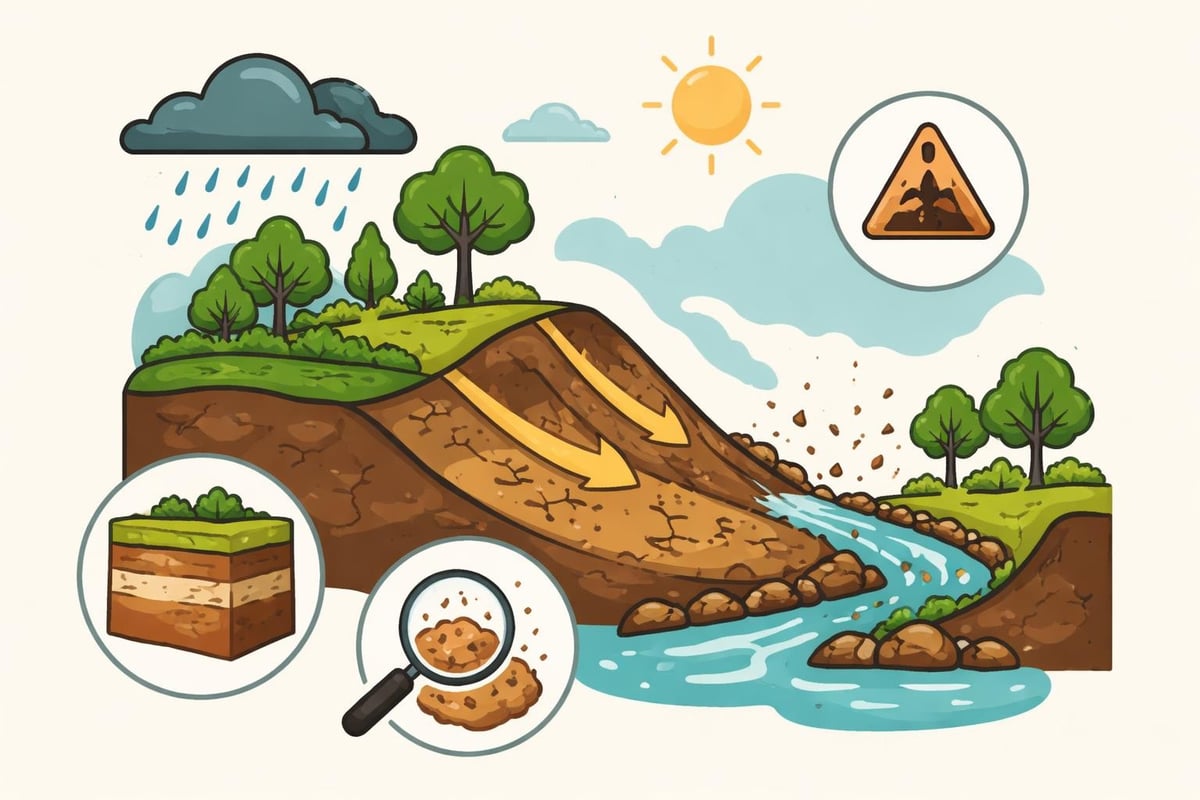
Erosion occurs when soil particles detach from their original position and move downslope under the influence of water, wind, or gravity. During construction activities, vegetation removal and soil disturbance dramatically accelerate these natural processes, increasing erosion rates by factors of ten to one hundred compared to undisturbed conditions.
Water erosion manifests in several distinct forms. Sheet erosion removes thin layers of soil uniformly across slopes, while rill erosion creates small channels that concentrate flow. Gully erosion develops when rills deepen and widen into larger channels that cannot be eliminated through normal tillage or grading operations.
Factors Influencing Erosion Rates
Multiple variables determine how rapidly soil erodes from exposed surfaces:
- Rainfall intensity and duration: Higher intensity storms generate greater runoff velocities and erosive energy
- Soil properties: Clay content, organic matter, and aggregate stability influence resistance to detachment
- Slope gradient and length: Steeper and longer slopes allow water to achieve higher velocities
- Vegetation cover: Root systems and surface protection reduce raindrop impact and slow overland flow
- Ground surface conditions: Compaction, crusting, and roughness affect infiltration and flow patterns
Sediment transport capacity depends on flow velocity, with particle size distribution determining which materials remain suspended versus settling out. Understanding these relationships allows engineers to design controls that reduce velocities below critical thresholds, promoting deposition before sediment reaches sensitive receptors.
Regulatory Framework and Compliance Requirements
Erosion and sediment control regulations exist at federal, state, provincial, and municipal levels, creating overlapping jurisdictions that project teams must navigate. The U.S. Environmental Protection Agency’s model ordinances provide templates for local regulations, while specific requirements vary significantly by location.
Most jurisdictions require erosion and sediment control plans for projects disturbing areas above threshold sizes, typically ranging from 0.1 to 1.0 acres. These plans must address site conditions, proposed controls, maintenance schedules, and inspection protocols.
Key Regulatory Components
| Requirement | Typical Threshold | Documentation |
|---|---|---|
| Erosion Control Plan | >0.5 acres disturbed | Drawings, specifications, schedules |
| Stormwater Permit | >1.0 acre (varies) | NOI, SWPPP, monitoring reports |
| Sediment Basin Design | Site-specific | Capacity calculations, outlet design |
| Inspection Frequency | Weekly + after storms | Logs, photos, corrective actions |
Construction activities near water bodies face additional scrutiny, with permits often requiring specific setbacks, buffer zones, and in-stream work windows. State agencies like North Carolina’s Department of Environmental Quality maintain comprehensive programs with certification requirements for plan designers and inspectors.
Municipal regulations add another layer of requirements. Portland’s erosion and sediment control regulations exemplify how cities establish standards for ground-disturbing activities, including specific control measures, installation timelines, and enforcement mechanisms.
Best Management Practices for Construction Sites
Erosion and sediment control best management practices (BMPs) fall into two broad categories: erosion prevention measures that stabilize soil in place, and sediment capture systems that intercept and trap particles after detachment. Effective programs deploy both approaches in coordinated sequences.
Erosion Prevention Techniques
Prevention represents the most cost-effective strategy, eliminating sediment generation rather than attempting to capture it downstream. Preserving existing vegetation wherever feasible maintains root structure and surface protection. Where disturbance is unavoidable, minimize exposed area and duration.
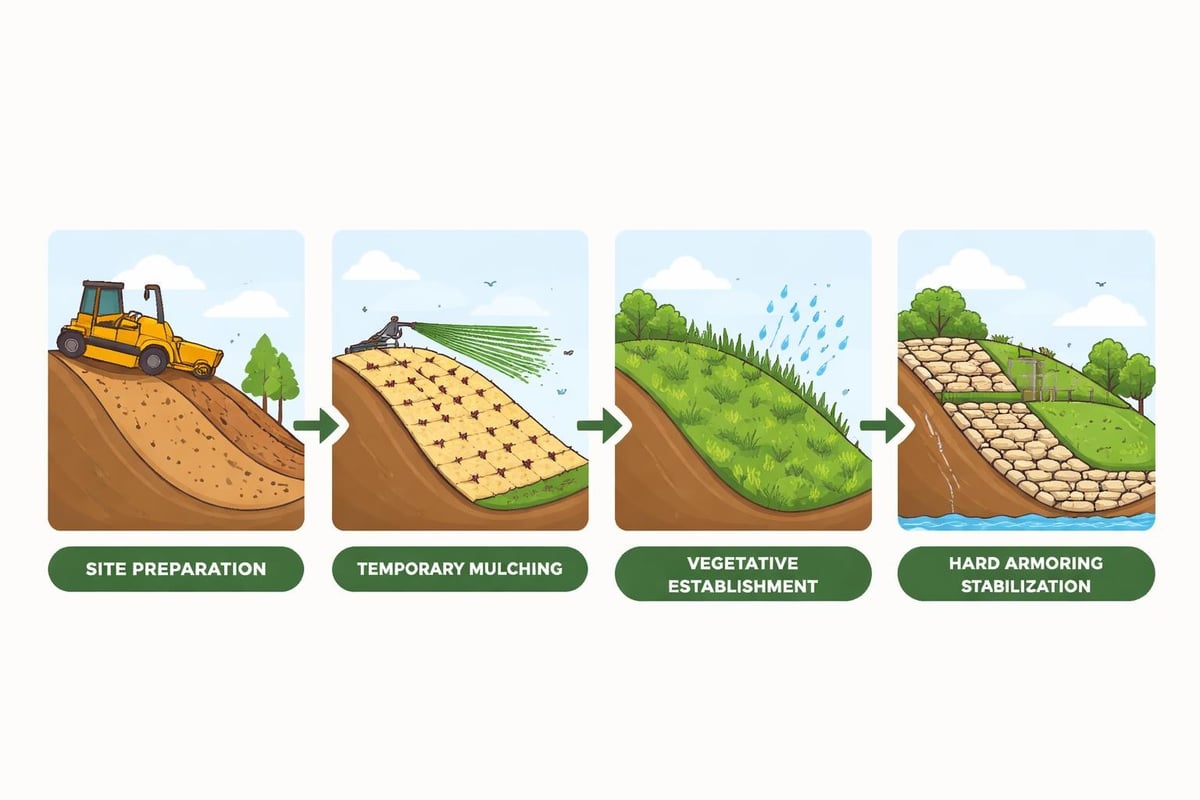
Temporary stabilization methods include:
- Hydraulic mulches with tackifiers for rapid application on slopes
- Erosion control blankets providing immediate surface protection
- Soil binders creating temporary crusts on graded areas
- Dust control measures preventing wind erosion
Permanent stabilization establishes long-term protection through:
- Seeding with appropriate species for climate and soil conditions
- Sodding for immediate cover on critical areas
- Planting of trees and shrubs for enhanced root reinforcement
- Hard armoring with riprap or gabions where vegetation alone proves insufficient
The International Erosion Control Association’s design standards provide detailed guidance on material specifications, installation procedures, and performance criteria for various control products.
Sediment Capture Systems
When erosion prevention alone cannot achieve compliance, sediment capture systems provide secondary protection. These controls slow water velocity, promote settling, and filter suspended particles before discharge.
Perimeter controls intercept sheet flow at site boundaries. Silt fences, when properly installed with fabric trenched into soil and supported by posts, remove coarse sediment through filtration. Effectiveness depends on correct installation depth, appropriate fabric selection, and regular maintenance to prevent overtopping or bypassing.
Sediment basins provide storage volume for larger sites, detaining runoff to allow settling before release. Properly designed basins incorporate:
- Adequate storage capacity based on drainage area and design storm
- Appropriate length-to-width ratios promoting laminar flow
- Energy dissipation at inlets preventing re-suspension
- Dewatering structures (skimmers, perforated risers) releasing clarified water
- Access for sediment removal when accumulated depth reaches triggers
Check dams installed in drainage swales create temporary ponding, reducing velocity and capturing sediment in progressive stages. Stone or sand bag construction allows for adjustment and removal as site conditions evolve.
Site-Specific Engineering Considerations
Effective erosion and sediment control requires careful evaluation of site constraints and tailoring of measures to local conditions. Cookie-cutter approaches frequently fail when confronted with challenging topography, soil types, or climatic factors.
Slope Stabilization Challenges
Steep slopes present particular difficulties, with limited options for conventional controls. Gradient thresholds determine appropriate stabilization methods, with slopes exceeding 3:1 (horizontal:vertical) typically requiring specialized approaches beyond simple seeding.
Projects involving significant earthwork benefit from geotechnical input on slope design and stabilization. ZALIG’s geotechnical engineering services address slope stability through comprehensive analysis of soil strength parameters, groundwater conditions, and appropriate stabilization measures including retaining walls, soil reinforcement, and drainage systems that reduce erosion potential while maintaining structural integrity.
Soil-Specific Considerations
Soil characteristics fundamentally influence control measure selection and performance. Dispersive soils, which deflocculate readily in water, require special attention with chemical amendments or specialized erosion blankets. Sandy soils drain rapidly but lack cohesion, necessitating immediate stabilization after grading.
Clay-rich soils present dual challenges: they resist erosion when vegetated but become highly erodible when bare and saturated. Compaction during wet conditions creates impermeable surfaces that increase runoff volume and velocity.
| Soil Type | Erosion Risk | Recommended Controls | Special Considerations |
|---|---|---|---|
| Sand | High (low cohesion) | Rapid stabilization, check dams | Immediate cover critical |
| Silt | Very High | Multiple BMP layers, basin storage | Most erodible particle size |
| Clay | Moderate to High | Avoid wet-weather grading, drainage | Seal formation when bare |
| Organic | High | Preservation preferred | Difficult to re-vegetate |
Integrated Approaches for Complex Projects
Large-scale infrastructure and land development projects demand coordinated erosion and sediment control strategies that integrate with broader site design. Transportation corridors, for example, involve linear disturbances across varying terrain with multiple outfall locations requiring individual assessment.
Hydrotechnical analysis informs control measure sizing and placement by quantifying runoff volumes, peak flows, and sediment loading under different storm scenarios. ZALIG’s hydrotechnical engineering services provide hydrologic and hydraulic modeling that supports erosion control planning, including watershed delineation, flow routing, and channel stability assessment critical to designing effective sediment management systems.
Phased Construction Sequencing
Strategic phasing minimizes exposed area at any given time, reducing erosion potential and simplifying control requirements. Effective sequencing considers:
- Staging areas and access roads established with permanent stabilization
- Clearing limited to immediate work zones
- Rough grading completed in sections with temporary stabilization between phases
- Final grading and permanent controls installed progressively
- Upstream areas stabilized before proceeding downstream
This approach reduces total control costs while improving environmental outcomes compared to wholesale site clearing.
Advanced Materials and Emerging Technologies
Research continues advancing erosion control products and methodologies. Recent studies on Geosynthetic Rolled Erosion Control Products demonstrate improved performance characteristics compared to traditional materials, with enhanced durability, higher permissible shear stress values, and better vegetation establishment rates.
Turf reinforcement mats (TRMs) provide permanent reinforcement for high-velocity channels, combining synthetic matrices with vegetation to achieve shear stress resistance exceeding bare vegetative covers by factors of ten or more. These products enable stable vegetated channels in applications previously requiring concrete or riprap.
Compost filter socks offer advantages over silt fence in certain applications, providing organic matter for vegetation establishment while filtering sediment. When properly sized and maintained, they achieve comparable sediment removal with simpler installation requirements.
Monitoring and Adaptive Management
Real-time monitoring technologies enable proactive erosion and sediment control management. Turbidity sensors in discharge points provide continuous water quality data, alerting teams to control failures before regulatory violations occur. Drone-based site inspections identify problem areas across large sites more efficiently than traditional walking inspections.
Adaptive management protocols establish decision frameworks for modifying controls based on performance observations. This approach recognizes that design assumptions may not perfectly match field conditions, allowing for systematic adjustments that improve outcomes.
Long-Term Performance and Maintenance
Even well-designed erosion and sediment control systems fail without proper maintenance. Sediment accumulation reduces storage capacity in basins and causes overtopping at perimeter controls. Vegetation establishment requires adequate moisture, nutrients, and protection from traffic during critical establishment periods.
Inspection protocols should address:
- Perimeter controls: Check for undermining, gaps, sediment accumulation, and structural integrity
- Slope protection: Verify blanket anchoring, identify rill formation, assess vegetation density
- Sediment basins: Measure accumulated depth, verify outlet function, check embankment stability
- Inlet protection: Clear debris, repair damage, confirm adequate sizing
Maintenance triggers specify thresholds requiring corrective action. For example, sediment removal becomes necessary when basin storage is reduced by 50% or when accumulated sediment reaches one-third the fence height at perimeter controls.
Documentation of inspections and maintenance activities provides defensible records demonstrating regulatory compliance. Rhode Island DOT’s handbook offers practical guidance on establishing effective inspection and maintenance programs.
Design Integration with Other Site Systems
Erosion and sediment control does not exist in isolation but must integrate with grading, drainage, utilities, and permanent stormwater management systems. Poor coordination results in conflicts, redundant costs, and control failures.
Permanent stormwater infrastructure should be protected from sediment intrusion during construction through:
- Isolation of inlets with filter fabric or gravel sumps
- Bypass systems routing construction-phase runoff around permanent BMPs
- Final cleaning before system activation
- Delayed connection until contributing areas achieve stabilization
Utility corridors require special attention, as linear trenches concentrate flow and create erosion channels. Trench plugs at regular intervals prevent channelization, while prompt backfilling and restoration minimize exposure duration.
Training and Certification Considerations
The technical complexity of erosion and sediment control has led to formal certification programs for designers and inspectors. Multiple organizations offer credentials recognizing demonstrated competency in control measure selection, plan development, and field implementation.
The American Society of Agricultural and Biological Engineers highlights ongoing research priorities that inform evolving best practices, emphasizing the need for improved understanding of control effectiveness across varying conditions.
Professional development in this field requires staying current with:
- Regulatory changes at multiple governmental levels
- New product introductions and performance data
- Revised design standards and specifications
- Lessons learned from control failures and successes
Organizations benefit from maintaining internal expertise while also engaging specialized consultants for complex or high-risk projects where consequences of control failure justify additional investment in design rigor.
Climate Adaptation and Resilience
Changing precipitation patterns challenge traditional erosion and sediment control design assumptions. Many regions experience increased rainfall intensity during individual events even as total annual precipitation remains stable or declines. This shift toward more extreme storms requires revisiting design storm selections and control measure capacities.
Updated guidelines from New South Wales reflect evolving understanding of rainfall patterns and their implications for control measure design, incorporating climate projections into sizing recommendations.
Resilient approaches incorporate safety factors above minimum regulatory requirements, recognizing that climate uncertainty justifies conservative design. Modular controls that can be expanded if needed provide flexibility as conditions evolve.
Effective erosion and sediment control protects water quality, prevents costly site remediation, and ensures regulatory compliance throughout construction activities. By integrating site-specific engineering analysis, proven best management practices, and adaptive maintenance protocols, project teams can minimize environmental impact while controlling costs. ZALIG Consulting Ltd delivers comprehensive erosion control solutions through our hydrotechnical, geotechnical, and environmental engineering services, supporting clients from initial planning through project closeout with practical, permitting-ready designs that address real-world site challenges.