

Differential settlement represents one of the most significant challenges in foundation engineering and construction. When different parts of a structure settle at varying rates or magnitudes, the resulting distortions can compromise structural integrity, disrupt building functionality, and trigger costly repairs. Understanding the mechanisms that drive uneven settlement, recognizing early warning signs, and implementing preventive measures are essential for protecting infrastructure investments and ensuring long-term performance across civil, commercial, and industrial projects.
Understanding Differential Settlement Mechanics
Differential settlement occurs when one portion of a foundation moves downward more than adjacent areas, creating relative displacement between structural elements. This phenomenon differs from uniform settlement, where an entire structure settles evenly without inducing internal stresses. The magnitude of differential movement, rather than total settlement, typically governs whether damage occurs.
Primary Causes and Contributing Factors
Soil variability ranks among the leading causes of differential settlement. Natural deposits rarely exhibit uniform properties throughout a site, and variations in soil type, density, moisture content, and compressibility create conditions for uneven foundation movement. Understanding the causes of differential settlement requires comprehensive site investigation to identify subsurface conditions that may lead to uneven compression.
Foundation loading patterns also contribute significantly to settlement differentials. When structural loads concentrate in specific areas or when building sections vary in weight, the resulting stress distribution produces unequal compression in underlying soils. Multi-story buildings with varying floor heights, structures with heavy mechanical equipment concentrated in specific zones, and facilities with mixed-use areas often experience these loading imbalances.
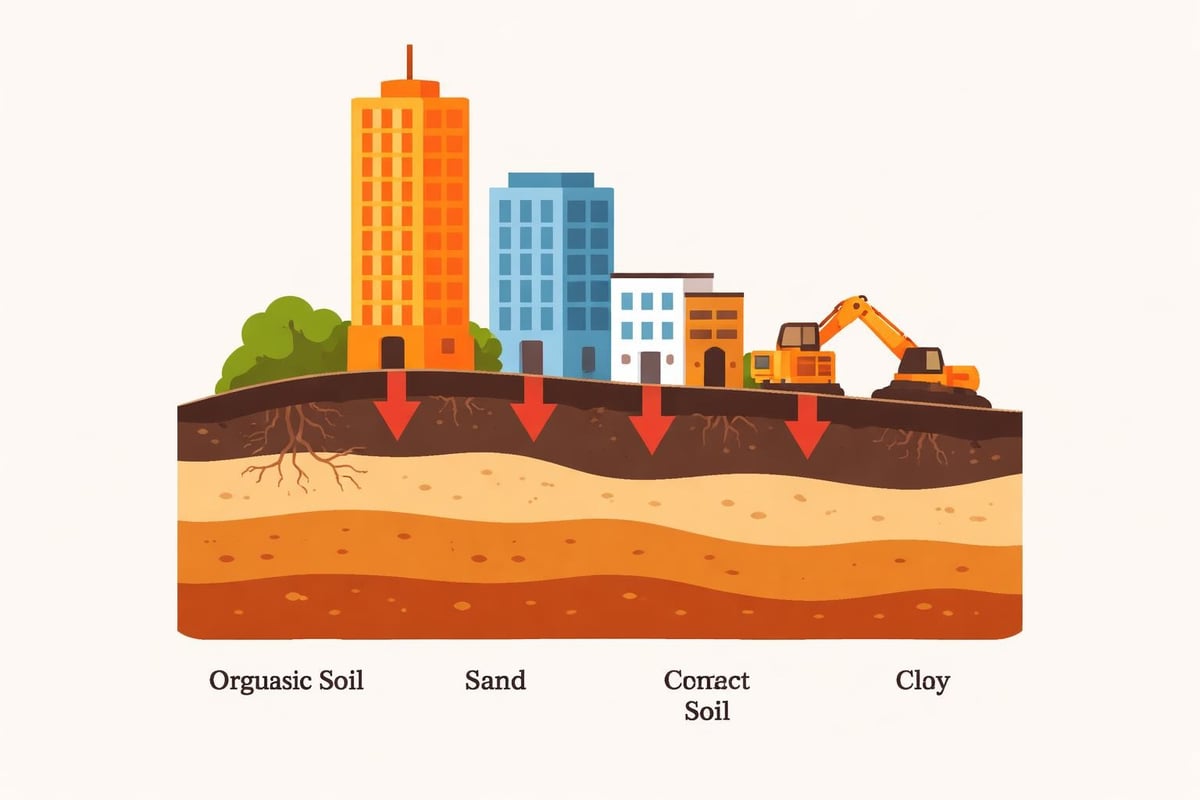
External factors can induce settlement differentials even when foundations are initially designed adequately. Groundwater fluctuations, adjacent excavations, utility installations, and seismic activity all modify subsurface conditions and stress states. Construction activities near existing structures warrant particular attention, as adjacent construction can trigger settlement through excavation-induced stress relief, dewatering operations, or vibration transmission.
The following table summarizes common differential settlement triggers:
| Trigger Category | Specific Causes | Settlement Risk Level |
|---|---|---|
| Soil Variability | Heterogeneous deposits, compressible layers, organic soils | High |
| Loading Imbalance | Concentrated equipment, varying building heights, asymmetric loads | Moderate to High |
| Moisture Changes | Groundwater drawdown, poor drainage, expansive soils | High |
| Adjacent Activity | Excavation, tunneling, dewatering, pile driving | Moderate to High |
| Time-Dependent | Consolidation, secondary compression, creep | Low to Moderate |
Detection and Monitoring Approaches
Early identification of differential settlement allows for timely intervention before damage becomes severe. Visual inspection remains the first line of defense, with trained personnel examining structures for characteristic distress patterns. Crack formation provides clear evidence of movement, particularly when cracks exhibit diagonal patterns, concentrate near corners, or progressively widen over time.
Door and window operation difficulties often signal foundation movement. When frames become misaligned due to differential settlement, doors stick, windows refuse to open, and gaps appear around casings. Floor levelness issues similarly indicate settlement, with sloping floors, gaps between floors and walls, or difficulty rolling objects across surfaces all suggesting uneven foundation movement.
Instrumentation and Quantitative Assessment
Precision monitoring using surveying equipment and specialized instrumentation quantifies settlement magnitudes and rates. Optical levels, total stations, and GPS systems establish elevation benchmarks and track vertical movements with millimeter-level precision. Regular monitoring campaigns create settlement histories that reveal whether movements are active, stabilizing, or accelerating.
Settlement monitoring points installed on foundations, structural columns, and representative floor locations provide spatial data about differential movements. Crack monitoring gauges document whether existing cracks continue propagating or have stabilized. Inclinometers measure lateral movements in walls and columns that may accompany vertical settlement.
For critical infrastructure, automated monitoring systems provide continuous data collection and alert capabilities. Real-time monitoring proves particularly valuable during adjacent construction activities, dewatering operations, or when structures approach serviceability limits.
Impact on Different Structure Types
Differential settlement affects various structure types differently based on their construction methods, materials, and tolerance for movement. Masonry and concrete structures exhibit relatively low tolerance for differential movements, developing cracks and distress at smaller displacement magnitudes than steel-framed buildings. Historical brick structures show particular vulnerability due to limited tensile strength and brittle failure modes.
Transportation Infrastructure Considerations
Bridge structures present unique differential settlement challenges. Approach embankments often settle more than rigid bridge structures, creating bumps at bridge ends that reduce driving comfort and accelerate pavement deterioration. Differential settlement at bridge ends follows predictable patterns influenced by embankment height, foundation soil properties, and construction sequencing.
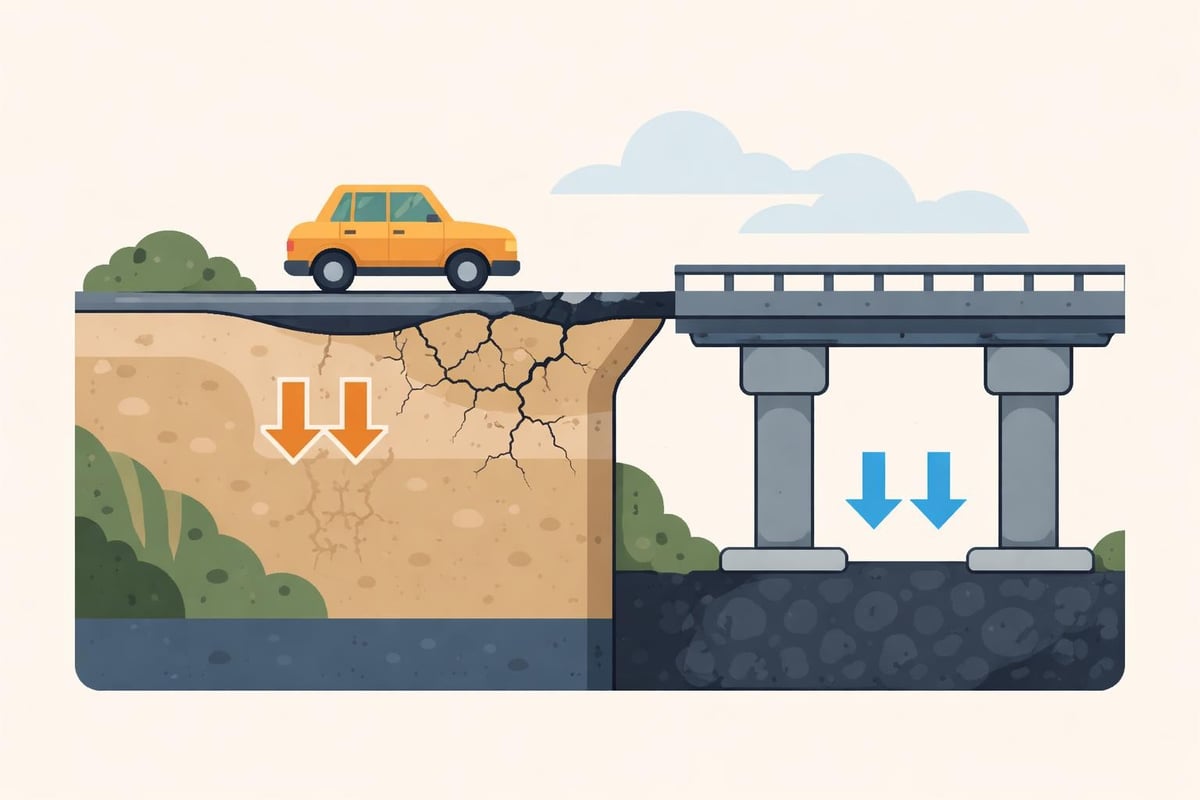
Geosynthetic reinforcement and soil improvement techniques mitigate approach settlement, though GRS-IBS performance under differential settlement depends on reinforcement spacing, soil properties, and load distribution. Transportation agencies increasingly adopt settlement-tolerant details and specify maximum allowable differentials to maintain serviceability.
Seismic loading introduces additional complexity to differential settlement predictions. Bridge approach differential settlement under seismic conditions requires specialized fragility modeling to account for earthquake-induced soil shear strains and permanent ground deformations.
Foundation Design Strategies
Preventing differential settlement begins with appropriate foundation selection and design. Site investigation data inform foundation type, depth, and bearing elevations to minimize settlement potential. When subsurface conditions include compressible layers, foundation systems must either extend through weak soils to competent bearing strata or distribute loads to limit compression.
Foundation System Comparison
| Foundation Type | Settlement Tolerance | Application | Limitations |
|---|---|---|---|
| Shallow Spread Footings | Low | Competent soils, light loads | Sensitive to soil variability |
| Mat Foundations | Moderate | Reduces differential settlement, uniform loads | Requires competent bearing soil |
| Deep Foundations (Piles) | High | Bypasses weak soils, high loads | Higher cost, specialized equipment |
| Piled Rafts | Very High | Optimizes settlement control | Complex design, careful execution |
Piled raft foundations combine pile support with mat foundation elements to optimize settlement control while managing construction costs. Design charts for differential settlements of piled raft foundations provide empirical methods to predict performance under various load distributions and soil conditions.
The comprehensive geotechnical engineering services ZALIG provides include foundation design recommendations tailored to site-specific conditions and settlement tolerance criteria. Foundation systems must balance performance requirements, construction feasibility, and project economics while maintaining acceptable differential movements throughout the structure's service life.
Site Improvement and Ground Modification
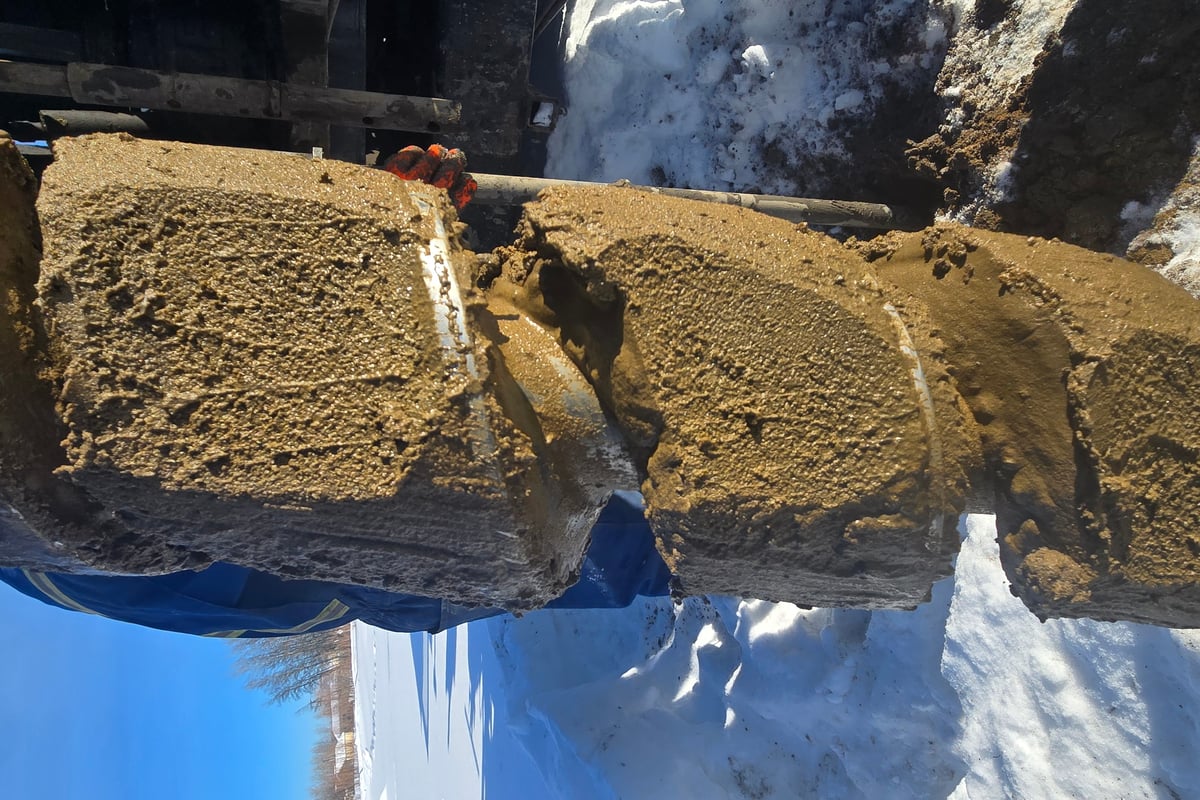
When natural soil conditions present unacceptable differential settlement risk, ground improvement techniques modify subsurface properties to enhance uniformity and reduce compressibility. Improvement methods range from density increase through compaction to complete soil replacement in critical zones.
Common Ground Improvement Methods
Deep soil mixing injects cementitious materials into weak soils, creating improved soil-cement columns that increase stiffness and reduce settlement potential. Stone columns densify loose granular soils while providing drainage paths to accelerate consolidation in cohesive deposits. Vibro-compaction densifies sandy soils through vibration and compaction energy.
Preloading with surcharge fills pre-compresses soils before construction, completing primary consolidation and reducing post-construction settlement. Prefabricated vertical drains accelerate consolidation in low-permeability soils, reducing preloading duration from years to months. Vacuum consolidation combines drainage with negative pressure to achieve consolidation without heavy surcharge loads.
Soil replacement excavates and replaces highly compressible materials with engineered fill compacted to specified densities. While excavation depths limit applicability, replacement ensures uniform bearing conditions when performed properly. Jet grouting and compensation grouting provide targeted improvement in restricted access conditions.
Remediation and Repair Solutions
When differential settlement produces unacceptable distress, remedial measures restore structural integrity and halt progressive damage. Repair strategies depend on settlement magnitude, whether movement continues, and structure type.
Underpinning extends foundation depth to reach competent bearing strata, providing additional support to settling elements. Traditional underpinning excavates beneath existing foundations in alternating sections, installing new concrete piers or walls. Micropiles drilled through existing foundations offer less disruptive installation with similar load capacity.
Modern Remediation Technologies
Polyurethane injection lifts and stabilizes settled concrete slabs through expansion of injected foam materials. The technique provides rapid execution with minimal disruption, though suitability depends on void conditions and soil characteristics. Compaction grouting densifies loose soils through displacement and consolidation, reducing future settlement potential.
Structural strengthening addresses settlement-induced distress without modifying foundation support. Carbon fiber reinforcement, steel plate bonding, and post-tensioning restore load-carrying capacity to cracked elements. Jacking systems level floors and realign structural elements, though underlying settlement causes require concurrent treatment.
The choice between repair options requires engineering analysis of settlement causes, structure condition, and performance objectives. Monitoring following repair confirms effectiveness and reveals whether additional intervention proves necessary.
Long-Term Performance Considerations
Differential settlement often exhibits time-dependent behavior requiring long-term monitoring and management. Metro structures on soft deposits demonstrate that settlement can continue for years following construction, with differential movements accumulating gradually.
Primary consolidation in fine-grained soils follows predictable patterns based on loading history and drainage conditions. Secondary compression continues beyond primary consolidation, producing ongoing settlement at decreasing rates. Predicting long-term settlement requires laboratory testing to establish compressibility parameters and consolidation characteristics.
Serviceability and Damage Thresholds
Structure serviceability limits define acceptable differential settlement magnitudes before function or appearance become unacceptable. Angular distortion, which relates differential settlement to the distance over which it occurs, provides a normalized measure for comparing settlement tolerance across structure types.
Residential structures typically tolerate angular distortions up to 1/300 before significant damage occurs. Industrial buildings with overhead cranes require stricter limits, often 1/500 or tighter, to maintain operational tolerances. Historical structures and brittle materials necessitate even more conservative thresholds.
Establishing realistic settlement criteria during design prevents over-conservative solutions while ensuring structures meet performance expectations. Criteria should reflect actual damage mechanisms rather than arbitrary limits, incorporating both differential settlement magnitude and rate considerations.
Regulatory and Quality Assurance
Building codes and engineering standards specify investigation requirements, design methods, and performance criteria related to differential settlement. The National Building Code of Canada and provincial building codes establish minimum foundation design requirements, though project-specific conditions may warrant more rigorous approaches.
Quality assurance during construction verifies that foundation installations match design assumptions. Subgrade preparation, excavation depths, bearing material properties, and concrete placement all require verification before proceeding with subsequent construction. Documentation creates defensible records demonstrating compliance with specifications.
Foundation inspections identify potential defects before they produce differential settlement. Exposed footings should show uniform bearing on approved materials without soft spots, organic matter, or frozen soils. Pile installation records documenting driving resistance, penetration depths, and load test results confirm deep foundation adequacy.
Post-construction monitoring during the warranty period identifies whether settlements remain within predicted ranges. Structures exhibiting unexpected movements require investigation to determine causes and appropriate responses. Early intervention typically costs significantly less than addressing advanced damage.
Risk Management Frameworks
Systematic risk assessment identifies differential settlement potential during project planning, allowing proactive mitigation rather than reactive repairs. Risk frameworks evaluate subsurface uncertainty, structure sensitivity, adjacent activities, and consequence severity to prioritize investigation and design efforts.
Projects with high settlement risk justify more extensive site investigation, laboratory testing, and foundation design effort. Probabilistic analysis methods quantify uncertainty ranges and inform risk-based design approaches. Contingency planning establishes monitoring protocols and intervention thresholds to manage residual risks.
The following steps establish effective differential settlement risk management:
- Conduct comprehensive geotechnical investigation including borings, soundings, and laboratory testing across the entire site footprint
- Analyze subsurface variability to identify zones with differing settlement potential and establish design parameters
- Evaluate loading patterns and structural layout to identify areas vulnerable to differential movement
- Select foundation systems appropriate for soil conditions, structural requirements, and settlement tolerance
- Specify construction quality requirements including subgrade verification, material testing, and installation monitoring
- Implement performance monitoring during and after construction to verify settlements remain within acceptable limits
- Establish contingency response plans defining intervention thresholds and remediation approaches
Differential settlement management requires integrated expertise spanning geotechnical investigation, foundation engineering, construction monitoring, and structural assessment. Successful projects anticipate settlement potential through thorough site characterization, implement appropriate foundation systems, and verify performance through construction and into service life. Whether you're planning new infrastructure, evaluating existing facilities, or addressing settlement-related distress, ZALIG Consulting Ltd delivers practical engineering solutions backed by field investigation, laboratory testing, and decades of multidisciplinary experience across civil, transportation, and industrial projects.