

In 2026, the quality of construction material and testing is more vital than ever for building infrastructure that stands the test of time. As industry standards evolve, professionals must stay informed to ensure projects are safe, durable, and sustainable.
This comprehensive guide explores construction material and testing from every angle—covering essential materials, robust testing methods, regulatory standards, sustainability, and future trends.
Discover actionable insights that help you achieve reliable project outcomes and minimize risks. Make informed choices and embrace best practices in material selection and testing for a stronger, more resilient future.
Overview of Construction Materials in 2026
The landscape of construction material and testing in 2026 is more dynamic and innovative than ever. With rapid advances in technology and sustainability goals, professionals must stay informed about material choices and their performance. Selecting the right materials and ensuring their quality is essential for safe, efficient, and forward-thinking infrastructure.
Major Categories of Construction Materials
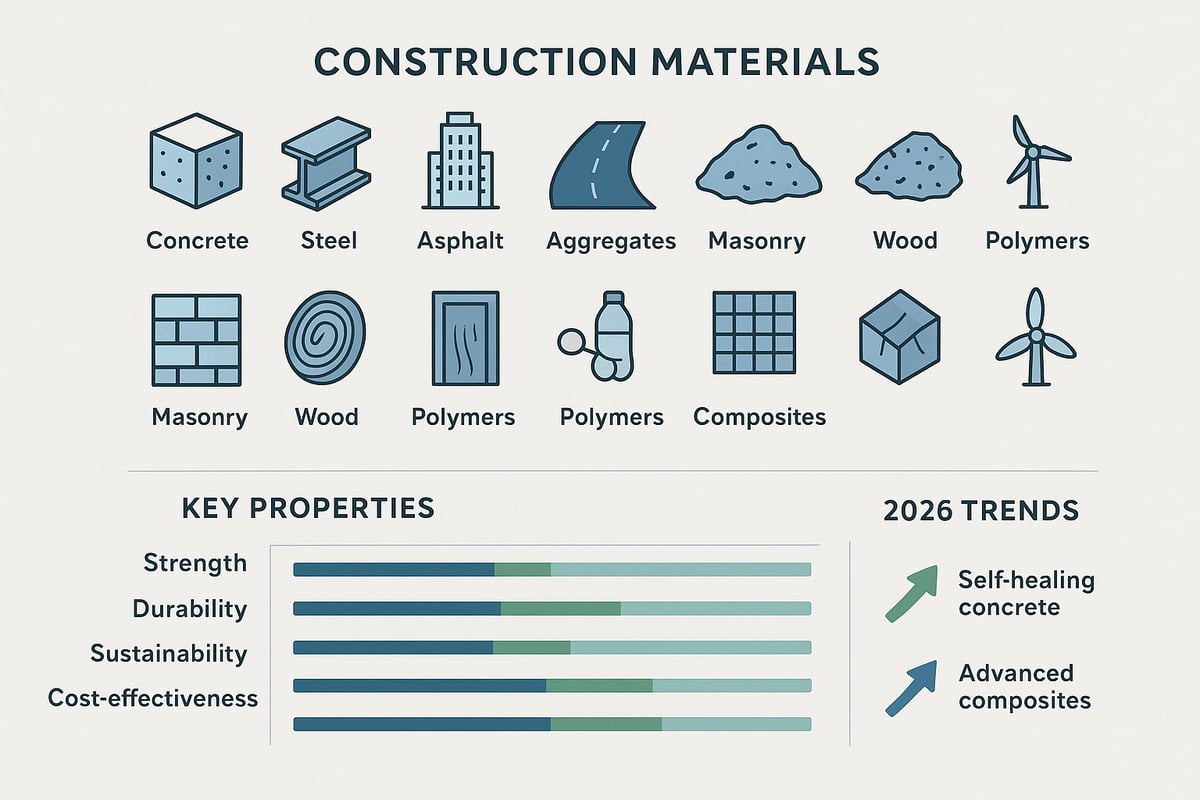
In 2026, construction material and testing practices revolve around a diverse set of core building materials. These include concrete, steel, asphalt, aggregates, masonry, wood, polymers, and composites. Each material serves specific roles. Concrete remains the go-to for foundations and slabs, while steel is essential for structural frameworks and high-rise buildings. Asphalt is preferred for roadways and pavements, and aggregates provide foundational strength in both concrete and asphalt mixes.
Innovations are transforming the industry. For example, self-healing concrete uses embedded capsules to repair small cracks, extending structural life. Advanced composites, which combine fibers and resins, offer high strength-to-weight ratios for bridges and facades. Polymers are increasingly used for waterproofing and insulation. According to recent Emerging Building Materials Industry Trends 2026, sustainable materials and digital integration are gaining traction globally.
Here is a quick comparison of common materials:
| Material | Typical Use | Key Property | 2026 Innovation |
|---|---|---|---|
| Concrete | Foundations, slabs | Durability, strength | Self-healing mixes |
| Steel | Frames, bridges | Tensile strength | Smart sensors |
| Asphalt | Roads, runways | Flexibility, cost | Recycled content |
| Aggregates | All structures | Load distribution | Eco-friendly blends |
| Masonry | Walls, facades | Fire resistance | Lightweight blocks |
| Wood | Residential, CLT | Sustainability | Engineered timber |
| Polymers | Roofing, sealants | Chemical resistance | Bio-based plastics |
| Composites | Bridges, panels | High strength-to-weight | Nanomaterial fibers |
Globally, concrete and steel account for over 70% of total material volume, but demand for sustainable alternatives is rising. The construction material and testing landscape is evolving to keep pace with these changes.
Factors Influencing Material Selection
Selecting the appropriate material for a project is a complex process. Key considerations include:
- Project requirements: Structural load, exposure to weather, and design aesthetics.
- Local availability: Proximity to suppliers and transportation logistics.
- Cost versus performance: Balancing upfront expenses with long-term durability.
- Environmental impact: Lifecycle assessments and carbon footprint.
- Regulatory compliance: Meeting codes and standards for safety and sustainability.
For example, when choosing between traditional concrete and geopolymer mixes for a major bridge, engineers weigh compressive strength, curing time, and environmental benefits. Geopolymers offer lower emissions and resistance to chemical attack, but may have higher initial costs or limited supply.
Supply chain disruptions can influence material choices as well. In North America, sourcing locally available aggregates and recycled materials is becoming essential to reduce delays and costs. Construction material and testing experts often conduct lifecycle and risk assessments before making final decisions.
A real-world scenario: On a large infrastructure project, opting for geopolymer concrete reduced the carbon footprint by 40%, while rigorous construction material and testing ensured compliance with both performance and sustainability criteria.
Material Quality and Risks of Poor Selection
The quality of construction materials directly impacts project outcomes. Common defects, such as insufficient curing of concrete or use of low-grade steel, can lead to structural failures, safety hazards, and expensive rework. High-profile failures, like bridge collapses or building envelope breaches, often trace back to substandard materials or inadequate testing.
Working with certified suppliers and maintaining traceability throughout the supply chain is critical. Construction material and testing protocols require documentation and verification at every stage. Historic failures, such as the 2018 pedestrian bridge collapse in Florida, highlight the consequences of ignoring quality controls.
Data from recent studies show that material-related defects account for up to 30% of total rework costs in major projects. Investing in rigorous construction material and testing up front helps prevent costly repairs, legal liabilities, and reputational damage. Ultimately, prioritizing quality and compliance protects both public safety and long-term project value.
The Importance of Construction Material Testing
Construction material and testing is fundamental to every successful project, regardless of scale. It is the foundation for compliance, safety, and long-term durability. Without rigorous assessment, even the most advanced designs can fall short. The right approach to construction material and testing protects investments, enhances reputation, and ensures that structures stand the test of time.
Objectives and Benefits of Material Testing
The primary goal of construction material and testing is to verify that all materials meet project specifications and adhere to regulatory standards. This process confirms the strength, durability, and safety of materials before and during construction. By identifying potential issues early, teams can address them proactively, reducing the risk of costly delays or failures.
Key benefits include:
- Ensuring compliance with local and international codes.
- Reducing the likelihood of rework and long-term maintenance.
- Supporting insurance, warranty, and liability requirements.
- Enhancing overall project reliability.
For a detailed overview of the range of tests available, review Construction Material Testing Services. These services help teams achieve the highest standards at every stage of construction. A timely test, for instance, once prevented a major delay on a commercial building by catching a material defect before installation.
Types of Projects Requiring Material Testing
Construction material and testing is vital for a variety of project types. Some of the most common include:
- Infrastructure such as bridges, highways, and tunnels.
- Commercial developments and residential buildings.
- Industrial facilities and complex energy projects.
- Public sector and government-funded initiatives.
Each of these projects has unique requirements, but all demand strict quality control. Testing ensures that every component, from concrete to steel, performs as expected. This practice not only meets regulatory demands but also supports efficient project delivery and public safety.
Consequences of Inadequate Testing
Neglecting construction material and testing exposes projects to significant risks. Safety hazards, structural failures, and costly legal liabilities can arise from undetected defects. According to industry statistics, a notable percentage of construction failures each year are directly linked to insufficient material testing.
Consequences include:
- Increased frequency of rework and unexpected repairs.
- Legal action and regulatory penalties for non-compliance.
- Damaged reputation and loss of client trust.
A single oversight in the testing process can lead to cascading failures, highlighting the critical need for robust quality assurance. Contractors who cut corners often face higher long-term costs and diminished standing in the industry.
ZALIG Consulting Ltd: Trusted Partner in Material Testing
ZALIG Consulting Ltd stands out as Alberta’s leading provider in construction material and testing. Their certified geotechnical, environmental, and material testing services are trusted by public, industrial, and private sector clients. With in-house laboratories and expert field teams, ZALIG ensures every material meets or exceeds applicable standards.

Clients benefit from:
- Comprehensive testing for concrete, soil, asphalt, aggregates, and steel.
- Tailored solutions for each project’s unique needs.
- Cost-effective strategies and rigorous quality management.
ZALIG’s reputation is built on innovation and reliability. For those seeking compliance, quality assurance, and peace of mind, partnering with an industry leader like ZALIG is the best path to project success.
Modern Testing Methods and Technologies
Modern construction material and testing practices are evolving rapidly in 2026, integrating advanced science and technology to ensure precision and compliance. Professionals need to understand both traditional and emerging techniques to guarantee that every material used meets rigorous project demands. This section explores laboratory and field testing, cutting-edge technologies, and robust data management, providing a comprehensive overview for those seeking excellence in construction material and testing.
Laboratory Testing Techniques
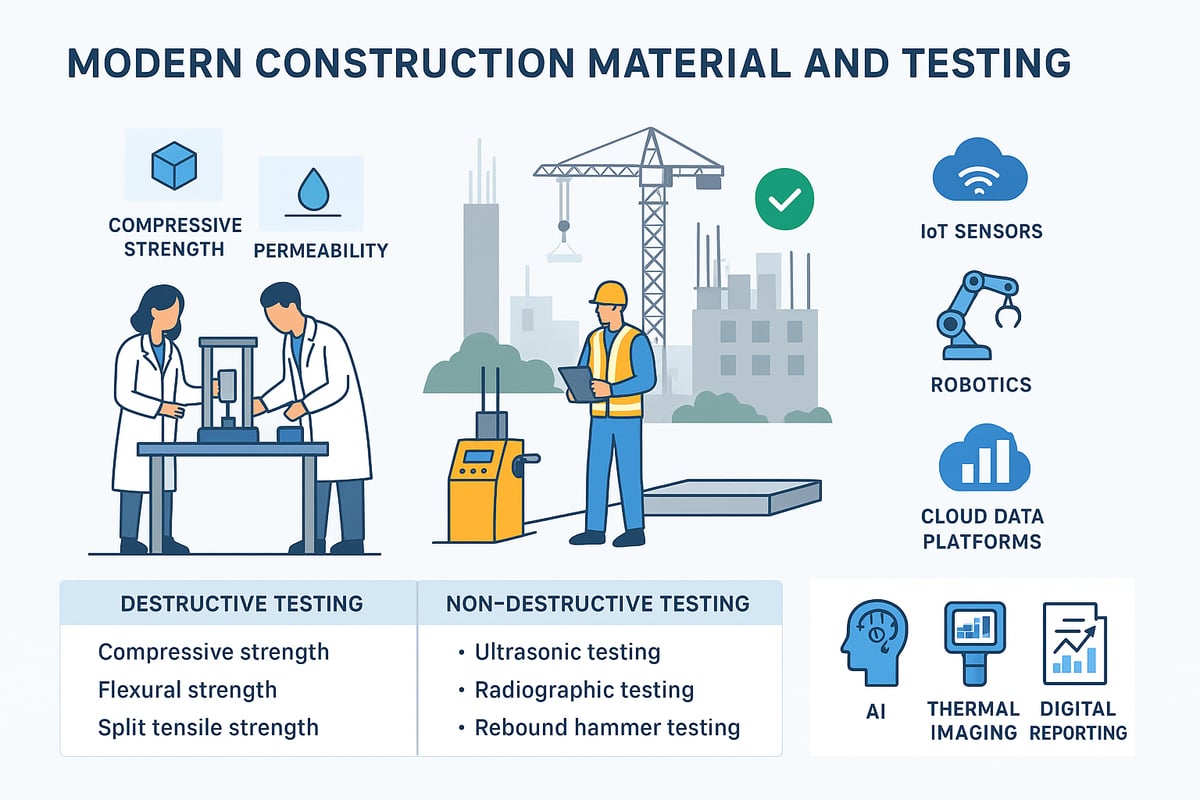
Laboratory testing forms the backbone of construction material and testing, providing objective data on material performance. Two primary categories exist: destructive testing, which involves physically altering or breaking samples, and non-destructive testing, which evaluates properties without causing damage.
| Testing Type | Description | Examples |
|---|---|---|
| Destructive | Alters or destroys the specimen | Compressive strength, tensile tests |
| Non-destructive | Leaves specimen intact | Ultrasonic, radiographic, rebound |
Destructive tests like compressive strength and tensile strength are essential for concrete and steel validation. For example, Concrete Compression Testing Methods remain the gold standard for assessing load-bearing capacity in concrete cylinders.
Non-destructive methods, such as ultrasonic pulse velocity or radiographic imaging, allow repeated evaluation of materials like masonry or welds. Accredited laboratories, including those certified by AASHTO or A2LA, ensure that testing aligns with current standards. Leading labs in North America now process over 600,000 concrete cylinder tests annually, reflecting the scale and importance of construction material and testing in today’s projects.
Field Testing and On-Site Inspection
Field testing complements laboratory analysis by evaluating construction material and testing directly at the project site. Proper sampling procedures and adherence to field protocols are vital for accurate results and compliance.
Common in-situ tests include soil compaction, moisture content, and density measurement. These assessments help verify that foundations and backfills meet project specifications. Portable equipment, such as nuclear density gauges and handheld moisture meters, provides rapid feedback for real-time decision-making.
Trained technicians play a crucial role in the reliability of field testing. Standardized processes, including chain-of-custody documentation and calibration checks, minimize variability and errors. The integration of field and lab data supports a holistic approach to construction material and testing, ensuring structural integrity from the ground up.
Advanced and Emerging Testing Technologies
The future of construction material and testing lies in innovative technologies that enhance accuracy, speed, and predictive capability. Digital sensors and IoT-enabled monitoring systems now allow for continuous, real-time data collection on material performance.
Automated testing equipment and robotics are increasingly used for repetitive or hazardous tasks, improving safety and consistency. Non-destructive evaluation (NDE) techniques, such as ultrasonic, radiographic, and thermal imaging, enable detailed internal assessments without damaging the material.
Artificial intelligence and machine learning are transforming data analysis, allowing for predictive maintenance and early detection of potential failures. A notable case study involves the use of IoT sensors in a major bridge project, where continuous monitoring enabled proactive quality adjustments and minimized downtime. These advancements are redefining industry standards for construction material and testing, driving efficiency and reliability.
Quality Assurance and Data Management
Robust quality assurance and data management systems are essential for successful construction material and testing workflows. Accurate tracking and documentation of test results support compliance with regulatory bodies and client requirements.
Digital platforms are now widely used for real-time reporting, compliance verification, and audit readiness. Secure data storage ensures traceability and accountability, especially for large or multi-site projects. The adoption of cloud-based platforms has streamlined project management, enabling stakeholders to access up-to-date information from any location.
These practices not only enhance transparency but also help identify trends and prevent recurring issues. By prioritizing quality assurance and robust data handling, organizations can maximize the value of construction material and testing investments.
Regulatory Standards and Compliance in 2026
Navigating regulatory standards is essential for every construction material and testing process in 2026. As the industry evolves, compliance with national and international standards is more critical than ever. Understanding the landscape helps professionals deliver quality, safety, and durability across all project phases.
Key Regulatory Bodies and Standards
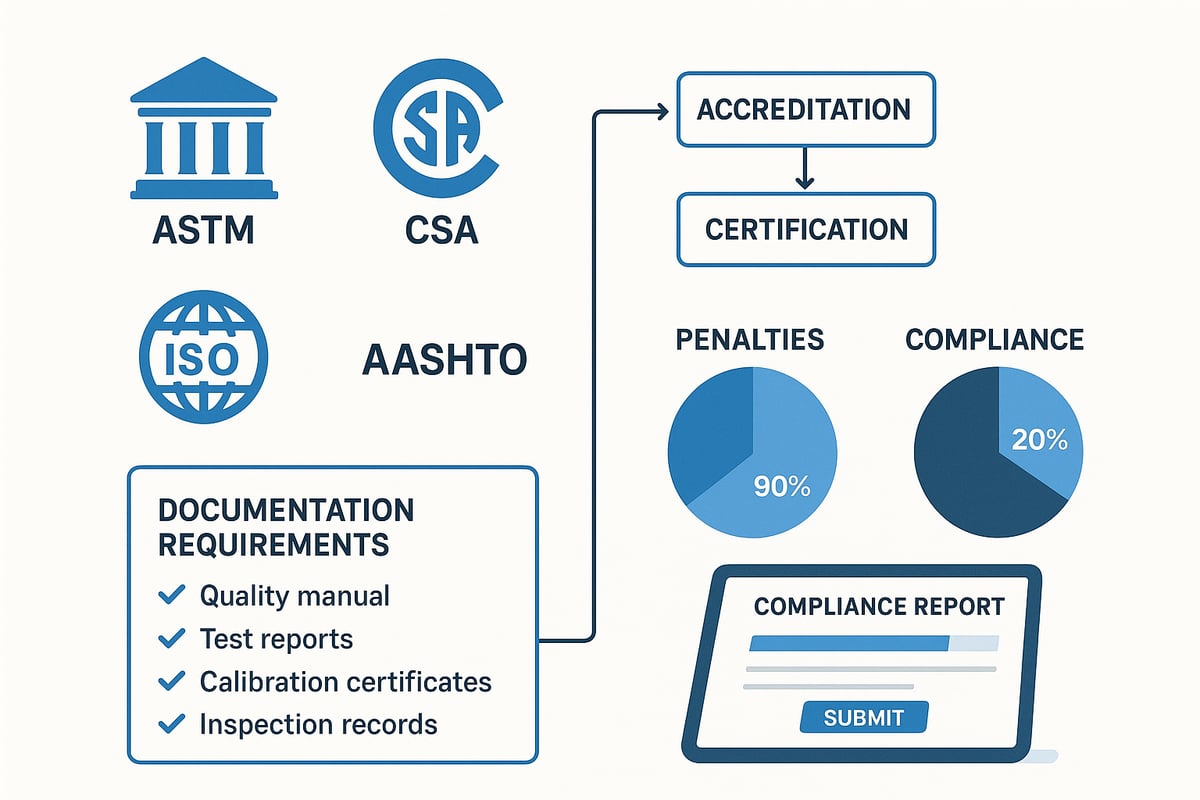
The foundation of construction material and testing compliance lies in adhering to well-established standards. Leading organizations such as ASTM International, the Canadian Standards Association (CSA), the International Organization for Standardization (ISO), and the American Association of State Highway and Transportation Officials (AASHTO) set the technical requirements for materials used in construction. Local building codes further refine these requirements for regional needs.
In 2026, updates continue to enhance guidance for modern materials and new testing technologies. Government agencies and industry associations collaborate to ensure that construction material and testing protocols reflect the latest safety, sustainability, and performance benchmarks. For a deeper understanding of these technical requirements, the Technical Requirements for Construction Materials Testing resource offers detailed insights into current best practices.
Staying current with these standards ensures projects meet regulatory expectations while supporting innovation.
Accreditation and Certification Processes
Accreditation is a cornerstone of reliable construction material and testing. Working with accredited testing laboratories guarantees that testing procedures meet rigorous quality and technical standards. Programs such as the AASHTO Accreditation Program validate the competence of labs, providing assurance to project owners and regulatory bodies alike.
Certification extends to materials and suppliers, ensuring every product used in construction meets specified criteria. This process helps prevent the use of substandard or non-compliant materials, protecting both stakeholders and end-users. Accredited labs and certified suppliers are vital partners in any construction material and testing workflow.
Continuous updates to certification programs reflect advancements in material science and industry needs, making ongoing compliance an active responsibility.
Documentation and Reporting Requirements
Robust documentation is fundamental to construction material and testing compliance. Essential documents include test reports, certificates of compliance, and traceability records for every material batch. Increasingly, digital submission protocols streamline these processes, with regulatory portals allowing for efficient uploads and real-time status tracking.
For complex projects, cloud-based platforms facilitate the management of multi-phase documentation, ensuring all regulatory and client requirements are met. A well-organized documentation process not only supports compliance but also simplifies audits and regulatory reviews.
Case studies show that adopting digital reporting reduces administrative burdens and accelerates project timelines, making compliance less of a hurdle and more a competitive advantage.
Penalties and Risks of Non-Compliance
Failure to meet construction material and testing standards can have severe legal, financial, and reputational consequences. Regulatory violations may result in hefty fines, project shutdowns, or even criminal liability in extreme cases. According to recent industry data, the frequency and cost of such violations have increased as regulatory scrutiny intensifies.
Non-compliance also undermines client trust and can damage long-term business prospects. Best practices include regular training, robust internal audits, and proactive engagement with regulatory updates to mitigate these risks.
Maintaining strict adherence to standards and documentation ensures that every construction material and testing process stands up to scrutiny, safeguarding both project success and professional reputation.
Sustainability and Innovation in Construction Materials
Sustainability is no longer optional in the world of construction material and testing. The industry is moving rapidly toward greener solutions, both to meet regulatory demands and to address growing client expectations for environmentally responsible projects.
Green Materials and Sustainable Practices
The shift toward eco-friendly materials is transforming construction material and testing strategies. Recycled aggregates, low-carbon cement, and bio-based composites are now common in infrastructure and building projects. These materials reduce carbon footprints and support circular economy principles.
Lifecycle assessments and Environmental Product Declarations (EPDs) are vital tools for comparing the true environmental impacts of different materials. For example, using recycled concrete in urban redevelopment projects not only diverts waste from landfills but also conserves natural resources.
Contractors now prioritize suppliers with robust sustainability credentials. Sustainability is increasingly a differentiator in competitive bidding, especially for public sector contracts. With the construction material and testing process, sustainable practices must be integrated from design through completion.
Material Testing for Sustainability
Rigorous testing protocols are essential to validate the environmental claims of construction material and testing. Emissions testing, recyclability assessments, and environmental impact studies ensure that materials meet regulatory and certification requirements.
Certifications such as LEED, BREEAM, and Green Globes require documented proof of material performance and sustainability. Testing laboratories provide critical data for these certifications, helping project teams achieve green building targets.
Testing also supports access to regulatory incentives and funding for sustainable projects. As clients demand more transparency, robust material testing for sustainability becomes a core part of project delivery and compliance strategies.
Innovations Shaping the Future
Innovation is accelerating the evolution of construction material and testing. Self-healing materials, such as advanced asphalt that repairs cracks automatically, are already being adopted in highway construction to extend service life and reduce maintenance costs.
Smart composites and nanotechnology are further enhancing material strength, durability, and sustainability. Biomimetic engineering is producing new bio-composite materials inspired by nature, such as Biomimetic Engineering of Fortified Ice Composite, which offers remarkable mechanical properties and environmental benefits.
Circular economy principles are being woven into material sourcing and testing protocols. These advances are creating new benchmarks for both performance and sustainability in construction.
Industry Trends and Market Data
Demand for sustainable construction material and testing is driving significant industry growth. The global market for green building materials is projected to increase by double digits annually through 2026, fueled by stricter regulations and corporate sustainability goals.
Investments in research and development for advanced material testing are at a record high. Clients are increasingly requesting green certifications and comprehensive sustainability reporting as part of project requirements.
The construction sector is responding with robust quality control systems, transparent data, and innovative partnerships. As sustainability and innovation continue to reshape the market, organizations that lead in construction material and testing will set the standard for the industry.
Future Trends in Construction Material Testing
The landscape of construction material and testing is rapidly evolving, influenced by technological innovation, global collaboration, and the demand for resilient, sustainable projects. Industry professionals must stay informed about these future trends to maintain quality, compliance, and competitiveness in 2026 and beyond.
Digital Transformation and Automation
Digital transformation is revolutionizing construction material and testing by integrating tools like digital twins, BIM platforms, and IoT devices. These technologies enable real-time monitoring, predictive analytics, and automated data collection, making quality control more proactive and less reactive.
Automated robots handle repetitive sampling and testing tasks on-site, reducing human error and increasing efficiency. Predictive analytics help teams anticipate material performance issues before they arise, improving project timelines and safety.
Cloud-based platforms streamline reporting and compliance, offering seamless data sharing across teams. For a deeper look at quality management advances, explore Quality Control and Assurance in Construction. These innovations ensure construction material and testing processes deliver reliable, actionable insights for every project.
Evolving Standards and Globalization
Construction material and testing standards are becoming more harmonized worldwide, which is crucial as projects and supply chains span multiple countries. Regulatory frameworks are adapting to address new materials, sustainability requirements, and cross-border compliance.
Organizations must stay current with updates, such as the AISC Updates Certification Standards 2026, which impact steel fabrication and erection. By aligning with international standards, companies reduce project risks and streamline approvals.
Globalization also increases the complexity of sourcing and testing, requiring robust traceability and documentation. As a result, construction material and testing protocols are more rigorous, supporting safer and more efficient infrastructure worldwide.
Skills and Workforce Development
The future of construction material and testing will demand a workforce skilled in both traditional methods and advanced digital tools. Technicians are expected to interpret complex data from sensors, operate automated testing equipment, and collaborate within interdisciplinary teams.
Ongoing training, certification, and partnerships with academic institutions are vital to address the skills gap. Industry-academia collaborations foster the development of new testing methodologies and ensure a steady pipeline of qualified professionals.
As construction material and testing evolves, continuous education becomes a cornerstone for maintaining quality and compliance. Investing in workforce development helps organizations adapt to emerging technologies and regulatory changes, securing project success.
Anticipated Challenges and Opportunities
Supply chain disruptions and material shortages remain key challenges for construction material and testing in 2026. Balancing cost, quality, and sustainability requires agile decision-making and robust risk management.
Opportunities arise from adopting innovative materials, leveraging digital platforms, and prioritizing green certifications. Companies that lead in sustainable practices and advanced testing gain a competitive edge.
By embracing new technologies and focusing on best practices, industry leaders can navigate uncertainties and drive improvement in construction material and testing outcomes, positioning themselves for long-term growth and resilience.
Article written using RankPill.