

Constructability Review Guide: Best Practices for 2026 Projects
In 2026, construction projects encounter tighter budgets, complex regulations, and growing pressure to improve efficiency. These challenges demand a smarter approach to planning and execution. That is where a constructability review becomes essential for project success.
This guide dives into the constructability review process, showing why it matters now more than ever. You will discover what a constructability review is, its benefits, the key steps to follow, proven best practices, common mistakes to avoid, and how to measure its impact. Unlock the strategies that leading teams use to deliver projects on time and on budget.
Understanding Constructability Reviews: Definition, Purpose, and Value
A constructability review is a formal process that brings construction expertise into the design phase of a project. Industry standards, including those from the Construction Industry Institute (CII), define constructability as the integration of construction knowledge and experience into planning, design, procurement, and field operations. The goal is to optimize project outcomes by identifying potential challenges early.
The purpose of a constructability review is to ensure that designs are practical, cost-effective, and buildable. By involving construction professionals from the start, teams can spot design issues, improve sequencing, and select materials that best suit site conditions. This early input helps prevent costly rework, delays, and unforeseen problems during construction.
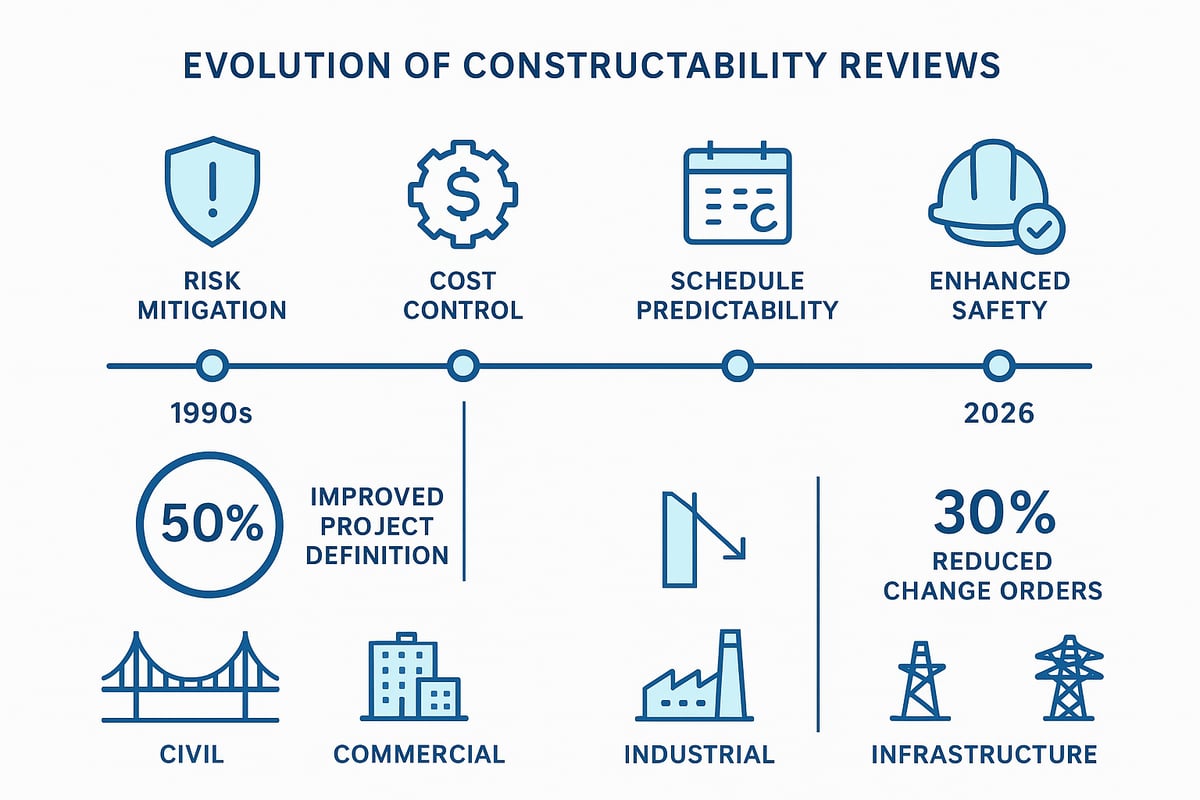
Since the 1990s, the approach to constructability review has evolved significantly. Early reviews were often ad hoc, conducted late in the design process. Today, leading organizations recognize the value of ongoing, structured reviews at key project milestones. Research from Independent Project Analysis (IPA) highlights that projects with formal constructability review programs consistently outperform those without, especially in cost and schedule predictability.
Constructability reviews are now considered a top Value Improving Practice (VIP) in the industry. According to IPA’s long-term data, projects with robust review programs achieve better project definition, fewer change orders, and improved competitiveness. The process is not just about checking drawings; it is about proactively managing risk and aligning the design with construction realities.
The core objectives of a constructability review can be summarized as follows:
| Objective | Benefit |
|---|---|
| Risk mitigation | Identify and address issues before construction |
| Schedule predictability | Reduce delays and streamline project delivery |
| Cost control | Lower project costs through efficient design |
| Enhanced safety | Improve site safety with practical solutions |
Statistically, projects that implement a structured constructability review program report improved project definition and execution competitiveness (IPA, 2025). This proactive approach leads to fewer requests for information (RFIs), reduced rework, and greater certainty in budget and schedule.
For example, engaging construction teams early in reviewing crane access or optimizing site layouts can yield significant benefits. One project improved crane placement, reduced congestion, and minimized labor hours simply by acting on constructability review recommendations. Such insights are only possible when the review process is thorough and collaborative.
Constructability reviews are essential across all project types, including civil, commercial, industrial, and infrastructure developments. For instance, a thorough site investigation is often the foundation for an effective constructability review. Leveraging resources like Geotechnical Site Investigation for Subdivisions ensures that teams have accurate data to inform both design and buildability, reducing the risk of costly surprises.
In summary, the constructability review process has matured into a critical driver of project success. By embedding construction expertise early, organizations can optimize designs, control costs, and deliver safer, more predictable outcomes across every sector.
Key Components of an Effective Constructability Review Program
A high-performing constructability review program is built on a strong foundation of structure, expertise, and process discipline. For 2026 projects, the right approach can make the difference between project success and costly overruns. Let us break down the two core components: program essentials and the review process itself.
Essential Elements of a Constructability Program
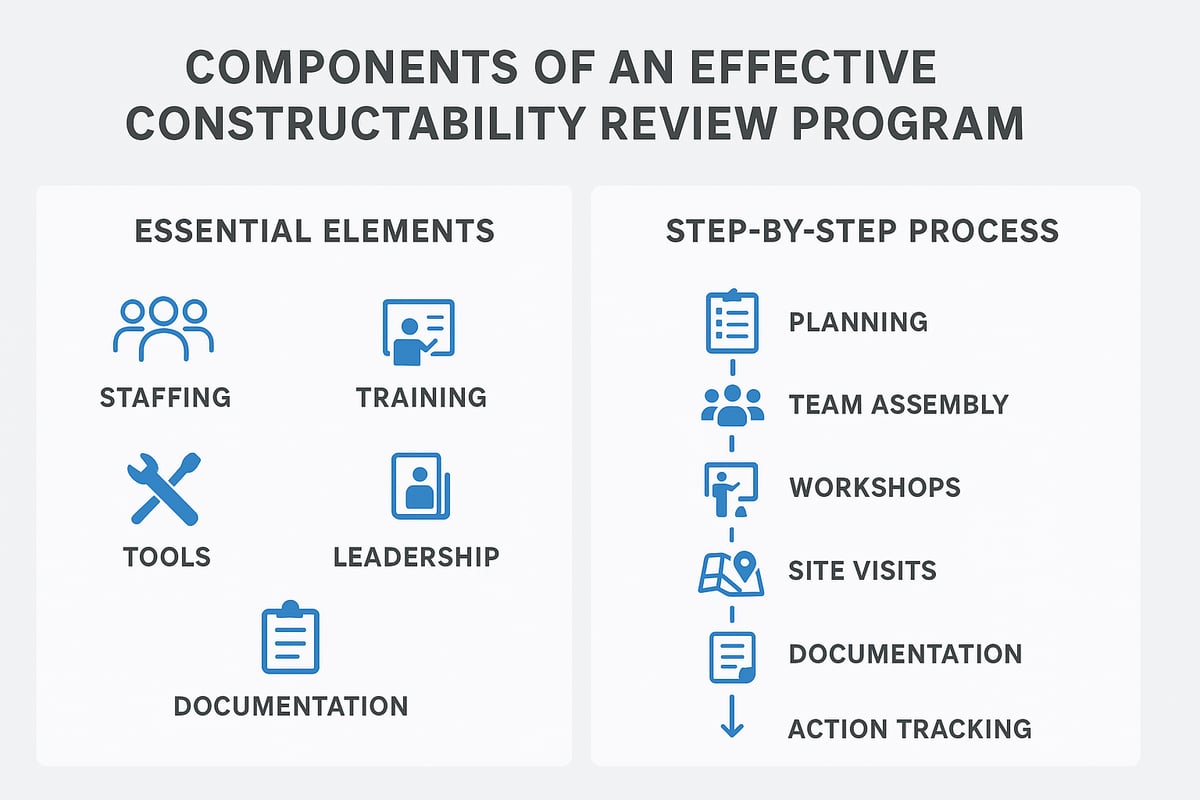
An effective constructability review program requires a structured, ongoing approach that integrates construction experience from the earliest project stages. Consistency is key—programs must be embedded within organizational processes, not treated as one-off exercises.
Staffing is critical. Involve experienced construction professionals from the start, including during conceptual design. Their insights shape practical solutions that designers alone might overlook. Training and tools further support this effort. Standardized procedures, checklists, and accessible knowledge-sharing platforms ensure every constructability review is thorough and repeatable.
Corporate support is non-negotiable. Leadership must champion the program, allocating resources and emphasizing its value. Integration with engineering teams is also essential. When construction needs are reflected in engineering decisions, designs become more buildable and schedules more reliable.
Documentation and follow-up drive continuous improvement. Every recommendation should be clearly recorded, tracked, and revisited. For example, programs that shift engineering focus to construction requirements consistently achieve better cost and schedule results.
Quality assurance practices are a cornerstone of this framework. For more on how these practices support effective constructability reviews, see Quality Control and Assurance in Construction.
The Constructability Review Process: Step-by-Step
A robust constructability review process unfolds in several key steps, each designed to maximize impact and capture value.
Step one is early planning. Reviews should begin during the Front-End Loading (FEL) phases, specifically FEL 2 and FEL 3. Early engagement enables teams to influence design before key decisions are finalized, thereby reducing the risk of costly changes later.
Next, assemble a multifunctional team. Include owner construction managers, designers, field supervisors, and contractors. Diverse expertise ensures all angles are considered, preventing knowledge gaps that may lead to rework.
Facilitated working sessions follow. These collaborative workshops encourage open discussion, surfacing constructability challenges and opportunities that might otherwise go unnoticed. Use structured agendas and checklists to maintain focus and depth.
Ensure comprehensive scope coverage. Reviews should address the entire project, not just selected elements. This holistic approach uncovers interdependencies and prevents scope gaps.
Site visits are indispensable. Seeing the physical context firsthand informs design and logistics decisions. Teams gather practical insights that desk-based reviews cannot provide.
Thorough documentation is essential at every stage. Record findings, proposed actions, and responsible parties using standardized templates. Clear records ensure accountability and enable future reference.
Finally, action tracking closes the loop. Assign a responsible person for each recommendation, and use project management tools to monitor progress. This step is often overlooked, but projects that rigorously track actions achieve higher implementation rates and greater overall value.
For example, projects conducting regular site visits and assigning responsibility for each action item have consistently higher rates of implemented improvements, according to industry data. This disciplined process ensures that the benefits of each constructability review are fully realized.
Constructability Review Best Practices for 2026 Projects
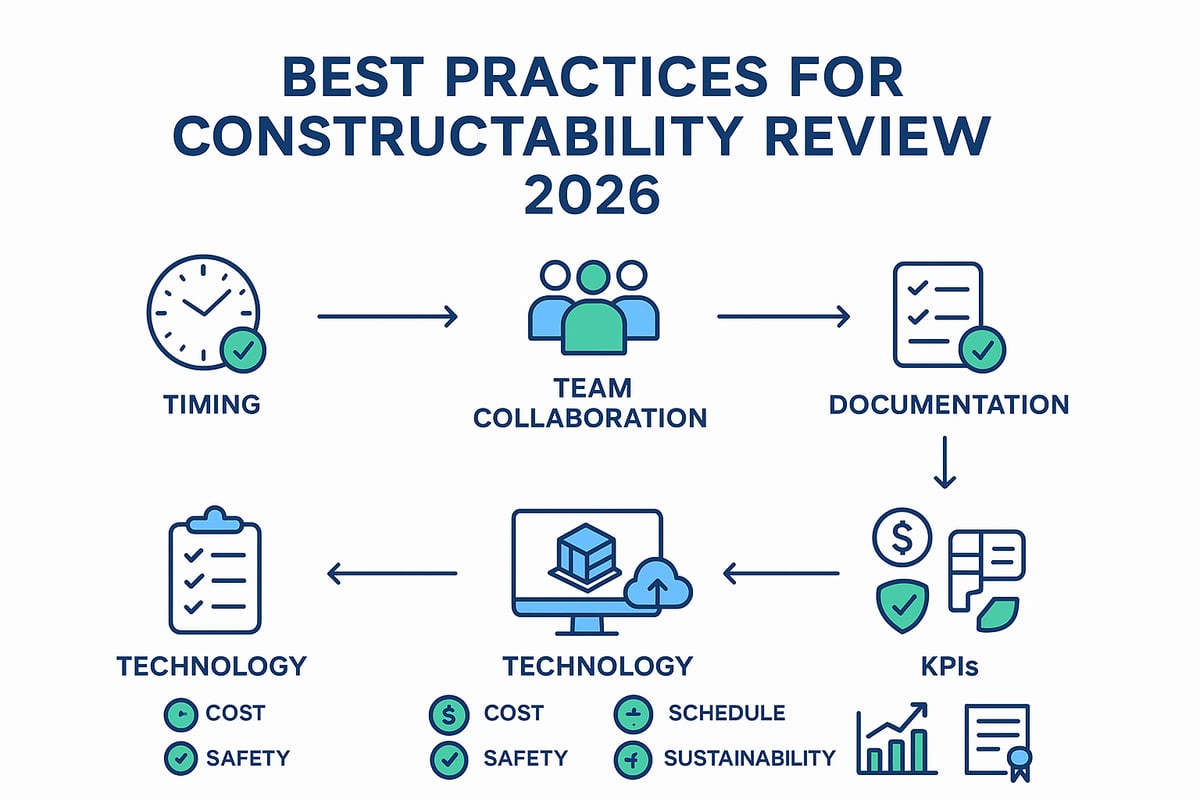
Staying ahead in 2026 means adopting a disciplined approach to the constructability review process. By applying proven best practices, project teams can improve cost, schedule, safety, and sustainability outcomes. Below, we break down the essential methods every team should master.
Timing and Frequency: When and How Often to Review
A high-impact constructability review program depends on timely and repeated engagement. Reviews should occur at least twice, during FEL 2 and FEL 3, to maximize their influence on design and execution.
Teams often overlook the value of early and periodic reviews. Data shows that only half of the projects conduct reviews at both major design stages. However, those who do experience fewer costly changes and better alignment with project goals.
For complex or evolving projects, schedule additional reviews after major scope changes. This ensures that each constructability review addresses current conditions, reducing risk and improving outcomes.
Team Composition and Collaboration
The strength of a constructability review lies in the diversity and expertise of its team members. Include owner construction managers, engineers, contractors, and field supervisors from the outset.
Multifunctional teams offer a broader perspective, helping to identify risks and opportunities that a single discipline might miss. In fact, 80% of successful projects have owner construction managers directly involved in the review process.
Encourage open communication and active knowledge sharing. A collaborative constructability review creates an environment where insights from the field inform design decisions, making the process more effective.
Robust Documentation and Analysis
Comprehensive documentation is the backbone of a successful constructability review. All participants should receive detailed materials, such as drawings and specifications, before each session.
Utilize structured templates and checklists to ensure consistency and thoroughness. Documenting estimated benefits for each recommendation helps prioritize actions and drives follow-through.
Projects that invest in robust documentation and benefit analysis see significantly higher rates of implemented recommendations. This disciplined approach ensures that every constructability review delivers measurable value.
Assigning Responsibility and Tracking Actions
Clear accountability is essential for translating constructability review findings into real-world improvements. Assign a responsible party to each action item identified during the review.
Despite its importance, only two-thirds of projects consistently assign responsibility, leading to missed opportunities. Use project management tools to monitor the status and closure of each action.
By making accountability a central pillar of the constructability review process, teams can ensure that valuable insights lead to tangible project enhancements.
Leveraging Technology and Digital Tools
Modern constructability review programs benefit greatly from digital transformation. Adopt digital platforms for real-time collaboration, documentation, and action tracking.
Building Information Modeling (BIM) enables advanced visualization, clash detection, and improved communication among stakeholders. For deeper insights into the benefits and challenges of BIM, see Digitalization in Infrastructure Construction Projects.
Integrate constructability review outputs directly with project management systems. This seamless connection increases transparency and accelerates decision-making in fast-paced 2026 projects.
Focus Areas: Cost, Schedule, Safety, and Sustainability
Prioritize recommendations that directly impact project cost, schedule, and safety. Constructability review teams should also integrate sustainability and carbon management, reflecting current industry trends.
Consider the following focus areas:
| Focus Area | Example Improvement |
|---|---|
| Cost | Optimize material handling to reduce waste |
| Schedule | Sequence activities for minimal delays |
| Safety | Redesign site layout for safer access |
| Sustainability | Select low-carbon construction methods |
By addressing these areas, each constructability review aligns project execution with both immediate and long-term objectives.
Measuring and Demonstrating Value
Tracking performance is key to demonstrating the impact of each constructability review. Monitor key performance indicators such as cost savings, schedule adherence, and the reduction of RFIs and change orders.
Benchmark results against industry data and previous internal projects. Sharing success stories and lessons learned across the organization builds momentum for ongoing improvement.
A data-driven constructability review process not only validates its effectiveness but also fosters a culture of excellence within the project team.
Common Pitfalls and How to Avoid Them
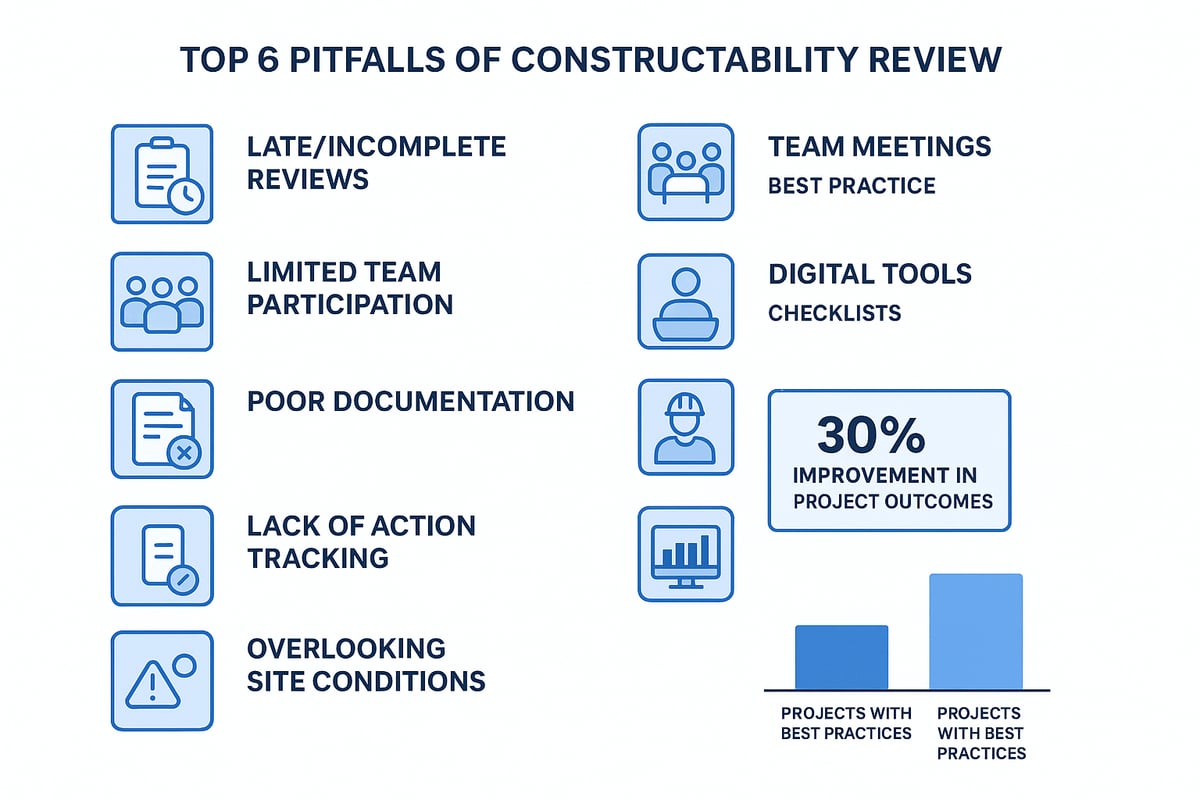
Conducting a constructability review can dramatically improve project outcomes, but only if common pitfalls are recognized and addressed. Many teams underestimate how small missteps can undermine the entire process. In today’s construction environment, overlooking these challenges can lead to costly delays and missed opportunities. According to the 2025 North American Engineering and Construction Outlook, industry leaders emphasize that effective constructability review is crucial for navigating tighter budgets and evolving project demands.
Incomplete or Late Reviews
One of the most significant issues in constructability review is starting too late or conducting reviews only after design is finalized. This limits the ability to influence design decisions, resulting in missed cost-saving opportunities and increased risk. Early engagement during front-end loading stages is essential to maximize the impact of constructability review.
Limited Team Participation
A successful constructability review requires input from a diverse, cross-functional team. Excluding construction managers, field supervisors, or specialty contractors can create blind spots. Projects often struggle when only design teams are involved, leading to missed practical insights that affect buildability and efficiency.
Poor Documentation and Action Tracking
Another common pitfall is inadequate documentation of findings and a lack of clear action tracking. Without robust records, recommendations from the constructability review are easily forgotten or misunderstood. Failure to assign responsible parties for each action item results in incomplete implementation and lost value.
Overlooking Site Constraints and Insufficient Analysis
Skipping site visits or failing to consider local conditions often leads to recommendations that are impractical or incomplete. Insufficient analysis during a constructability review can result in superficial feedback that fails to identify critical issues. Projects that approach reviews as a simple checklist exercise tend to underperform compared to those that dig deeper.
| Pitfall | Impact | Solution |
|---|---|---|
| Incomplete/Late Reviews | Reduced influence, higher costs | Schedule early, repeat as needed |
| Limited Team Participation | Missed insights, higher risk | Include all stakeholders |
| Poor Documentation/Tracking | Unimplemented improvements | Assign responsibility, use tools |
| Overlooking Site Constraints/Insufficient Analysis | Missed issues, rework | Conduct site visits, deeper review |
Solutions and Example
To avoid these pitfalls, schedule the constructability review early and repeat it at key milestones. Mandate cross-functional participation, including field staff and construction professionals. Use structured checklists and templates to ensure comprehensive documentation. Assign responsibility for each action and track progress using project management software. For instance, projects that perform site visits and clearly assign action items see higher rates of implementation and improved outcomes (IPA, 2025). Prioritizing these practices ensures your constructability review delivers measurable value and supports project success.
Measuring Constructability Review Quality and Impact
Evaluating the effectiveness of a constructability review is essential for driving continuous improvement and ensuring lasting value for every project. Without structured measurement, even the most thorough process can lose its impact over time. By implementing clear metrics and benchmarking methods, organizations can transform their constructability review into a proven driver of project success.
Quality Metrics and Assessment Tools
To ensure a constructability review delivers real value, organizations should adopt structured metrics that objectively assess the process. Key indicators include the depth of analysis, the quality and completeness of documentation, diversity of the review team, and the closure rate for action items. For example, a project that tracks every recommendation and assigns a responsible party for each action demonstrates a mature approach to review quality.
The use of standardized procedures and checklists is critical. Drawing from industry best practices and the Independent Project Analysis (IPA) 2022+ methodology, teams can audit their constructability review process at regular intervals. This approach helps identify strengths and highlight areas needing improvement.
Incorporating technical services, such as Construction Material Testing Services, further strengthens the assessment process. These services provide objective data to support the review’s findings, ensuring that recommendations are grounded in reliable field results. Regular feedback loops and internal audits create a culture of accountability and continuous learning.
Quantifying Outcomes and Continuous Improvement
The next step is to quantify how a constructability review impacts project outcomes. This involves gathering data on cost savings, schedule adherence, safety performance, and the frequency of change orders. By comparing these metrics against both industry benchmarks and an organization’s past projects, teams can clearly see where improvements have been made.
Continuous improvement is possible only when lessons learned are systematically captured and shared. After each constructability review cycle, teams should update their procedures and training materials to reflect new insights. This approach helps institutionalize best practices and prevent repeated mistakes.
Benchmarking also plays a vital role in this phase. By participating in industry benchmarking programs, organizations can measure their constructability review performance against leading peers. The result is a cycle of improvement that raises the bar for every future project.
Case Examples and Industry Benchmarks
Real-world examples show the power of a high-quality constructability review. Projects that rigorously apply these practices consistently report reduced schedule delays and measurable cost savings. According to IPA findings, teams using structured reviews outperform their peers in both predictability and efficiency.
For a broader view, organizations can refer to resources like the April 2025 Construction Statistics from the U.S. Census Bureau. Such data provides context for comparing project results and highlights the competitive advantage gained by refining the constructability review process.
Ultimately, sharing these success stories and metrics across the organization reinforces a culture of excellence and encourages broader adoption of best practices.
The Future of Constructability Reviews: Trends and Innovations for 2026
The future of the constructability review is rapidly evolving, driven by digital transformation and industry pressures. As projects become more complex, teams are turning to advanced tools and innovative processes to ensure every constructability review delivers measurable value.
Artificial intelligence and machine learning are reshaping the constructability review process. AI-powered software now scans building models to detect clashes, optimize layouts, and flag constructability risks earlier than ever. Automated review tools can process vast amounts of project data in seconds, providing actionable insights for design teams. As a result, constructability review activities are becoming more efficient and predictive, shifting focus from manual checks to strategic problem-solving.
Sustainability is now central to every constructability review. Teams are using digital tools to assess the carbon footprint of construction methods and materials at the design stage. By integrating sustainability metrics, review teams can recommend design changes that reduce environmental impact and comply with stricter 2026 regulations. This proactive approach ensures that every constructability review not only supports project efficiency but also aligns with long-term sustainability goals.
Collaboration technology is transforming how constructability review teams work together. Cloud-based platforms and digital twins enable real-time sharing of models, documents, and feedback, breaking down silos between designers, engineers, and contractors. For example, integrating geotechnical data with digital twins, as described in the Geotechnical Engineering Services Overview, gives teams a more complete picture of site conditions. This transparency leads to better decisions and fewer surprises during construction.
The constructability review process is also adapting to industry volatility. Early contractor involvement and collaborative contracting models are becoming standard, helping teams respond quickly to supply chain disruptions and labor shortages. According to the 2Q 2025 Cost Report, uncertainty is now a defining feature of construction projects. Agile constructability review practices, including frequent touchpoints and rapid feedback loops, are essential for success in this environment.
Looking ahead, constructability review will become even more data-driven and automated. Companies that embrace digital tools, early engagement, and continuous improvement will achieve faster delivery and higher quality. By embedding constructability thinking across all project phases, organizations can ensure that every constructability review remains a cornerstone of project success in 2026 and beyond.
As we look ahead to 2026, embracing best practices in constructability reviews can make all the difference in meeting your project’s goals—whether it’s boosting efficiency, controlling costs, or ensuring safety. If you’re ready to strengthen your approach and want guidance grounded in industry expertise, we’re here to help.
At ZALIG Consulting Ltd, we bring hands-on experience and tailored testing services to every stage of your project, supporting you from planning through execution. Let’s discuss how you can put these practices into action for your next project. Contact Us: info@zalig.ca or +1 800 515 0497