
The engineering services sector in Canada continues to evolve as infrastructure demands increase and regulatory requirements become more complex. A Canadian engineering firm today must balance technical expertise across multiple disciplines while delivering practical, defensible solutions that meet both client needs and compliance standards. From geotechnical investigations and environmental assessments to transportation planning and construction quality assurance, multidisciplinary firms play a critical role in shaping the built environment across civil infrastructure, commercial development, and industrial projects.
The Scope of Engineering Services in Canada
Engineering firms across Canada provide specialized expertise to support projects from initial feasibility through final commissioning. The industry encompasses a broad range of technical disciplines, each addressing specific challenges in project development and construction execution.
Multidisciplinary Service Integration
A modern Canadian engineering firm typically integrates field services, laboratory testing, and engineering design to deliver comprehensive project support. This integration allows clients to work with a single firm throughout the project lifecycle, reducing coordination gaps and improving consistency in technical recommendations.
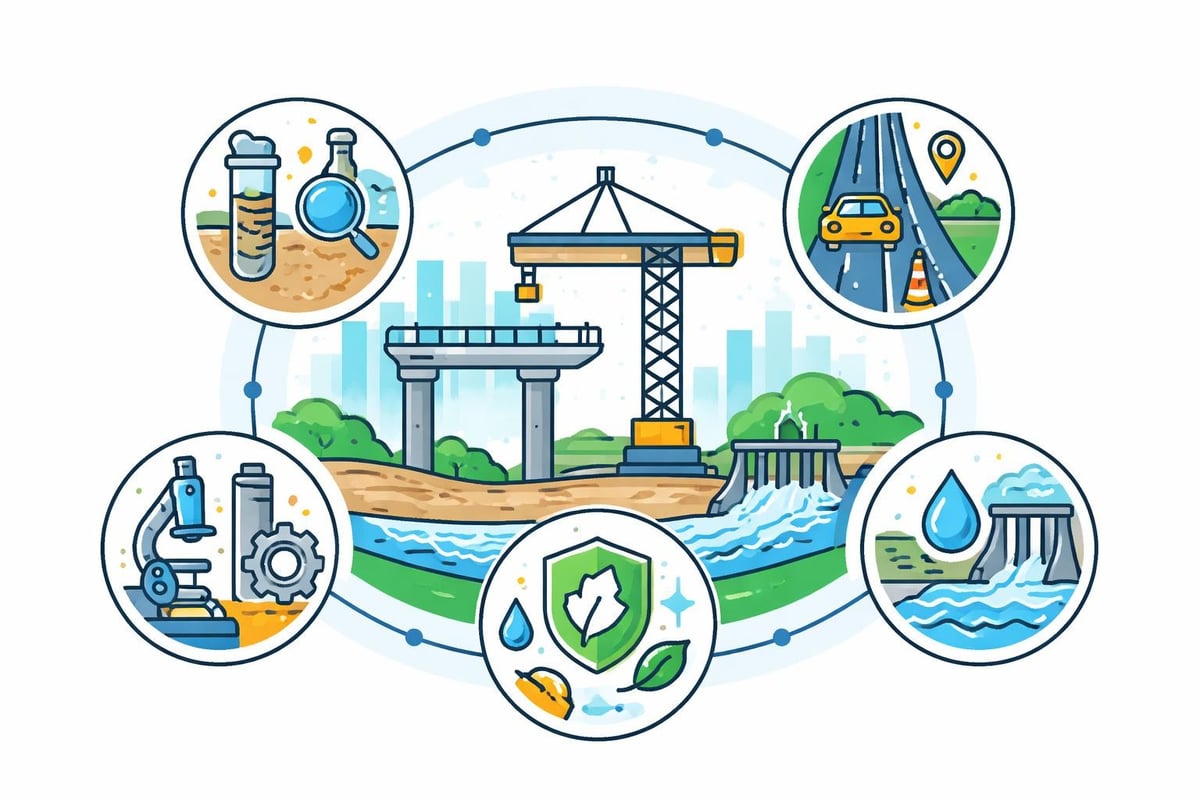
Core service areas include:
- Geotechnical investigations and foundation design
- Environmental site assessments and risk management
- Transportation planning and traffic engineering
- Hydrotechnical analysis for drainage and watercourse management
- Construction materials testing and quality control
The value of multidisciplinary capability becomes evident when projects require coordination between environmental compliance, geotechnical conditions, and construction sequencing. A firm that can address all these elements internally streamlines decision-making and reduces the risk of conflicting recommendations.
Industry Size and Economic Impact
The Canadian engineering services sector represents a significant portion of the country's professional services economy. According to Statistics Canada’s 2023 industry overview, the engineering services industry demonstrates consistent growth in operating revenues and employment, reflecting ongoing demand for technical expertise across infrastructure and development sectors.
Market analysis from IBISWorld indicates that the engineering services industry in Canada continues to expand, driven by infrastructure renewal, resource development, and urbanization pressures. The number of firms operating in this sector has also grown, with business statistics showing an increase in both large multidisciplinary firms and specialized boutique consultancies.
Revenue Distribution and Market Segments
| Segment | Revenue Contribution | Growth Drivers |
|---|---|---|
| Civil Infrastructure | 35-40% | Municipal renewal, transportation expansion |
| Industrial | 25-30% | Resource projects, manufacturing facilities |
| Commercial Development | 20-25% | Urban development, mixed-use projects |
| Environmental Services | 10-15% | Regulatory compliance, remediation |
Different regions across Canada show varying demand patterns based on local economic drivers. Western provinces tend to have higher demand for resource-related engineering, while Ontario and Quebec show strong commercial and institutional project activity.
Key Service Areas for Canadian Engineering Firms
Geotechnical Engineering
Geotechnical services form the foundation of most civil infrastructure and development projects. A Canadian engineering firm providing geotechnical expertise conducts subsurface investigations, analyzes soil and groundwater conditions, and develops foundation recommendations tailored to site-specific conditions.
Typical geotechnical deliverables include:
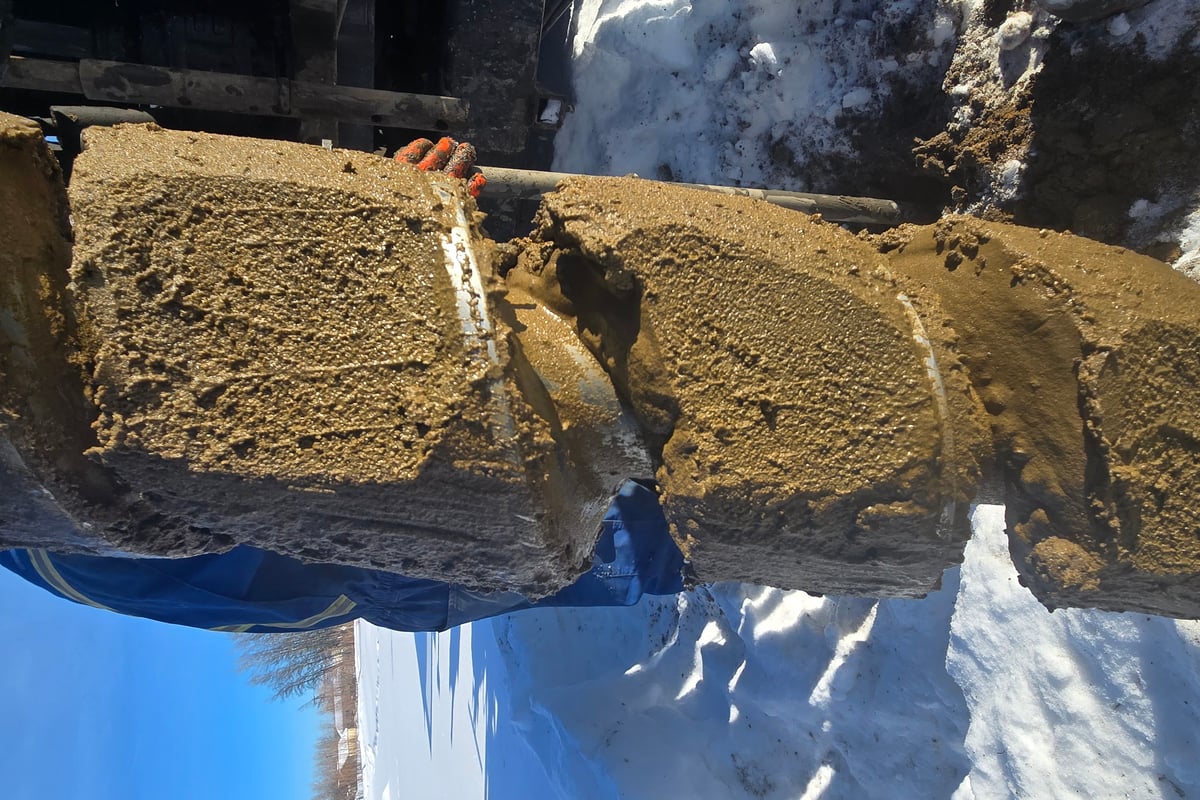
- Subsurface investigation programs with drilling and sampling
- Laboratory testing for soil classification and engineering properties
- Foundation design for buildings and structures
- Slope stability analysis and stabilization measures
- Earth structure design for embankments and retaining systems
- Dewatering and drainage system planning
Projects involving challenging ground conditions such as high water tables, expansive soils, or frost-susceptible materials require careful geotechnical analysis to manage construction risk and ensure long-term performance. The geotechnical engineering capabilities that include advanced laboratory testing provide the technical foundation for defensible design recommendations.
Environmental Site Assessment and Risk Management
Environmental due diligence has become a standard component of property transactions and development approvals. A Canadian engineering firm offering environmental services conducts Phase I, II, and III Environmental Site Assessments to identify potential contamination risks and support regulatory compliance.
Environmental assessment services help property owners and developers understand site conditions before acquisition or redevelopment. Phase I assessments involve records review and site reconnaissance, while Phase II work includes intrusive investigation with soil and groundwater sampling. Phase III assessments focus on remediation planning and implementation when contamination is confirmed.
For projects requiring detailed environmental investigation, firms integrate environmental assessment protocols with practical risk management strategies that balance regulatory requirements with project budgets and timelines.
Transportation Engineering and Traffic Analysis
Transportation planning and design services address road networks, intersection geometry, access management, and traffic flow optimization. A Canadian engineering firm working in transportation conducts Traffic Impact Assessments to evaluate how proposed developments affect existing road systems and identify necessary improvements.
Transportation engineers collaborate with municipal authorities to ensure designs meet local standards and support development approvals. Services extend from preliminary concept planning through detailed design and construction support, including pavement design, drainage integration, and signing and marking plans.
The transportation engineering services that support development projects help clients navigate municipal approval processes while delivering safe, efficient circulation and parking layouts.
Quality Assurance Through Materials Testing
Construction materials testing provides independent verification that installed materials meet specification requirements. A Canadian engineering firm offering CCIL-certified testing services conducts field sampling and laboratory analysis for concrete, asphalt, aggregates, and compacted fill materials.
Materials testing services include:
- Concrete cylinder sampling and compressive strength testing
- Asphalt mix verification and field density confirmation
- Aggregate gradation, durability, and quality testing
- Soil compaction verification for earthwork and backfill
- Foundation bearing verification and pile integrity testing
Quality control testing helps contractors identify material issues early, before they become costly construction problems. Independent testing also provides owners with documentation that work meets contract requirements and regulatory standards.
When foundation systems require verification, materials testing complements geotechnical design by confirming that installation meets specified performance criteria. This integration of design and field verification reduces risk for all project stakeholders.
| Test Type | Standard | Typical Frequency | Purpose |
|---|---|---|---|
| Concrete Cylinders | CSA A23.1 | Per 50-100 m³ | Verify compressive strength |
| Asphalt Density | ASTM D6938 | Per 250-500 tonnes | Confirm compaction |
| Soil Compaction | ASTM D1556 | Per lift per zone | Verify earthwork density |
| Aggregate Gradation | ASTM C136 | Per source/shipment | Quality consistency |
Hydrotechnical Engineering for Water Management
Hydrotechnical services address surface water management, drainage design, and watercourse interaction. A Canadian engineering firm providing hydrotechnical analysis conducts hydrologic and hydraulic modeling to size drainage systems, evaluate flood risk, and design erosion protection measures.
Projects involving culvert installations, stormwater management ponds, or watercourse crossings require detailed hydraulic analysis to meet regulatory requirements and ensure long-term functionality. Engineers evaluate watershed characteristics, rainfall patterns, and downstream impacts to develop compliant, resilient solutions.
Regulatory agencies increasingly require detailed technical support for works affecting watercourses and floodplains. Firms that can provide the necessary hydrologic modeling and regulatory liaison help clients navigate approval processes efficiently.
Industry Consolidation and Market Trends
The Canadian engineering services sector has seen significant consolidation in recent years as larger firms acquire specialized companies to expand geographic reach and service capabilities. Stantec’s record-setting financial performance in 2025 demonstrates the scale achievable through strategic growth and service diversification.
Recent notable acquisitions include Stantec’s purchase of Page, a U.S.-based design and engineering firm, and Colliers’ addition of Higher Ground Consulting to expand engineering capabilities in Western Canada. Stantec’s planned acquisition of Morrison Hershfield further illustrates the trend toward creating comprehensive multidisciplinary platforms.
What Drives Consolidation
- Client demand for single-source solutions across multiple disciplines
- Geographic expansion to serve clients across broader regions
- Technology investment requirements for modeling and analysis tools
- Talent acquisition and retention through larger organizational platforms
- Regulatory complexity requiring deeper specialized expertise
Despite consolidation trends, mid-sized regional firms continue to compete effectively by offering responsive service, local market knowledge, and principal-level involvement on projects. Employee ownership models at firms like RJC Engineers demonstrate alternative approaches to organizational growth and leadership development.
Selecting the Right Engineering Partner

Clients evaluating a Canadian engineering firm should consider several factors beyond technical credentials. The right firm brings not only discipline expertise but also practical construction knowledge, regulatory experience, and collaborative problem-solving capabilities.
Evaluation Criteria
Technical capability includes:
- Relevant discipline expertise for project requirements
- In-house field and laboratory capabilities
- Professional registration in applicable jurisdictions
- Quality management systems and insurance coverage
- Technology platforms for modeling and analysis
Project delivery factors include:
- Track record with similar project types and scales
- Understanding of local regulatory requirements
- Responsiveness and communication approach
- Ability to integrate with project teams
- Value engineering and constructability focus
The best engineering relationships develop when firms understand client objectives beyond technical scope. Whether supporting property transactions, development approvals, or construction execution, the engineering firm should align recommendations with business timelines and risk tolerance.
Regional Considerations Across Canada
Engineering requirements vary significantly across Canadian provinces due to differences in geology, climate, regulatory frameworks, and development patterns. A Canadian engineering firm operating in multiple regions must adapt technical approaches to local conditions while maintaining consistent quality standards.
Western Canada Characteristics
Western provinces face unique challenges including expansive clay soils, high water tables in prairie regions, seismic considerations in British Columbia, and frost penetration concerns across all areas. Transportation projects must address significant seasonal temperature ranges that affect pavement performance and drainage function.
Environmental considerations in Western Canada often involve petroleum hydrocarbon impacts from historical industrial activity, requiring Phase II investigations and remediation planning to support redevelopment.
Ontario and Quebec Factors
Central Canada's established urban areas involve significant redevelopment activity on sites with complex environmental histories. Deep fill conditions, variable soil profiles from glacial deposition, and proximity to watercourses require detailed investigation programs.
Traffic analysis in dense urban settings must account for multimodal transportation including pedestrian, cycling, and transit interactions. Municipal design standards tend to be highly prescriptive, requiring detailed knowledge of local requirements.
Atlantic Provinces and Northern Regions
Coastal areas must address marine influences on foundations and structures, including salt exposure and wave action considerations. Northern regions face permafrost challenges, extreme frost penetration, and remote logistics that affect investigation and construction approaches.
Limited local laboratory and testing resources in remote areas often require firms to mobilize capabilities from southern bases, affecting project schedules and budgets.
Future Outlook for Engineering Services
Market projections from Grand View Research indicate continued growth for the Canadian engineering services sector through 2030, driven by infrastructure renewal needs, climate adaptation requirements, and ongoing development pressure in urban centers.
Emerging focus areas include:
- Climate resilience design for infrastructure exposed to changing weather patterns
- Sustainable development practices incorporating green infrastructure and reduced environmental impact
- Digital integration with building information modeling and geographic information systems
- Advanced materials requiring updated testing protocols and performance verification
- Indigenous consultation and partnership in project planning and delivery
A Canadian engineering firm that adapts to these evolving requirements while maintaining core technical competence will be well-positioned to serve clients across diverse project types and delivery models. The firms that successfully integrate technical innovation with practical, constructible solutions will continue to add value throughout the project lifecycle.
Technology Adoption in Engineering Practice
Modern engineering practice increasingly relies on sophisticated analysis tools for modeling complex systems and communicating results to non-technical stakeholders. Geotechnical engineers use finite element analysis for complex foundation systems, while transportation planners employ microsimulation to evaluate traffic flow scenarios.
Environmental site assessment now incorporates three-dimensional visualization of subsurface contamination plumes, and hydrotechnical analysis uses watershed-scale modeling to evaluate cumulative development impacts. These tools improve technical accuracy but require ongoing investment in software platforms and staff training.
The most effective application of technology maintains focus on practical recommendations that contractors can implement and owners can understand. Advanced analysis should support decision-making rather than obscure it with unnecessary complexity.
Collaborative Delivery Approaches
Successful project outcomes depend on effective collaboration between engineering consultants, owners, contractors, and regulatory agencies. A Canadian engineering firm that understands construction processes and contractor constraints develops more constructible designs and fewer field changes.
Early contractor involvement allows engineering teams to validate assumptions about construction methods, equipment access, and schedule constraints. This collaboration improves cost estimating accuracy and reduces the risk of value engineering substitutions that compromise design intent.
Regular communication with regulatory agencies during design development helps identify approval risks early and incorporate reviewer feedback before formal submission. Firms with established relationships with municipal and provincial reviewers can often expedite approval timelines through proactive coordination.
Environmental site assessments conducted with clear understanding of transaction timelines and financial contingencies provide more useful risk information than purely technical reports. Geotechnical recommendations that account for construction equipment capabilities and site logistics support more competitive bidding.
When foundation conditions prove more challenging than anticipated, a collaborative approach with the contractor and structural engineer identifies practical solutions quickly. Materials testing programs that align sampling frequency with construction progress provide timely feedback without delaying work.
ZALIG Consulting Ltd.'s approach to geotechnical engineering services demonstrates how integrated field investigation, laboratory testing, and design analysis deliver practical foundation solutions tailored to site conditions and construction constraints.
Professional Standards and Quality Management
Canadian engineering firms operate under provincial professional engineering legislation that establishes practice standards and accountability requirements. Professional engineers must seal work within their area of competence and maintain professional liability insurance to protect clients.
Quality management systems help firms maintain consistency across projects and personnel. Documented procedures for field investigation, laboratory testing, design review, and report preparation ensure that junior staff follow established protocols while senior engineers focus oversight on critical technical decisions.
Third-party accreditation programs such as CCIL certification for construction materials testing laboratories provide independent verification that testing procedures meet national standards. This accreditation gives project stakeholders confidence in test result reliability and defensibility.
Continuing education requirements ensure professional engineers stay current with evolving codes, standards, and technical methods. Firms that support professional development through training programs and conference attendance maintain technical capabilities as industry practices advance.
A successful Canadian engineering firm in 2026 combines deep technical expertise across multiple disciplines with practical understanding of construction realities and regulatory requirements. Whether supporting infrastructure renewal, commercial development, or industrial expansion, multidisciplinary firms that integrate field services, laboratory testing, and engineering design deliver the most value throughout project lifecycles. ZALIG Consulting Ltd provides comprehensive geotechnical, environmental, transportation, hydrotechnical, and materials testing services to help public and private sector clients navigate complex projects from planning through commissioning with practical, defensible engineering solutions.