

Understanding the capacity of soil to support structural loads is fundamental to every civil infrastructure project. Whether designing a high-rise building, transportation corridor, or industrial facility, engineers must determine how much load the underlying ground can safely carry without excessive settlement or catastrophic failure. This determination shapes foundation design decisions, influences construction costs, and directly impacts the long-term performance and safety of structures across commercial, industrial, and public sector projects.
What Is Bearing Capacity and Why It Matters
Bearing capacity represents the maximum pressure that soil or rock can support from a foundation without experiencing shear failure or excessive settlement. This critical parameter governs foundation sizing, depth, and type selection across all construction projects. When engineers evaluate bearing capacity, they assess both the ultimate capacity (the maximum load before failure) and the allowable capacity (the safe working load incorporating appropriate safety factors).
The concept extends beyond simple load-carrying calculations. Soil behavior under stress involves complex interactions between particle structure, moisture content, confinement conditions, and loading characteristics. Understanding these mechanisms allows engineers to predict performance, identify risks, and design foundations that perform reliably throughout their service life.
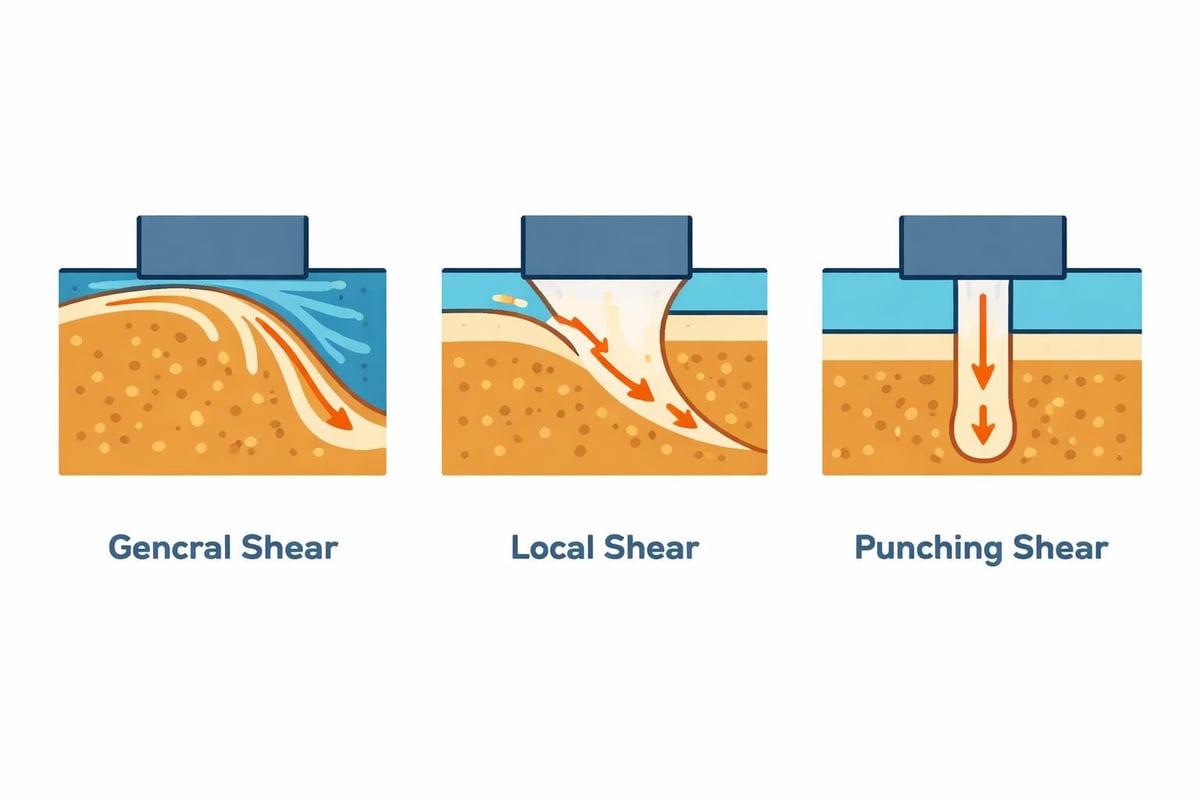
Three primary failure mechanisms govern how foundations fail:
- General shear failure occurs in dense, stiff soils where a well-defined slip surface develops
- Local shear failure happens in medium-dense soils with partial slip surface development
- Punching shear failure takes place in loose soils where the foundation penetrates downward with minimal lateral displacement
Each failure mode requires different analytical approaches and produces distinct patterns of distress. Recognizing which mechanism governs a particular site condition is essential for accurate capacity prediction.
Theoretical Foundations and Calculation Methods
Engineers rely on established theoretical frameworks to calculate bearing capacity values. The most widely used approach stems from Terzaghi's bearing capacity theory, which introduced systematic methods for quantifying soil strength under foundation loads. This framework, later refined by Meyerhof, Hansen, and Vesic, forms the basis for modern foundation design practice.
The general bearing capacity equation incorporates three key components representing different resistance mechanisms. These components account for soil cohesion, surcharge pressure from adjacent soil or foundations, and the self-weight of soil within the failure zone. Each component is modified by dimensionless bearing capacity factors that depend on the soil's internal friction angle.
Bearing Capacity Factors and Their Application
The bearing capacity factors (Nc, Nq, Nγ) vary dramatically with soil friction angle. For purely cohesive soils with zero friction angle, certain factors become unity while others approach specific theoretical values. As friction angle increases in granular soils, these factors grow exponentially, reflecting the enhanced resistance provided by particle interlocking and dilatancy.
| Friction Angle (φ) | Nc Factor | Nq Factor | Nγ Factor |
|---|---|---|---|
| 0° (soft clay) | 5.14 | 1.00 | 0.00 |
| 20° | 14.83 | 6.40 | 5.39 |
| 30° | 30.14 | 18.40 | 22.40 |
| 40° | 75.31 | 64.20 | 109.41 |
Shape factors, depth factors, and inclination factors modify the basic bearing capacity equation to account for foundation geometry, embedment depth, and eccentric or inclined loading. These correction factors ensure calculations reflect actual field conditions rather than idealized scenarios. The University of the West of England provides detailed explanations of these derivations and their practical application.
Soil Parameter Determination
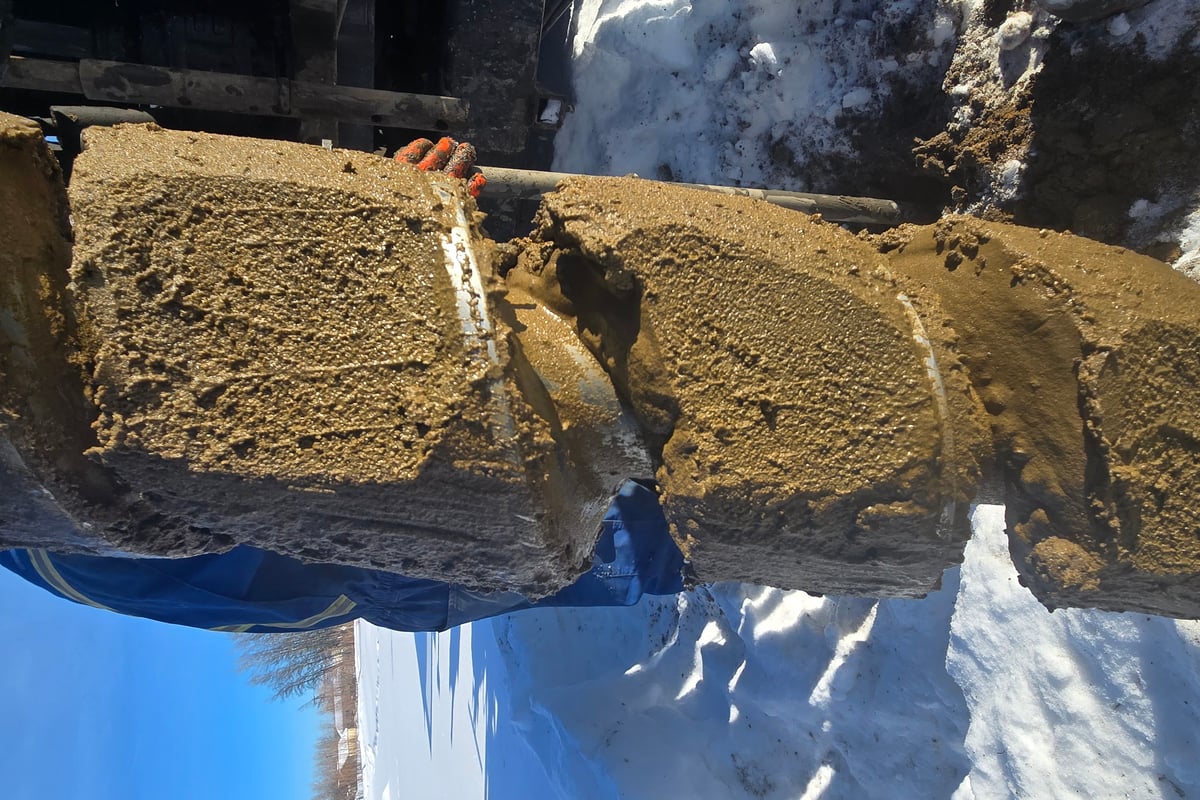
Accurate bearing capacity calculations depend entirely on reliable soil parameters. Engineers obtain these values through comprehensive geotechnical investigations combining field testing and laboratory analysis. Standard Penetration Testing (SPT), Cone Penetration Testing (CPT), and vane shear testing provide direct or indirect measures of soil strength in situ.
Laboratory testing on recovered samples allows measurement of:
- Unconfined compressive strength for cohesive soils
- Consolidated undrained and drained triaxial strength parameters
- Direct shear strength under specific normal stress conditions
- Consolidation characteristics affecting long-term settlement
The Transportation Research Board documents comprehensive guidelines for determining these parameters and applying them to foundation design calculations. Proper sampling techniques, careful specimen handling, and testing procedures following ASTM or CSA standards ensure defensible results that support regulatory approvals and manage project risk.
Practical Considerations in Foundation Design
While theoretical equations provide the analytical framework, practical foundation design requires engineering judgment informed by site-specific conditions and project constraints. Allowable bearing capacity incorporates safety factors typically ranging from 2.5 to 3.0 for ultimate limit states, though these values adjust based on soil variability, structure importance, and loading characteristics.
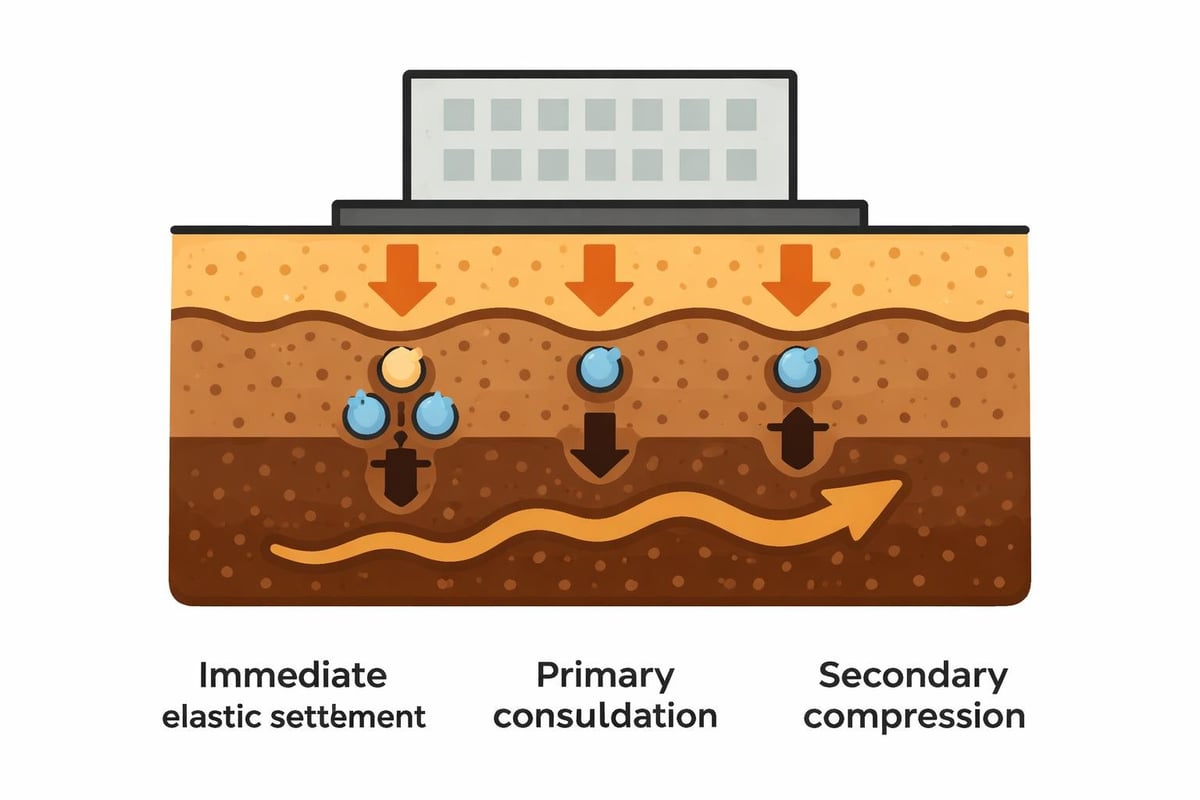
Settlement often governs foundation design more than shear capacity. A soil may possess adequate strength to prevent failure while still experiencing unacceptable deformation under service loads. Differential settlement, where adjacent foundation elements settle by different amounts, creates particularly severe distress in structures sensitive to displacement.
Engineers evaluate settlement through consolidation theory for fine-grained soils and elastic theory for coarse-grained materials. Time-dependent settlement in clays subjected to new loads follows well-established consolidation principles, while immediate settlement in sands responds to elastic compression and particle rearrangement.
Site-Specific Adjustments and Special Conditions
Real-world sites rarely match the idealized conditions assumed in basic bearing capacity equations. Groundwater presence significantly reduces effective stress and bearing capacity in cohesive soils. When the water table rises within a depth equal to the foundation width below the base, correction factors account for buoyancy effects on the soil below the foundation.
Sloping ground conditions, eccentric loading from walls or columns near property lines, and layered soil profiles all require specialized analysis approaches. The effective width method handles eccentricity by reducing the foundation dimension in bearing capacity calculations. Layered soils may require punching shear analysis when weak layers underlie stronger surface materials.
Frost heave in cold climates, expansive clay behavior in arid regions, and collapsible soil conditions in certain geologic settings introduce additional design constraints. Foundation depth must extend below frost penetration depths to prevent heave damage. Expansive soils may require specialized foundation systems or soil stabilization to manage volume change.
Testing and Verification Methods
Field verification of bearing capacity assumptions protects against design errors and validates analytical predictions. Plate load testing applies incremental loads to steel plates bearing on the foundation subgrade while measuring settlement at each load increment. The load-settlement curve reveals bearing capacity and provides data for settlement prediction.
The International Association of Dredging Companies discusses zone load testing and other verification methods used to confirm capacity in the field before full-scale construction proceeds. These tests prove particularly valuable when soil conditions vary significantly across a site or when limited subsurface information creates uncertainty in design parameters.
Dynamic testing methods using falling weights or driven probes offer rapid assessment capabilities, though correlation to static capacity requires site-specific calibration. Proof loading of completed foundations provides the ultimate verification but must be carefully controlled to avoid damage while confirming adequate capacity margins.
Quality Assurance During Construction
Construction activities significantly impact actual bearing capacity achieved in the field. Excavation disturbance, weather exposure, and groundwater infiltration can degrade subgrade conditions between exploration and construction. Regular observation of exposed bearing surfaces helps identify unsuitable materials requiring removal and replacement.
Foundation construction monitoring should verify bearing stratum identity, confirm design assumptions about soil conditions, and document any deviations requiring design adjustments. When engineers encounter unexpected materials or groundwater conditions, prompt evaluation and appropriate design modifications prevent costly failures or delays.
Advanced geotechnical investigations conducted during planning phases establish baseline conditions and design parameters. Advanced geotechnical laboratory testing provides detailed characterization of soil behavior under various stress paths and drainage conditions, supporting refined analysis and optimized foundation solutions.
Proof rolling of prepared subgrades using loaded trucks identifies soft spots and areas of inadequate compaction before concrete placement. This simple yet effective technique prevents localized failures that might not appear in design calculations based on average soil properties.
Regulatory Requirements and Design Standards
Building codes and regulatory frameworks establish minimum requirements for bearing capacity determination and foundation design. The Code of Federal Regulations outlines methods for determining soil classifications and bearing capacity values for certain structure types, providing standardized approaches that ensure baseline safety.
Professional engineering standards published by organizations like the American Society of Civil Engineers (ASCE) and Canadian Standards Association (CSA) offer detailed guidance on investigation extent, testing frequency, and analysis methods. These standards evolve to incorporate research findings and lessons learned from foundation performance observations.
State and provincial regulations often specify minimum investigation depths, required testing types, and documentation standards for projects within their jurisdictions. Municipal authorities may impose additional requirements based on local geologic conditions or historical performance issues. Understanding and complying with these regulatory requirements prevents approval delays and ensures designs meet community expectations for safety and performance.
The Association of State Dam Safety Officials provides specific guidance for bearing capacity evaluation under dam structures, where consequences of failure warrant particularly rigorous investigation and conservative design approaches.
Design Optimization and Cost Considerations
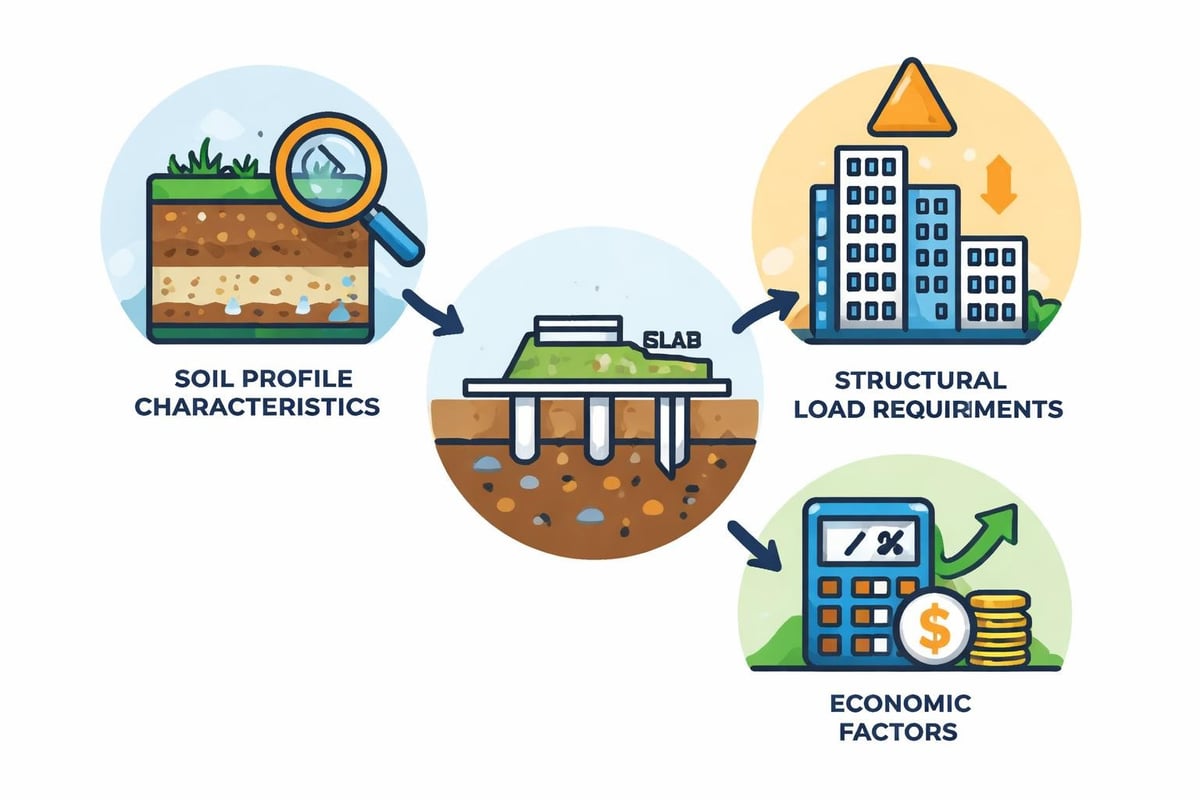
Foundation costs represent a substantial portion of overall project budgets, creating strong incentives for optimization while maintaining adequate safety margins. Rational bearing capacity assessment using site-specific soil parameters rather than conservative tabulated values often reveals opportunities for foundation economy without compromising performance.
Consider these optimization strategies:
- Increase foundation depth to reach stronger bearing strata when shallow soils prove inadequate
- Widen foundation elements to reduce bearing pressure when depth increases prove impractical
- Improve soil conditions through compaction, replacement, or stabilization when natural capacity proves insufficient
- Select alternative foundation types such as deep foundations when shallow options become uneconomical
Each approach carries distinct cost implications and constructability considerations. Geotechnical engineers work collaboratively with structural designers, contractors, and owners to identify the most economical solution meeting performance requirements and project constraints.
| Foundation Type | Typical Bearing Pressure Range | Best Application |
|---|---|---|
| Shallow spread footings | 50-300 kPa | Competent soils, light to moderate loads |
| Mat foundations | 100-500 kPa | Poor soils, heavy loads, differential settlement control |
| Driven piles | 500-5000 kPa (end bearing) | Deep deposits, high loads, scour zones |
| Drilled shafts | 1000-10000 kPa (end bearing) | Variable soils, noise restrictions, large loads |
Value engineering studies examining foundation alternatives during design development frequently identify substantial savings. Research from the University of Texas demonstrates predictive models based on comprehensive databases that help engineers estimate bearing capacity ranges early in planning, supporting informed decisions about foundation feasibility and cost.
Integration with Project Delivery
Effective bearing capacity assessment requires coordination across all project phases from due diligence through commissioning. Early-stage investigations during site selection and acquisition inform feasibility decisions and preliminary budgets. Detailed investigations during design development provide parameters for final foundation sizing and specification preparation.
Construction-phase services ensure actual conditions match design assumptions and allow prompt resolution of unexpected conditions. Post-construction monitoring on sensitive structures verifies predicted settlement magnitudes and rates, validating design approaches and informing future projects with similar conditions.
ZALIG Consulting Ltd delivers comprehensive geotechnical engineering services integrating field investigations, laboratory testing, and foundation design to support projects from initial planning through construction completion. Our multidisciplinary approach connects geotechnical capacity assessment with structural requirements, environmental constraints, and construction logistics.
Addressing Uncertainty and Risk Management
No site investigation captures every detail of subsurface conditions across an entire project footprint. Spatial variability in soil properties, limitations on boring density for budget reasons, and inherent variability in natural materials create uncertainty that must be recognized and managed through design conservatism and construction monitoring.
Probabilistic approaches to bearing capacity evaluation acknowledge this uncertainty explicitly, calculating failure probabilities rather than deterministic safety factors. While more complex than traditional methods, probabilistic analysis provides rational basis for calibrating designs to project risk tolerance and consequence of failure scenarios.
Contingency allowances in project budgets and schedules accommodate potential foundation modifications discovered during construction. Experienced owners recognize that some level of unforeseen condition response proves more economical than exhaustive investigation attempting to eliminate all uncertainty before construction begins.
Long-Term Performance Monitoring
Foundation performance extends throughout a structure's service life, requiring attention to time-dependent behavior and changing loading conditions. Settlement in fine-grained soils may continue for years after construction as consolidation progresses under sustained loads. Monitoring programs on critical structures track settlement magnitude, rate, and distribution to detect anomalous behavior requiring intervention.
Periodic inspections identify foundation distress signs including:
- Differential settlement causing structural cracking or distortion
- Erosion or scour undermining bearing capacity
- Groundwater changes affecting effective stress and capacity
- Adjacent construction imposing additional loads or vibration
Early detection allows corrective action before minor issues escalate to structural damage or safety concerns. The Designing Buildings Wiki discusses monitoring approaches and intervention strategies for foundations experiencing performance issues.
Climate change considerations increasingly influence foundation design through more intense precipitation events affecting groundwater levels, deeper frost penetration in some regions, and permafrost degradation in northern areas. Resilient design approaches anticipate these changing conditions through conservative capacity assumptions or adaptive foundation systems allowing future modification.
Bearing capacity fundamentals underpin safe, economical foundation design across all civil infrastructure sectors, requiring systematic investigation, rigorous analysis, and careful construction oversight. The integration of field exploration, laboratory testing, and engineering judgment produces foundation solutions that manage risk, support regulatory compliance, and deliver reliable long-term performance. ZALIG Consulting Ltd provides comprehensive geotechnical services combining these elements to support your infrastructure projects from initial feasibility through successful commissioning and beyond.