

Foundation failures can lead to catastrophic losses and spiraling costs, making allowable bearing pressure a cornerstone of structural safety in 2026. As construction projects become more complex, the importance of accurate, up-to-date geotechnical data has never been greater.
Today's engineers, architects, and developers need clear, actionable guidance to navigate evolving standards and avoid costly mistakes. This article delivers essential insights on allowable bearing pressure, helping you design safer, more efficient foundations.
We will define key terms, cover calculation methods, explain regulatory standards, discuss settlement and serviceability, and share real-world examples. Stay ahead of industry changes with expert advice tailored for modern construction.
Understanding Allowable Bearing Pressure: Key Concepts and Definitions
What Is Allowable Bearing Pressure?
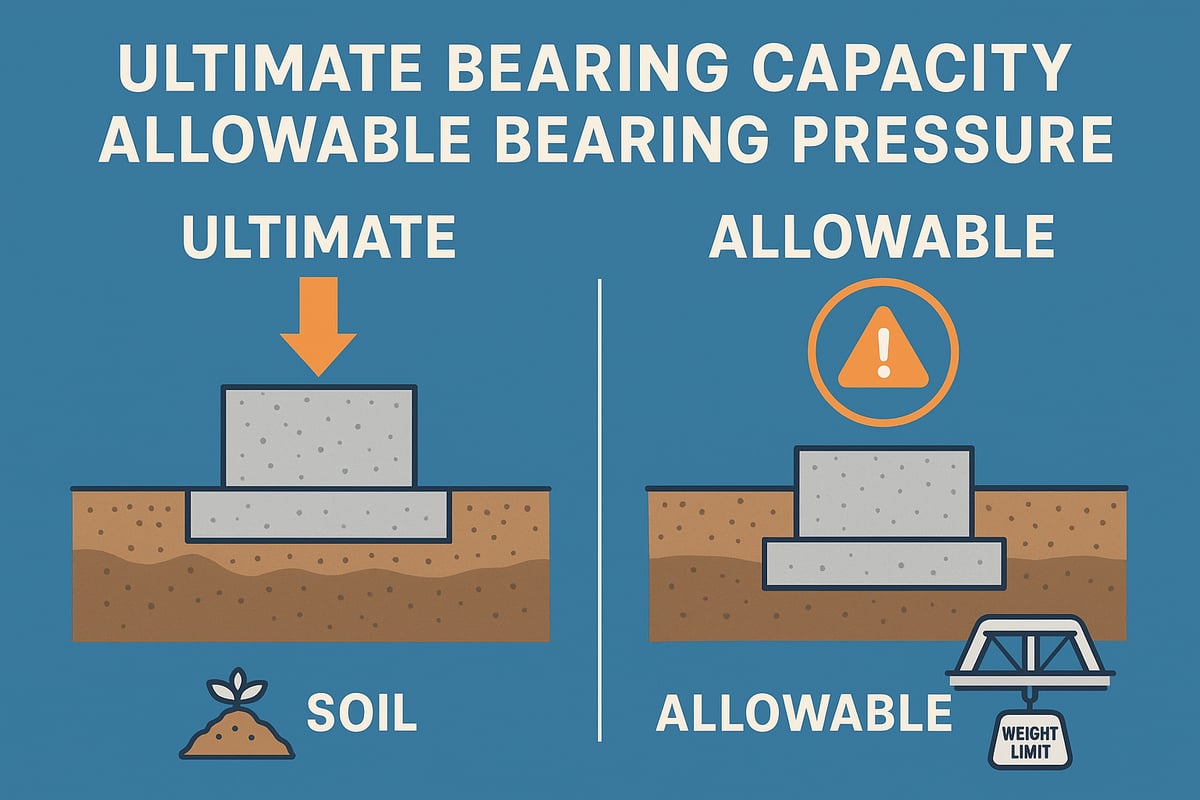
Allowable bearing pressure is a fundamental concept in geotechnical engineering. It describes the maximum pressure that can be safely applied by a foundation to the underlying soil without risking excessive settlement or structural failure. While ultimate bearing capacity represents the theoretical maximum load the ground can support, allowable bearing pressure is always lower, incorporating safety factors to manage uncertainties.
Think of ultimate bearing capacity as the absolute limit of a bridge, while allowable bearing pressure is the safe load limit set by engineers. Safety factors, typically ranging from 2.5 to 3.0, are applied to ensure reliability. Industry standards, such as the New York City Building Code Section 1806.2.1, provide authoritative definitions and recommended practices.
Understanding allowable bearing pressure is essential for foundation design. It helps engineers mitigate risk, ensuring buildings remain stable and safe throughout their lifespan.
Factors Influencing Allowable Bearing Pressure
Several factors directly impact allowable bearing pressure at a construction site. Soil type is a primary consideration—clay, sand, silt, or rock each have unique strengths and behaviors. The size, shape, and depth of the footing also play a significant role, as do groundwater conditions, which can weaken soils and reduce pressure limits.
The type of load applied—whether static, dynamic, or cyclic—affects how the soil responds. Site-specific geotechnical investigations are crucial for capturing these variables, as adjacent structures or environmental changes can alter ground conditions.
A comprehensive study of these factors enables accurate determination of allowable bearing pressure. Each construction project benefits from tailored analysis, reducing the risk of unforeseen settlement or failure.
Common Misconceptions and Industry Pitfalls
A common misconception is that allowable bearing pressure values are universal. In reality, relying on standard tables without site-specific assessment can lead to costly errors. For example, using generic values for clay in one region may result in excessive settlement or even structural problems elsewhere.
Confusion often arises between settlement criteria and bearing capacity limits. Some professionals mistakenly believe that as long as soil strength is adequate, settlement will not be an issue. However, many failures occur due to differential settlement, not outright capacity loss.
To avoid these pitfalls, always conduct a project-specific evaluation of allowable bearing pressure. This approach ensures designs account for both soil strength and acceptable settlement, safeguarding both performance and safety.
Importance in Modern Construction (2026 Context)
In 2026, urbanization and the rise of larger, more complex structures have increased the demand for precise allowable bearing pressure assessments. Modern materials and innovative construction techniques can alter how loads are transferred to the ground, requiring updated geotechnical knowledge.
Regulatory standards continue to evolve, emphasizing sustainability and resilience. Recent case studies highlight the consequences of misapplied bearing pressures, with foundation failures leading to significant financial and safety implications.
Staying current with best practices and regulatory updates is vital. Accurate assessment of allowable bearing pressure is now more critical than ever for engineers, architects, and developers aiming for safe, efficient, and future-ready projects.
Step-by-Step Guide: Determining Allowable Bearing Pressure in 2026
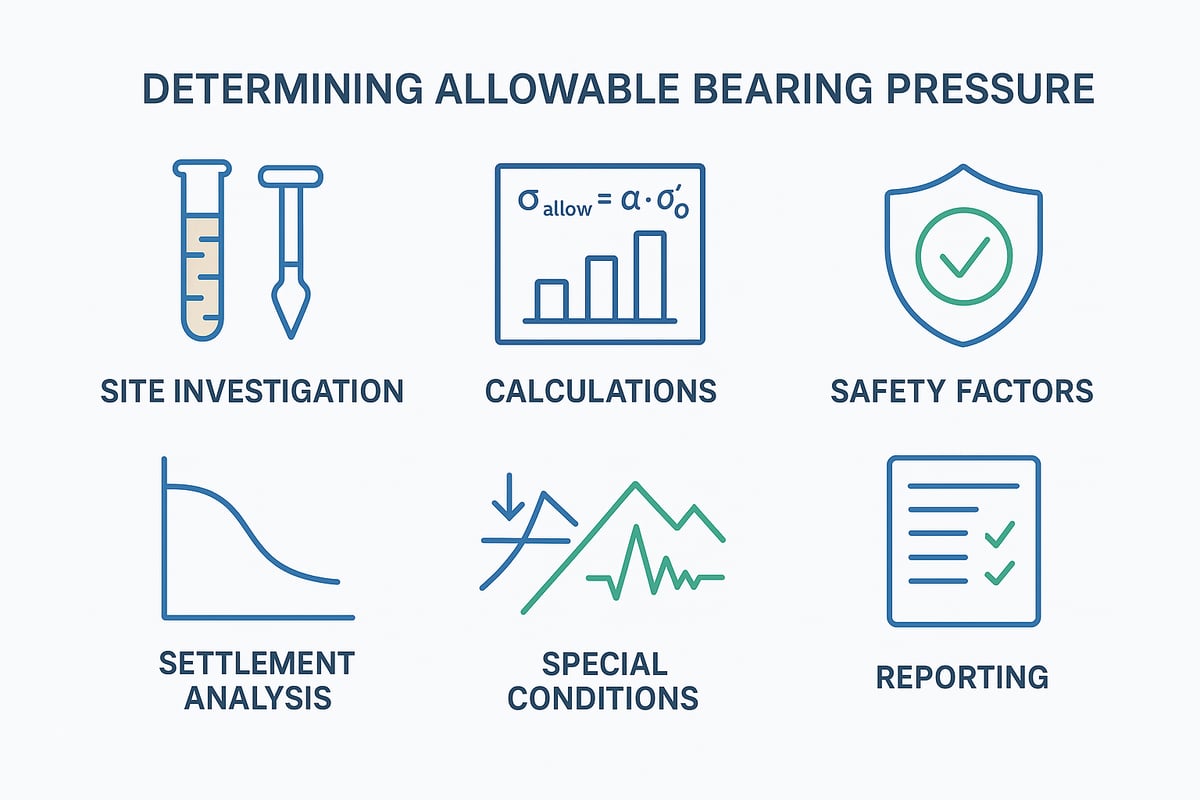
Determining allowable bearing pressure in 2026 demands a systematic, evidence-based approach. Each step is crucial for safeguarding structural integrity, cost-efficiency, and regulatory compliance. Let’s break down the process into manageable stages that guide you from site investigation to comprehensive documentation.
Step 1: Site Investigation and Soil Characterization
The journey to accurate allowable bearing pressure starts with a thorough geotechnical site investigation. This phase involves both field and laboratory testing, such as Standard Penetration Test (SPT), Cone Penetration Test (CPT), and soil classification per ASTM or CSA standards.
Representative soil samples are essential for reliable results. Factors like soil layering, moisture, and variability can dramatically influence outcomes. For detailed guidance on this process, see these Geotechnical Site Investigation Insights.
Key actions:
- Perform field tests (SPT, CPT, boreholes).
- Obtain undisturbed samples for lab analysis.
- Classify soils as per current codes.
- Document adjacent structures and environmental factors.
A comprehensive investigation ensures that the allowable bearing pressure reflects true site conditions, reducing risk and uncertainty.
Step 2: Calculating Ultimate Bearing Capacity
With soil data in hand, the next step is calculating ultimate bearing capacity. This involves applying established equations, such as Terzaghi’s or Meyerhof’s, which consider soil type, strength, depth, and footing dimensions.
Key inputs include:
- Soil shear strength (cohesion, friction angle).
- Foundation width and depth.
- Unit weight of soil.
Modern projects frequently utilize geotechnical software for precise analysis. Whether your foundation is shallow or deep, the calculated value sets the upper limit for allowable bearing pressure. Always ensure input data is current and site-specific to avoid errors.
Step 3: Applying Safety Factors
Once the ultimate value is known, safety factors must be applied to determine the final allowable bearing pressure. Typical safety factors range from 2.5 to 3.0, accounting for uncertainties in soil properties, load variability, and construction practices.
Codes like NYC 1806.2 or Canadian standards specify minimum safety requirements. For example, if the ultimate capacity is 300 kPa and a safety factor of 3 is applied, the allowable bearing pressure becomes 100 kPa.
Worked Example:
Ultimate Bearing Capacity = 300 kPa
Safety Factor = 3.0
Allowable Bearing Pressure = 300 / 3.0 = 100 kPa
Applying appropriate safety margins is essential for long-term performance and code compliance.
Step 4: Settlement Analysis and Serviceability Checks
Even if strength requirements are met, settlement can limit allowable bearing pressure. Total and differential settlement must be evaluated using elastic, consolidation, or empirical methods.
Typical steps include:
- Calculate predicted settlements for proposed loads.
- Compare with allowable tolerances (e.g., <25mm for masonry).
- Assess both total and differential settlement risks.
In some cases, settlement governs design more than bearing capacity. Serviceability checks ensure foundations remain functional and avoid costly remediation.
Step 5: Adjusting for Special Conditions
Site-specific challenges often require adjustments to allowable bearing pressure. High groundwater, uncontrolled fill, sloping ground, or seismic risk may necessitate conservative design or additional testing.
Special considerations:
- For high water tables, reduce bearing pressure to prevent instability.
- Uncontrolled fill demands cautious assessment or improvement.
- Sloping sites increase sliding and bearing failure risks.
- Seismic zones require dynamic analysis and stricter criteria.
Always consult codes for problematic soils and, if needed, implement soil improvement or stabilization measures.
Step 6: Documentation and Reporting
Thorough documentation is vital for regulatory approval and project success. A complete geotechnical report should include:
| Report Element | Description |
|---|---|
| Site description | Location, geology, history |
| Investigation methods | Field & lab tests, standards used |
| Soil profiles & classifications | Detailed logs, lab results |
| Calculations & assumptions | Ultimate and allowable bearing pressure |
| Recommendations | Foundation type, design values, limitations |
| Quality assurance | Peer review, data validation |
Clear communication of assumptions, limitations, and recommended pressures is crucial. Peer review and ongoing quality assurance help maintain high standards in 2026.
Regulatory Standards and Industry Guidelines for 2026
Navigating the regulatory landscape for allowable bearing pressure is more critical than ever in 2026. With evolving codes and increasing project complexity, professionals must stay current to ensure foundation safety and compliance. This section outlines the latest standards, code requirements, and practical considerations for modern projects.
Overview of Relevant Codes and Standards
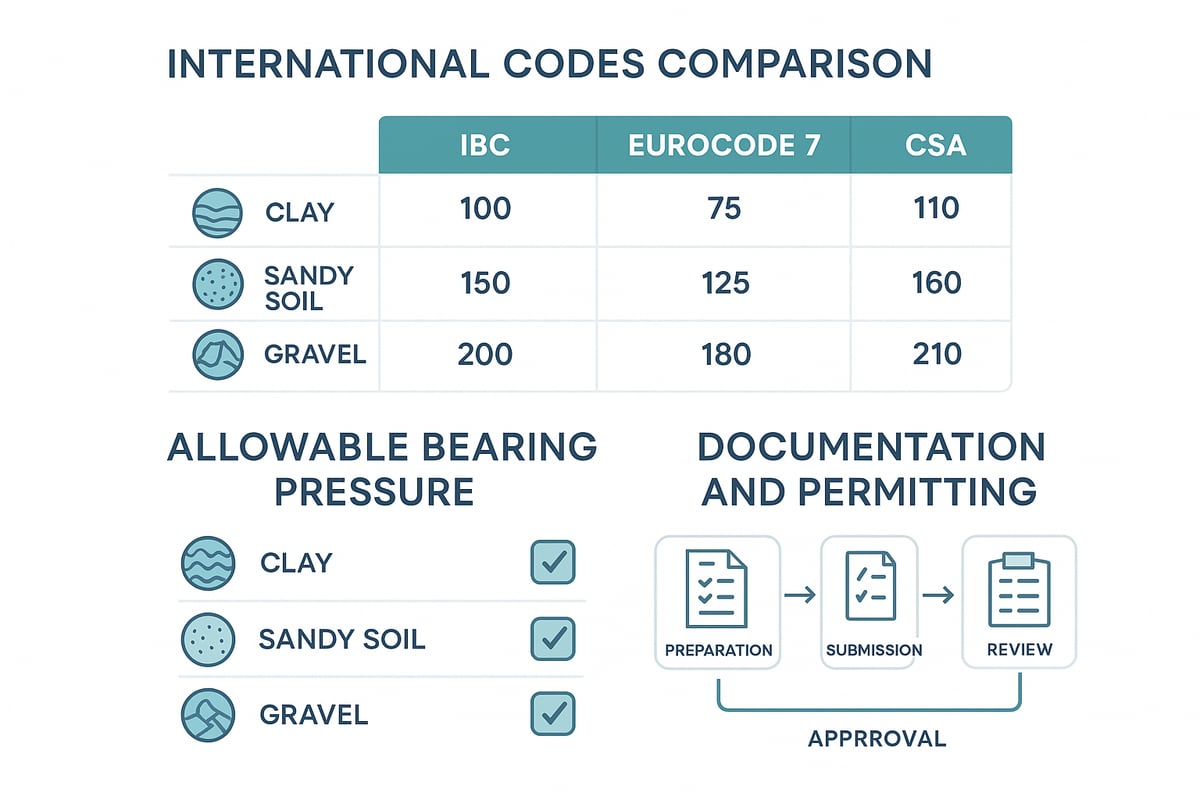
Multiple codes define allowable bearing pressure for foundation design. The International Building Code (IBC), New York City Building Code (NYC BC 1806.2), Canadian Standards Association (CSA), and Eurocode 7 all provide guidance, with updates regularly issued to reflect technical progress and lessons learned from failures.
For 2026, notable revisions include increased emphasis on site-specific investigation and stricter documentation. Differences between jurisdictions remain significant, so always consult local amendments. Many codes present standard values for soil types, but project teams are encouraged to use site-specific data when available.
Allowable Bearing Pressure for Various Soil and Rock Types
Codes typically provide tabulated allowable bearing pressure values for common soils, but these are conservative and assume ideal conditions. For example, dense sand may be assigned higher values than soft clay. However, these tables should never replace proper geotechnical testing.
| Soil Type | Typical Allowable Bearing Pressure (kPa) | Reference Code |
|---|---|---|
| Soft Clay | 75–150 | IBC, CSA, Eurocode 7 |
| Dense Sand | 250–450 | IBC, CSA |
| Gravel | 300–600 | IBC, Eurocode 7 |
| Weathered Rock | 500–1000 | IBC, NYC BC |
| Engineered Fill | 150–300 | Local Codes |
Codes like 24 CFR § 3285.202 – Soil Classifications and Bearing Capacity detail soil classes and corresponding allowable bearing pressure values, supporting regulatory compliance. Adjustments may be needed for soils improved by treatment or compaction.
Requirements for Controlled and Uncontrolled Fills
Controlled fills are engineered and compacted to meet strict standards, often verified by density tests and certified by a geotechnical engineer. Codes require minimum compaction levels, moisture control, and proof of quality for fills supporting foundations.
Uncontrolled fills lack documentation and present significant risk. Most codes, including NYC BC 1806.2.2, restrict or prohibit foundations on uncontrolled fill unless additional testing and improvement are performed. Always document fill history and testing in your geotechnical report.
Special Considerations for Artificially Treated Soils
Soil stabilization methods, such as lime or cement treatment and geosynthetic reinforcement, can significantly increase allowable bearing pressure. Codes require documentation of treatment methods, in-situ testing, and performance verification.
For treated soils, allowable bearing pressure values must reflect post-treatment properties, not just native conditions. Successful projects often combine laboratory testing and field trials to confirm design values before construction proceeds.
Documentation and Permitting Requirements
Comprehensive documentation is essential for regulatory approval and project success. Required submissions usually include:
- Geotechnical investigation reports
- Laboratory and field test results
- Calculations for allowable bearing pressure
- Foundation design recommendations
- Certification of controlled fill or soil treatment
- Ongoing monitoring and quality assurance records
Review and approval processes differ by jurisdiction, but clear communication of assumptions, limitations, and recommendations remains vital. Peer review and periodic updates to documentation are increasingly common in 2026 to maintain project integrity.
Settlement Tolerances and Serviceability in Foundation Design
Understanding settlement tolerances is crucial for ensuring the long-term serviceability and safety of any structure. As construction projects become more ambitious, the relationship between allowable bearing pressure and settlement performance demands careful attention. Modern codes and industry standards emphasize that both strength and serviceability criteria must be met for effective foundation design.
Defining Acceptable Settlement Tolerances
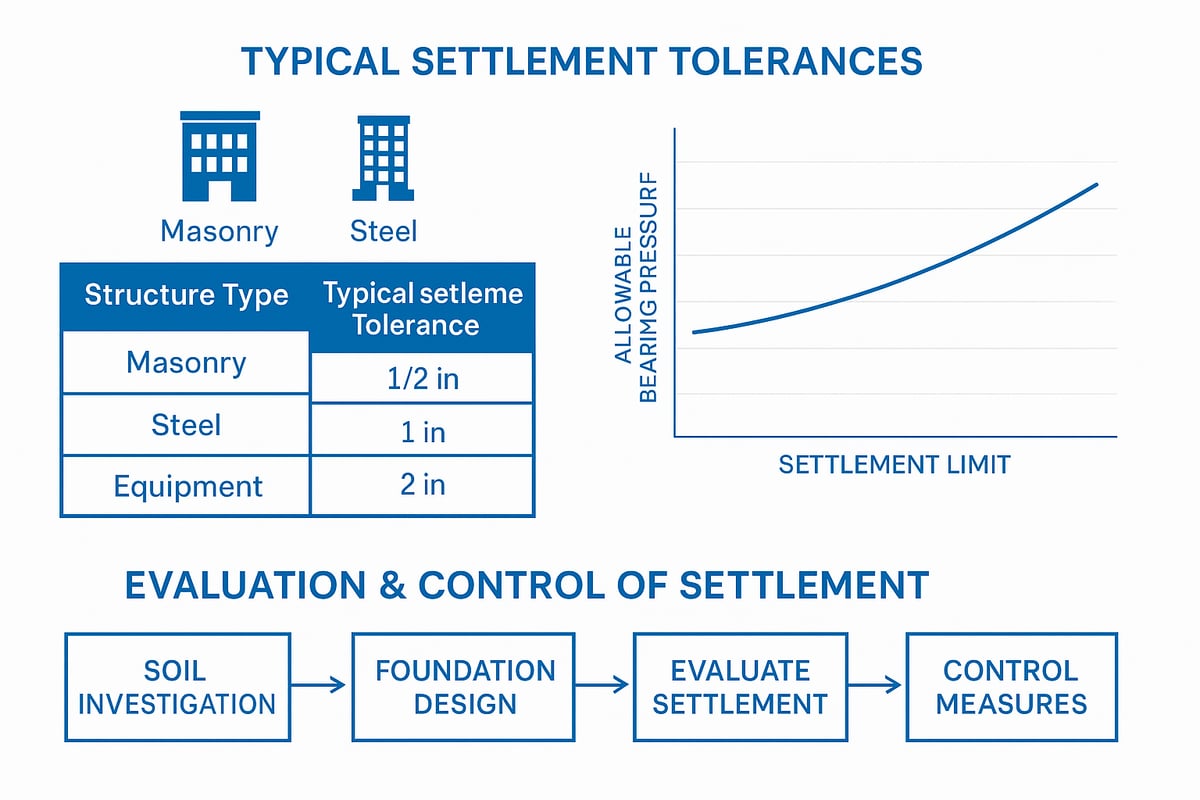
Acceptable settlement tolerances define how much movement a structure can safely experience without functional or structural issues. These limits vary based on the type of structure, its use, and sensitivity. For example, masonry buildings often require stricter settlement controls than flexible steel frames.
| Structure Type | Typical Limit (mm) |
|---|---|
| Masonry | <25 |
| Steel Frame | 25–50 |
| Sensitive Equipment | 5–10 |
Selecting the correct allowable bearing pressure is essential to keep settlements within these tolerances. Project-specific criteria must always be set, reflecting the structure's importance and intended use.
Total vs. Differential Settlement
Settlement is not just about how much a building sinks, but also how evenly it does so. Total settlement refers to the overall downward movement, while differential settlement is the uneven movement between different parts of a structure.
Excessive differential settlement can cause cracks, misaligned doors, or even structural failure. Many incidents have occurred where allowable bearing pressure was not properly matched to settlement tolerances, resulting in costly repairs. Industry best practices recommend controlling both total and differential settlement for lasting stability.
Methods for Predicting and Controlling Settlement
Engineers use analytical, empirical, and numerical methods to predict settlement. Analytical techniques involve calculations based on soil properties and loading, while empirical methods use data from similar projects. Advanced tools like Geotechnical Numerical Analysis Techniques offer detailed simulations, improving accuracy in settlement predictions.
Monitoring settlement during and after construction is also vital. Ground improvement techniques, such as preloading or grouting, can help increase allowable bearing pressure and minimize settlement risks. Combining these approaches ensures foundations perform as intended.
Role of Footing Size, Shape, and Depth
The geometry of a foundation has a direct impact on settlement behavior. Larger footings distribute loads over a wider area, but can cause greater total settlement if the soil is compressible. Shape also matters—rectangular pads may settle differently than circular ones due to stress distribution.
Optimizing footing dimensions based on site conditions and allowable bearing pressure can minimize settlement. Codes provide guidance on minimum and maximum sizes to balance safety, cost, and serviceability. Careful selection of depth and shape is a key part of successful foundation design.
Communication and Coordination Among Project Stakeholders
Effective communication between geotechnical, structural, and construction teams is essential. Sharing clear information about settlement tolerances and allowable bearing pressure helps avoid misunderstandings and costly mistakes.
Integrating geotechnical recommendations early in the design process leads to more efficient, reliable foundations. Lessons from recent projects show that collaboration and transparent documentation are vital for meeting serviceability goals and ensuring long-term structural performance.
Real-World Examples and Lessons Learned from Recent Projects
Real-world experience is essential for understanding how allowable bearing pressure shapes the success of modern foundations. The following examples and lessons provide valuable guidance for avoiding costly mistakes and applying best practices in 2026 projects.
Case Studies of Bearing Pressure Assessment
Recent projects show the importance of careful assessment and site-specific solutions. In one urban development, engineers faced variable soil conditions and used advanced lab testing to confirm the allowable bearing pressure for a mat foundation. Proper evaluation prevented excessive settlement and structural distress.
Another striking example is analyzed in the Case Study of Bearing Capacity Failure in a 4-Story Reinforced Concrete Building. Here, the misapplication of allowable bearing pressure values led to significant foundation movement, resulting in costly repairs and delays. These examples reinforce the need for rigorous geotechnical investigation and adherence to recommended limits.
Common Errors and Their Consequences
Misunderstanding allowable bearing pressure can have severe consequences. A frequent error is relying on generic code values instead of site-specific data. This mistake often results in unsafe foundations, unexpected settlement, or even failure.
Other pitfalls include overlooking groundwater effects, ignoring fill type, or failing to account for adjacent structures. When allowable bearing pressure is misapplied, structures may experience cracks, tilting, or service disruptions. These outcomes highlight the importance of tailored assessments and careful review of all influencing factors.
Best Practices for Ensuring Safe and Efficient Foundations
To ensure safe use of allowable bearing pressure, professionals should follow a systematic approach:
- Conduct thorough site investigations and advanced lab testing
- Use current codes and adjust for unique site conditions
- Apply conservative values when uncertainties exist
- Peer review geotechnical recommendations before finalizing designs
- Integrate findings into construction planning
A practical checklist helps teams avoid oversights and supports long-term durability. Incorporating ground improvement techniques, as outlined in Soil Stabilization and Ground Improvement, can also enhance bearing pressure capacity on challenging sites.
Innovations and Technology in Geotechnical Assessment
Modern technology has transformed how allowable bearing pressure is determined. In-situ sensors, drones, and data analytics allow for real-time monitoring and more accurate modeling. Geotechnical software can simulate complex soil-structure interactions, reducing uncertainty in design.
Advances in soil improvement methods, such as grouting or geosynthetics, provide engineers with more options to increase allowable bearing pressure safely. These innovations help optimize foundation design, reduce costs, and improve project timelines.
Future Trends and Anticipated Changes
Looking ahead, climate change, denser urban environments, and new materials will continue to influence allowable bearing pressure standards. Regulatory bodies are expected to update codes to address sustainability and resilience.
Engineers should stay informed of evolving requirements and adopt emerging technologies to maintain best practices. Proactive adaptation will be key to managing risks and ensuring the reliability of future foundations.
As you navigate the evolving landscape of allowable bearing pressure for 2026, it’s clear that staying informed and proactive is essential for building safe, efficient, and future-ready structures. Whether you’re an engineer, architect, or developer, leveraging expert geotechnical insights can help you avoid costly pitfalls and ensure your foundation design stands the test of time. If you have questions about your next project, or want guidance tailored to Alberta’s unique soils and regulations, we’re here to help. Reach out to our team for personalized advice and support—contact us at Contact Us: info@zalig.ca or +1 800 515 0497.